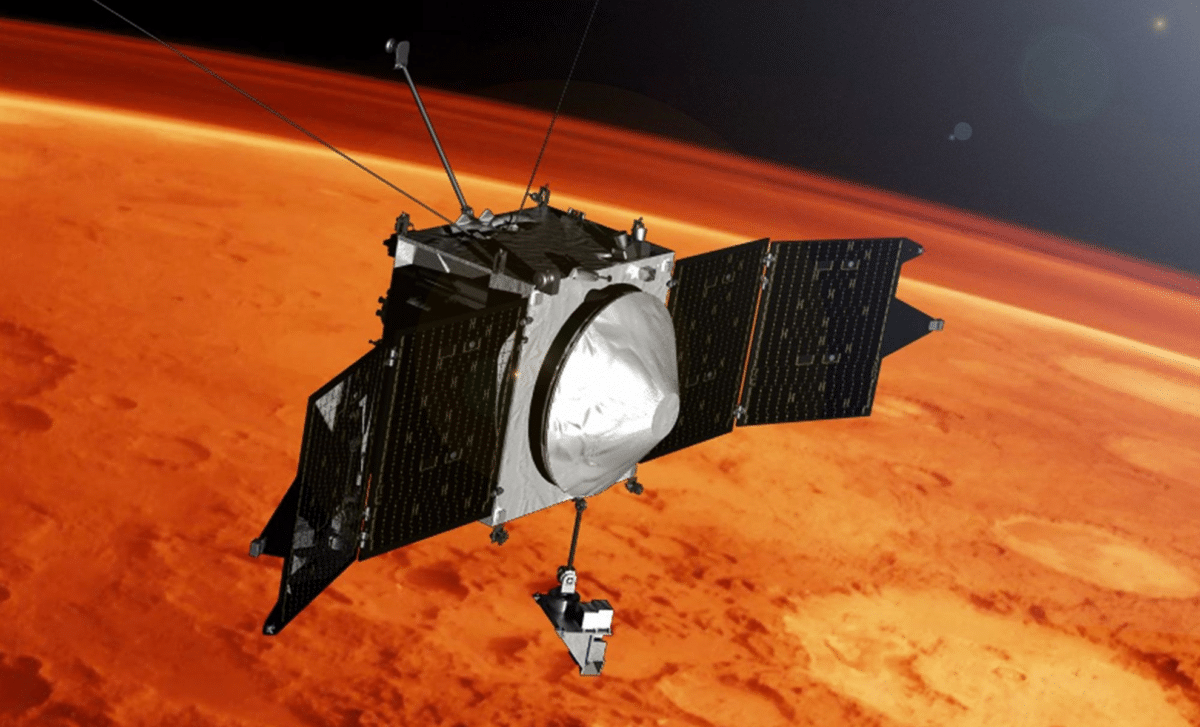
NASA is approaching a decisive moment on a Mars telecommunications orbiter that could shape the future of robotic and human exploration. According to Ars Technica, the agency must choose quickly whether to pursue a narrowly focused communications satellite or expand the mission to include scientific instruments, all under growing political, budgetary, and schedule pressure.
A Mars Orbiter at the Center of Policy, Budget, and Strategy
At the heart of the debate is how NASA interprets recent congressional language tied to funding for Mars infrastructure. The legislation emphasizes a commercial approach and limits eligibility to companies that have already “received funding from the Administration in fiscal year 2024 or 2025 for commercial design studies for Mars Sample Return; and proposed a separate, independently launched Mars telecommunication orbiter supporting an end-to-end Mars sample return mission.”
This wording has narrowed the competitive field while also constraining how ambitious the mission can be. Inside the agency, some officials view the mandate as pointing toward a telecommunications-only spacecraft, largely excluding additional science objectives. Others argue that such a minimal approach risks missing a rare opportunity to add scientific value at relatively low cost.
The clock is also a factor. Procurement timelines, launch windows, and fiscal deadlines mean NASA cannot delay much longer without pushing the mission years into the future.
How Much Does a Mars Communications Orbiter Really Cost?
One of the most contentious aspects of the discussion is budget realism. The Senate proposal allocates roughly $700 million, with $500 million often cited as a practical benchmark for the spacecraft itself. Industry insiders argue that this figure leaves substantial room for flexibility.
“$500 million is plenty for a communications payload, satellite bus, and launch,” one knowledgeable industry official told Ars. “I actually think those functions could be provided for well below $500 million.”
If that assessment holds, NASA could potentially include additional capabilities without exceeding its funding envelope. That possibility fuels arguments in favor of integrating compact science payloads, especially those designed for rapid development and lower risk.
Science Versus Simplicity in Mars Infrastructure
Advocates for adding science instruments say the logic is straightforward. Once a spacecraft is already traveling to Mars, marginal additions can deliver outsized returns. Casey Dreier, chief of space policy at The Planetary Society, frames the decision as a missed opportunity if NASA chooses restraint.
“To me, it seems like an easy decision,” Dreier said. Adding science instruments to a mission already headed to Mars aligns with NASA’s broader goals of maximizing science output and testing low-cost experimental technologies. “This project is already going to Mars, and science would add real value.”
Opponents worry that expanding the mission scope could complicate procurement, slow schedules, and introduce technical risk. That tension reflects a deeper question about whether NASA should treat Mars communications as pure infrastructure or as a hybrid platform supporting multiple objectives.
NASA’s Official Position and Commercial Partnerships
Publicly, NASA emphasizes reliability, continuity, and commercial collaboration. In a statement quoted by Ars Technica, the agency made clear that communications remain the top priority.
“NASA will procure a high-performance Mars telecommunications orbiter that will provide robust, continuous communications for Mars missions,” a spokesperson said. “NASA looks forward to collaborating with our commercial partners to advance deep space communications and navigation capabilities, strengthening US leadership in Mars infrastructure and the commercial space sector.”
This language signals a strategic shift. Rather than owning every element of Mars exploration, NASA increasingly views commercial providers as long-term partners responsible for foundational services.
Rocket Lab and the Case for Mars Infrastructure First
Among the companies positioning themselves for the mission, Rocket Lab has been particularly vocal. CEO Pete Beck has argued that communications infrastructure is not optional, but foundational.
“We’re pushing hard on the MTO,” Beck told Ars Technica. “The reality is that if you’re going to do anything on Mars, whether it’s scientific or human, you’ve got to have the comms there.”
He framed the orbiter as invisible infrastructure that enables every future ambition, including human landings.
“Everybody expects the communication just to be there, and you’ve got to put the foundations in first,” Beck said, adding that Rocket Lab sees the mission as a direct contribution to the first humans on Mars.
Why This Decision Reaches Far Beyond One Mission
What NASA decides in the coming months will ripple across Mars exploration for decades. A communications-only orbiter could arrive faster and with lower risk. A more ambitious version could redefine how NASA blends infrastructure, science, and commercial partnerships.
Either way, the choice will signal how the agency balances caution against opportunity as Mars transitions from a destination of isolated missions to a sustained, interconnected environment.