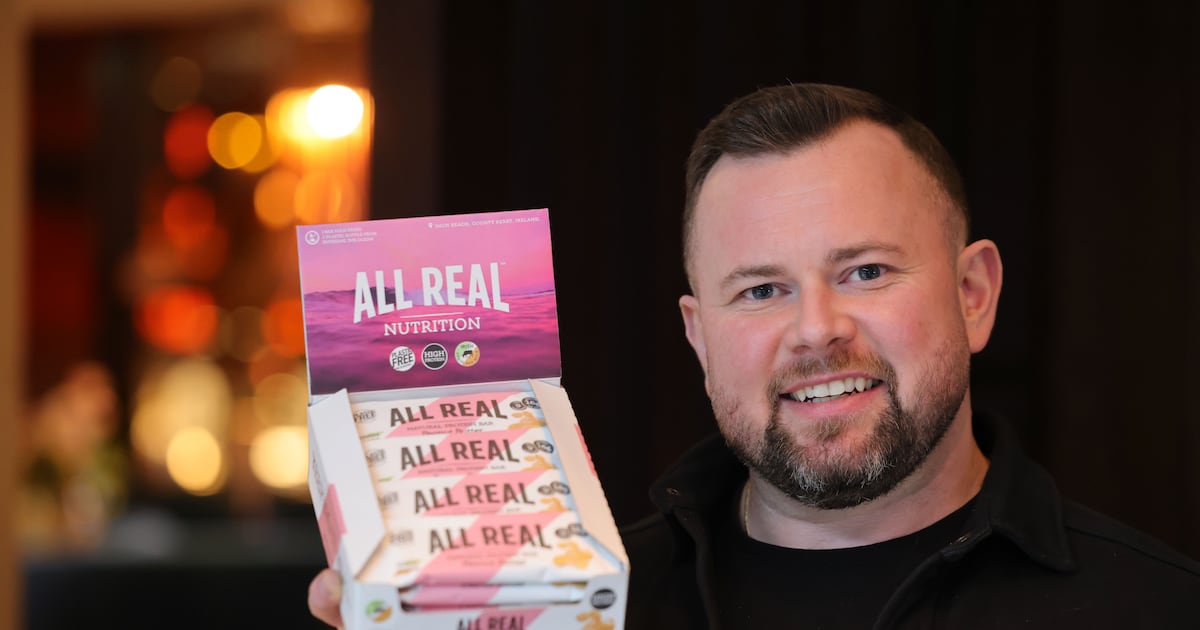
Starting any business is a challenge, but trying to break into a field dominated by brands such as Fulfil and Grenade – which are owned by confectionery giants Ferrero and Cadbury’s owner Mondelēz – is setting an ambitious goal.
For Niall Harty and his natural protein bar company, All Real Nutrition, it is all about having a David-versus-Goliath mentality.
The difference between All Real and what he describes as “faceless corporate brands” is that “you are seeing me and Ross [McDowell, co-founder] and people in the factory”.
For a growing business, the key is “clever relationship building with our retailers” and developing a brand with consumers. But at the end of the day, “you cannot argue with rate of sale”.
Creating natural protein bars is a “real technical challenge”, he says. “There is a reason why there are not many natural bars that have 20gof protein and low sugar, because technically, it is a very hard thing to pull off.”
“You might be able to produce it today,” he says, but by the time it makes its way into the customer’s hand, the protein in the bars will have hardened and rendered the bar nearly inedible.
“What we have done really well at All Real is we have got the Holy Trinity together: simple ingredients, nutrition that actually works, and the taste.”
The company is looking to appeal both to nutrition-focused people, with a competitive mix of macronutrients, and the general consumer audience, which Harty says is more focused on having natural contents.
He characterised many of the big brands in the space as being more akin to chocolate bars: “The healthy halo of that [type of] product is starting to go now. The veil is lifting.”
[ Who are the young food innovators of Ireland?Opens in new window ]
“Some of the other natural bars, where the nutrition might be great, they taste horrible; or they taste nice, and it’s basically just a block of dried fruit with 50g of sugar per 100g of product.”
Harty believes the company’s offering is carving out its own share of the market due to getting “the balance right” after between 500 and 600 iterations of the recipe.
He presents All Real as firmly in contrast to the big brands, many of which are produced in the same factories.
“We’re hands-on, we’re producing the product. We’re innovating every little thing, looking at the ingredients, changing suppliers, and making all minor tweaks.
“Every time we have a new run of packaging, we’re tweaking it a little bit, making it a little bit better, making [the bar] softer, reducing the sugar, improving the taste,” he says.
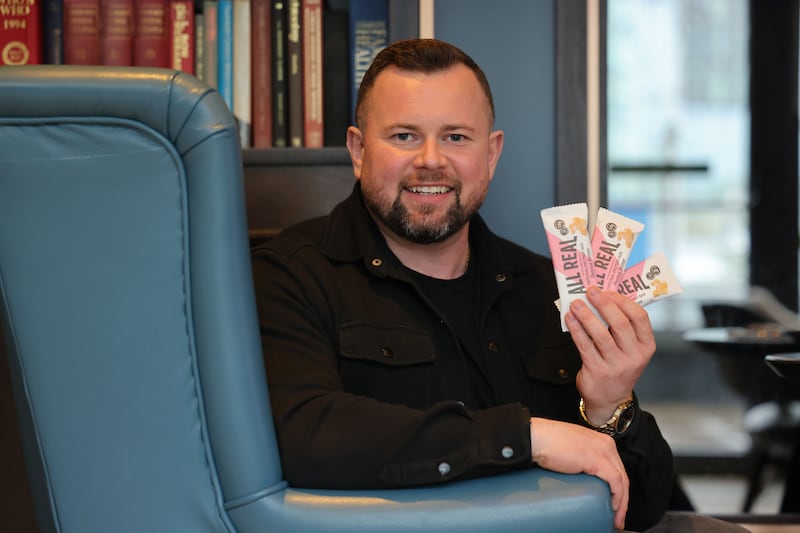 In 2016, Niall Harty handed in his notice to work on the business full-time. Photograph: Alan Betson/The Irish Times
The idea for the company came after his time in college, having felt his own diet had suffered. His first idea was to make paleo-friendly energy balls – before it was popular, apparently.
The enterprise had to be scrapped after a trademark issue over the name, so it was while working for Enterprise Ireland that Harty refined the idea.
His thinking at the time, he says, was “create a brand, start in Ireland and go to America”. Looking to take advantage of the reputation of Irish grass-fed dairy overseas, he looked to develop a milk-powder bar – an idea he subsequently pivoted away from.
“Typically, the big trends in the [United] States follow over here to Ireland after about four or five years. So maybe I can get ahead of the market and get a jumpstart.”
He began developing the bars after work and, in 2016, handed in his notice to work on the business full-time.
Harty went to the local Supervalu chain and successfully pitched his product, on the back of which he secured a loan to fund the beginning of the company.
With a customer and some cash, all he needed now was a business.
I was actually pretty bad at making bars, but I was a bit better at selling and marketing them
— Niall Harty
After renting a premises, he recalls writing down the goal of being the number one natural protein bar brand in Europe, but didn’t “have a clue of how to get there”.
“First day in the office – I’m not joking when they say this – I sat down, set up my table, set up my desk, opened up the laptop, and Googled ‘how to start a protein bar company’.”
The search didn’t return much information on the matter, he laughs, “So I figured, I’m going to have to figure that one out myself!”
Even without the help of Google, the company began to come together. Listings in local shops grew into participation in the Supervalu Food Academy programme, which gave the company access to locations across Munster.
A “one-man band”, Harty was up at 4am most days, making batches of product, packing them and delivering them to shops. He would sit nervously outside the shops, hyping himself up to make the sale, but slowly distribution grew to 50 outlets, and the business could afford to hire its first employee.
“It just made me realise I was actually pretty bad at making bars, but I was a bit better at selling and marketing them.”
It was not until Harty met his now co-founder Ross McDowell that the business truly fell into place as a joint venture between the two: “We are very much Ying and Yang.”
“He made me very busy with all the sales he was doing!”
Marking the change, the branding was later shifted from Origin Bars to All Real Nutrition. In the first year of the new name, 2021, they saw sales of nearly €400,000.
The investment helped to grow sales, which tripled to around €1.2 million in 2022, but that was followed by “slowish growth” over the next two years. It was a move to focus on direct-to-consumer that shifted the needle.
“It is now our biggest sales channel by far, and we’re growing nearly 200 per cent year on year in direct to consumer,” he says.
“We found that people really valued authenticity, so we doubled down on our strategy with advertising on Meta. We have so many ad campaigns, we spend a tremendous amount of money on videos, advertising and so on.”
But the move seems to be working for the company, which has shifted its focus to “thinking a bit more like a tech company, focusing on customer acquisition, cost, and retention”. He describes this as “a game changer”.
“That helped us go from €1.7 million in 2024 to last year, when we did €3.2 million; [that is] 80 per cent growth last year.
In 2026, the company is projecting more than €5 million in sales, and although 2027 is “a long way away”, they are hoping for €9 million in turnover then.