Dezeen School Shows: an aquatic sports centre made from recycled materials is among architectural proposals for the 2028 Olympic Games by the University of Southern California.
Also featured is a climate-responsive shading system for a stadium, and a site to host the opening and closing ceremonies.
Institution: University of Southern California
School: School of Architecture
Course: Vertical Topic Studio LA28: Radical Re-Use, Resilience and the ‘No-Build’ Olympics
Tutor: Gillian Shaffer Lutsko
School statement:
“Los Angeles is racing toward the 2028 Olympic and Paralympic Games with a pledge of ‘radical reuse’: no permanent new venues, only deft adaptations of the region’s existing stadiums, arenas and university facilities.
“This advanced vertical studio probes that claim, treating the games as a platform for carbon-conscious, socially equitable, future-proof design. Students begin with a clear-eyed look at Los Angeles today – housing scarcity, extreme heat, traffic, air-quality shortfalls and long-standing neighbourhood inequities – then benchmark the LA28 venue plan against these realities to test whether ‘no-build’ truly meets the city’s needs.
“Three lenses structure the work: sustainability, resilience and pre(use). Students develop proposals at the scale of buildings, venues and districts for review by LA28 planners, stakeholders and community advocates.
“The studio ultimately asks: what if the most responsible Olympic building is the one designed with the future in mind?
“The following five projects are a selection from a vertical topic studio LA28: Radical Re-Use, Resilience and the ‘No-Build’ Olympics, under the direction of faculty member Gillian Shaffer Lutsko.
“The topic studio includes undergraduate students in their fourth year of study and graduate students in their final year of study at the University of Southern California.”
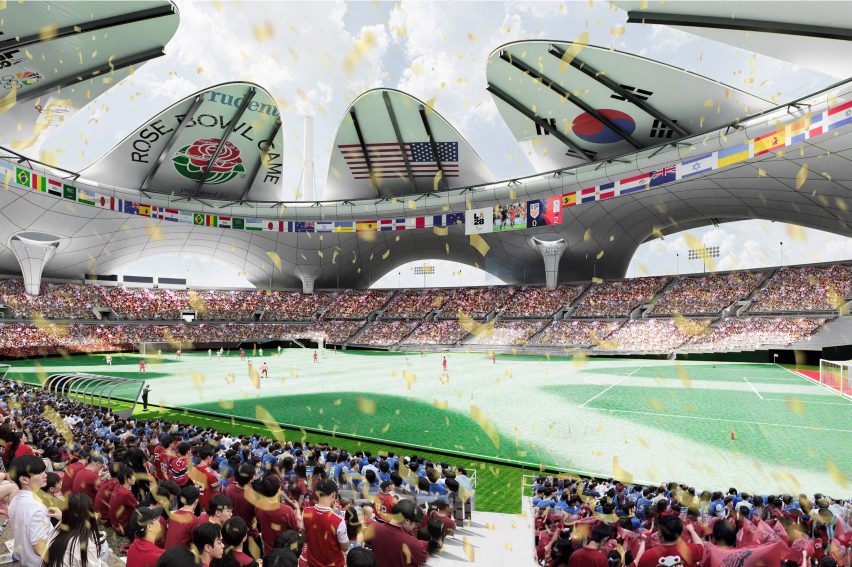
Hybrid Design: Permanent and Temporary Venue by Inhyuk Lee
“A climate-responsive shading system is introduced for the historic Rose Bowl Stadium, designed for the Los Angeles 2028 Olympic and Paralympic Games.
“Rather than adding a singular architectural object, the canopy functions as a contemporary environmental layer that enhances spectator comfort while preserving the stadium’s historic character.
“Translucent ETFE panels diffuse daylight and significantly reduce solar heat gain, creating a cooler microclimate without dimming the field or interfering with broadcast requirements.
“Petal-like apertures maintain natural ventilation and the Rose Bowl’s iconic open-sky atmosphere, while framing precise views of the mountains and horizon, thereby elevating both environmental performance and experiential quality.”
Student: Inhyuk Lee
Course: LA28: Radical Re-Use, Resilience and the ‘No-Build’ Olympics
Tutor: Gillian Shaffer Lutsko
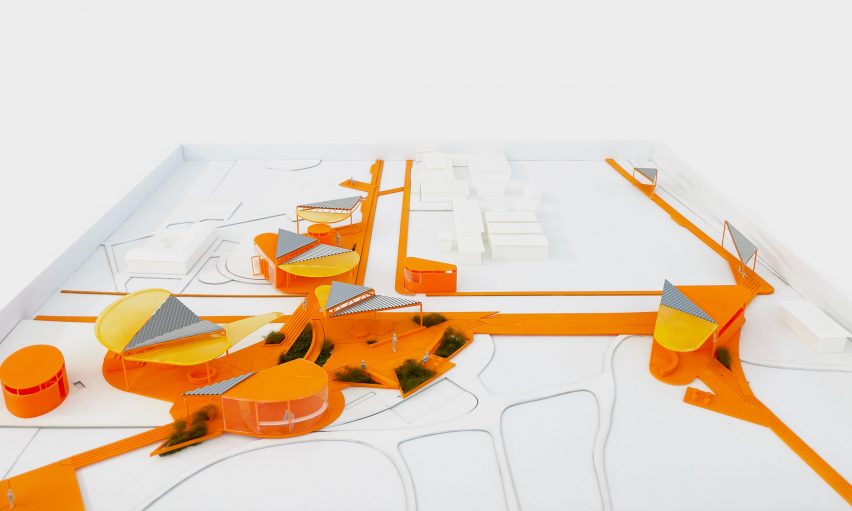
The Cooling Line by Anran Long
“The Cooling Line unfolds through Carson as a sequenced network of shimmering aluminium pavilions and shaded crossings that align with everyday pedestrian movements between bus stops, parks and Olympic venues.
“Addressing the city’s persistent first–last-mile problem, the project transforms these typically inhospitable gaps into a continuous, walkable microclimate of comfort and respite.
“Triangular canopies mitigate heat and glare, producing micro-pockets of shade that support lingering, gathering and equitable mobility.
“Following the games, the pavilions transition into neighbourhood park infrastructure, extending their role as civic cooling environments embedded in the rhythms of daily public life.”
Student: Anran Long
Course: LA28: Radical Re-Use, Resilience and the ‘No-Build’ Olympics
Tutor: Gillian Shaffer Lutsko
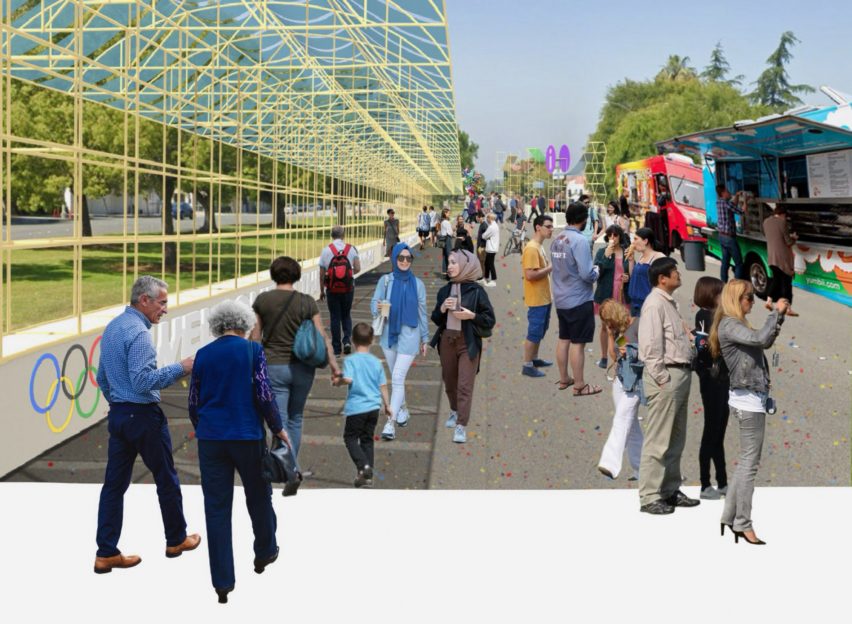
LA84’s Festival Feudalism: A Catalog for Temporary Urbanism by Karen Lee
“Among Olympic host cities, Los Angeles is distinctive for the cultural and athletic legacy of the 1984 games.
“As it prepares to host the event for a third time, the city again confronts the challenge of synthesising its heterogeneous identities and expansive, polycentric urban form.
“The temporary urbanism framework mobilises parks, streets and residual spaces through a constellation of pop-up pavilions and emblematic structures that articulate a renewed design language.
“Operating as a flexible kit-of-parts, the system reinterprets the ‘look of the games’ while stitching together dispersed venues and communities, producing a coherent and participatory Olympic experience for residents and visitors alike.”
Student: Karen Lee
Course: LA28: Radical Re-Use, Resilience and the ‘No-Build’ Olympics
Tutor: Gillian Shaffer Lutsko
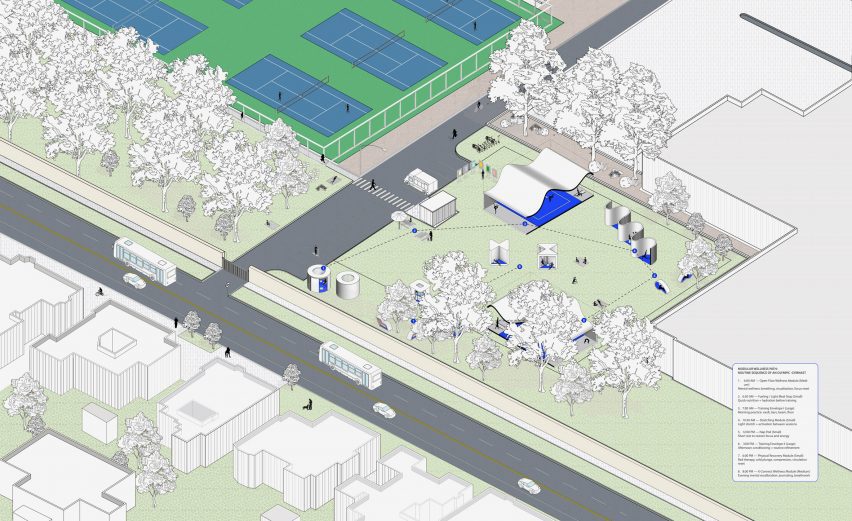
Beyond Temporary: S/M/L Modular Athlete Wellness by Sulem Hernandez
“Drawing from the full spectrum of athletic practice – encompassing preparation, recovery and mental regulation – a system of modular wellness environments is proposed.
“Conceived as an interdependent family of small, medium, and large components, the system reflects Koolhaas’s notion of architecture as an ecology of interconnected elements rather than discrete objects.
“Each module is anatomically and kinetically informed, its spatial posture and atmospheric qualities calibrated to distinct physiological and psychological needs.
“Small units support targeted physical restoration; medium modules cultivate focus and privacy; large assemblies function as adaptable training infrastructures.
“Designed for disassembly post-games, the modules are redistributed across Los Angeles as enduring community wellness resources.”
Student: Sulem Hernandez
Course: LA28: Radical Re-Use, Resilience and the ‘No-Build’ Olympics
Tutor: Gillian Shaffer Lutsko
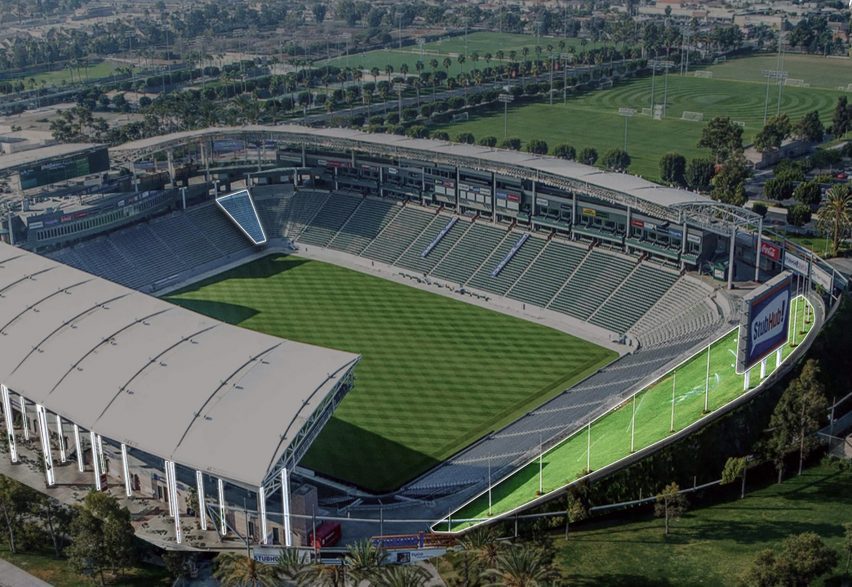
A Growing Legacy: South Bay Urban Food Farm by Maya Fisher
“South Bay Urban Food Farm proposes an LA28 legacy through adaptive reuse of Dignity Health Sports Park (Carson, CA), reframing Olympic infrastructure as a socio-ecological substrate rather than a disposable event-stage.
“Drawing on post-games precedents from London 2012 and Rio 2016, it maps latent spatial and structural capacities within the Main Stadium and campus—seating bays, columns, berms – as productive agrarian interfaces.
“Temporary games time insertions (seat-planters, column planters, terraced berm planters) seed a post-Olympic expansion across CSUDH and the wider South Bay.
“The project positions interstitial spaces as commons for cultivation, pedagogy and distribution, sustaining a community-governed food system across multiple seasons.”
Student: Maya Fisher
Course: LA28: Radical Re-Use, Resilience and the ‘No-Build’ Olympics
Tutor: Gillian Shaffer Lutsko
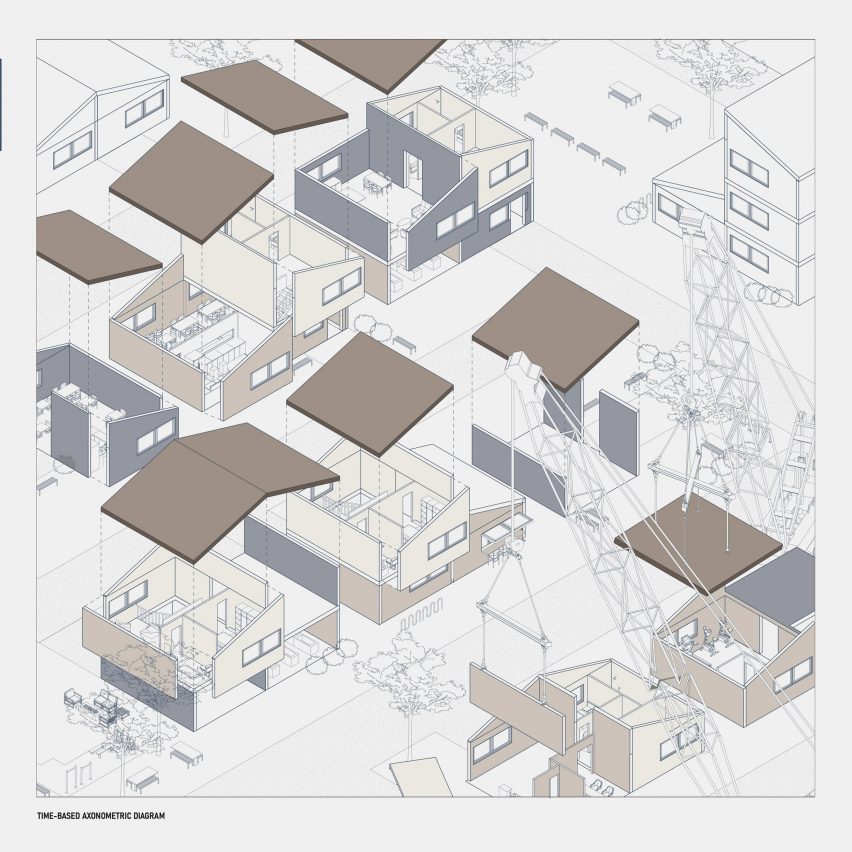
Re:Form LA28 by Thet Annie Noe
“Los Angeles’s housing scarcity frames the LA28 Olympic Village as a permanent urban intervention rather than a time-bound enclave.
“The project deploys an adaptive, panelised A+B+C system: A (accommodation) and C (community) satisfy Olympic Village programmatic ratios during the Games, housing athletes and shared amenities such as dining, training and health spaces.
“B (build) is strategically deferred and inserted post-Games to complete domestic typologies – living rooms, kitchens and family support—thereby converting temporary units into durable, attainable housing.
“Radical reuse is treated as an operative design logic: legacy is not appended after the event, but encoded in the assembly sequence, enabling Olympic infrastructure to transition into community assets with minimal waste and maximal continuity.”
Student: Thet Annie Noe
Course: LA28: Radical Re-Use, Resilience and the ‘No-Build’ Olympics
Tutor: Gillian Shaffer Lutsko
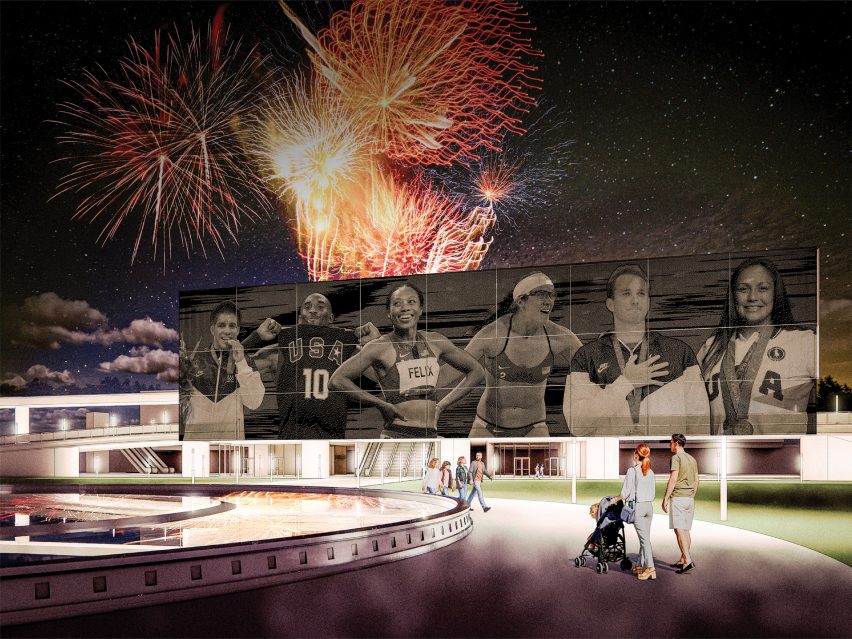
The Expo Park Thoroughfare by Grayson Dutch Seibert
“Exposition Park functions as a central armature of LA28, hosting opening and closing ceremonies alongside multiple athletic events.
“The Expo Park Thoroughfare reframes this concentration not as episodic spectacle but as an opportunity to recalibrate everyday urban connectivity.
“By inserting a multimodal corridor that privileges pedestrian priority, integrates micromobility and expands the Expo Line station’s capacity and legibility, the project stitches the park back into surrounding neighbourhoods and the regional transit network.
“The thoroughfare operates simultaneously as a logistics and urban room: a spatial device that organises movement, stages encounters and concentrates public life.
“During the games it becomes a civic promenade; post-Games, a durable spine for recreation, access and community use.”
Student: Grayson Dutch Seibert
Course: LA28: Radical Re-Use, Resilience and the ‘No-Build’ Olympics
Tutor: Gillian Shaffer Lutsko
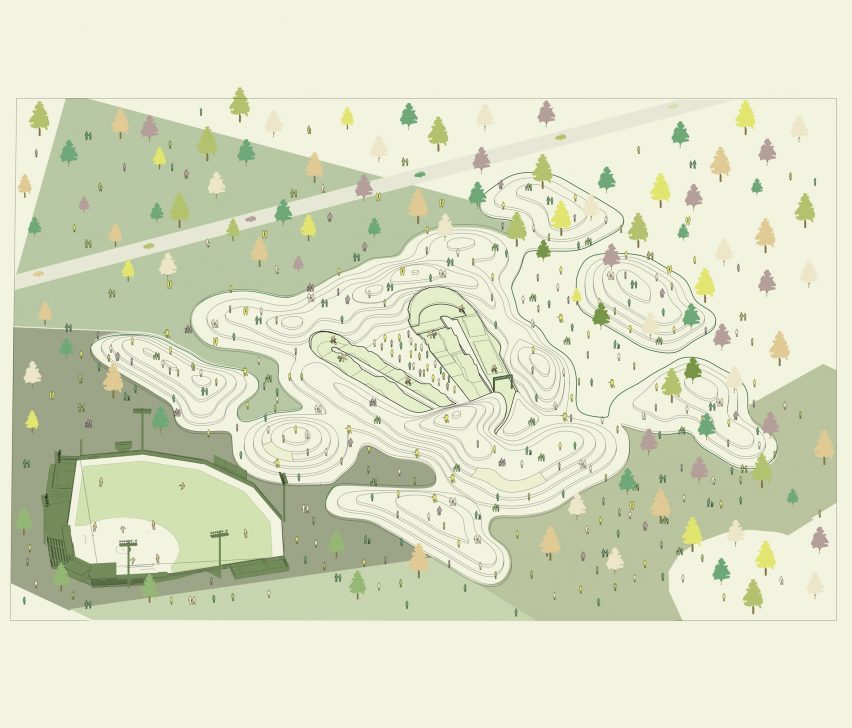
Stadium as Ground: The Olympic Thrill Zone of Converging Arenas by Navid Rodd
“Stadium as Ground: The Olympic Thrill Zone of Converging Arenas re-conceives the Olympic venue as a continuous, sculpted landscape architecture operating through topography rather than enclosure.
“For LA28, the ‘stadium’ becomes an interlocking field in which softball and BMX Freestyle occupy adjacent gradients of play and spectatorship, producing cross-programmed sound, motion and crowd flows.
“By relocating existing site functions below grade, the project liberates the surface as a public thrill zone: a civic terrain for circulation, gathering and collective spectacle, at the intersection of multiple events, legible during the games and durable afterwards.”
Student: Navid Rodd
Course: LA28: Radical Re-Use, Resilience and the ‘No-Build’ Olympics
Tutor: Gillian Shaffer Lutsko
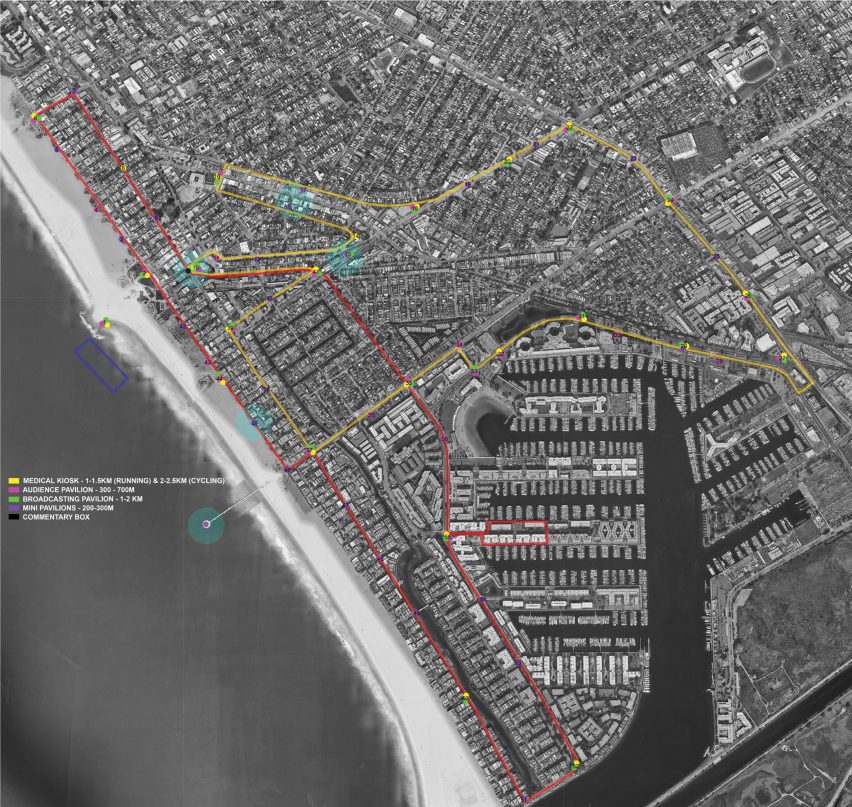
Triathlon Streetscape Atlas by Jainish Patel
“The LA28 triathlon and marathon cycling routes are reimagined as a civic streetscape, with Venice’s coastal corridors cast as an inhabited public room rather than a mere raceway.
“A sequence of permanent pavilions is sited along the route to choreograph shade, rest, medical triage, broadcasting, way-finding and gathering – thickening the everyday urban fabric that the event temporarily intensifies.
“Conceived as sustainable, community-governed ‘stealth architecture,’ each pavilion is legible in celebration yet operative in secondary use as emergency shelter/resource distribution during crises and civic usages.
“The work sutures sport to public space and resilience, re-coding Venice’s streets and beachfront as a durable infrastructural framework – one that foregrounds movement, expression and identity long after the games.”
Student: Jainish Patel
Course: LA28: Radical Re-Use, Resilience and the ‘No-Build’ Olympics
Tutor: Gillian Shaffer Lutsko
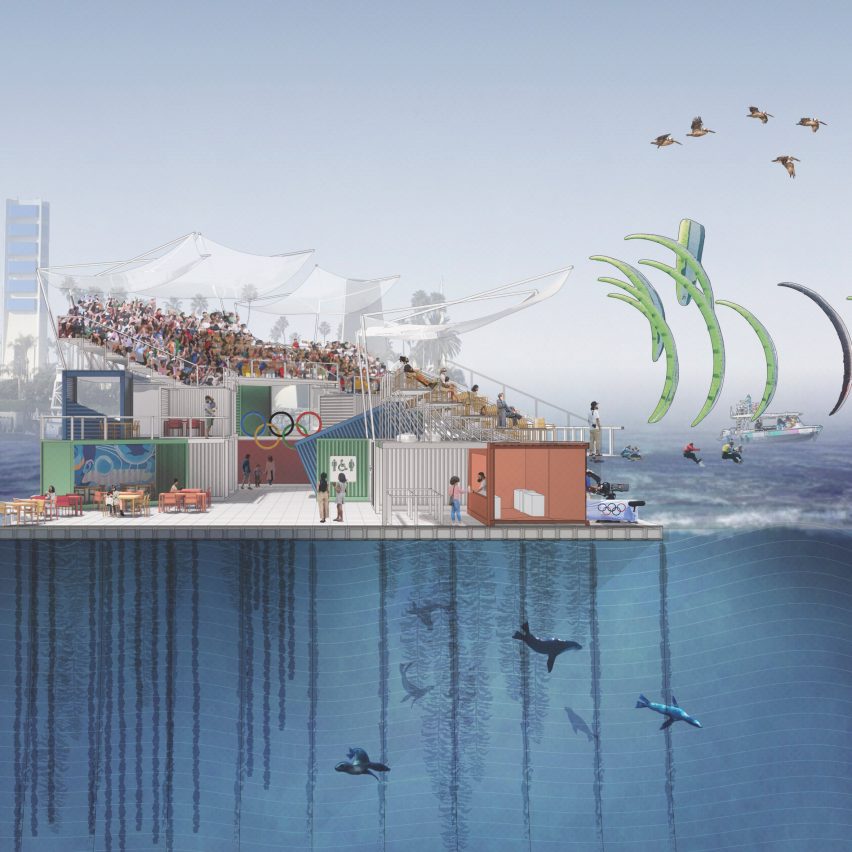
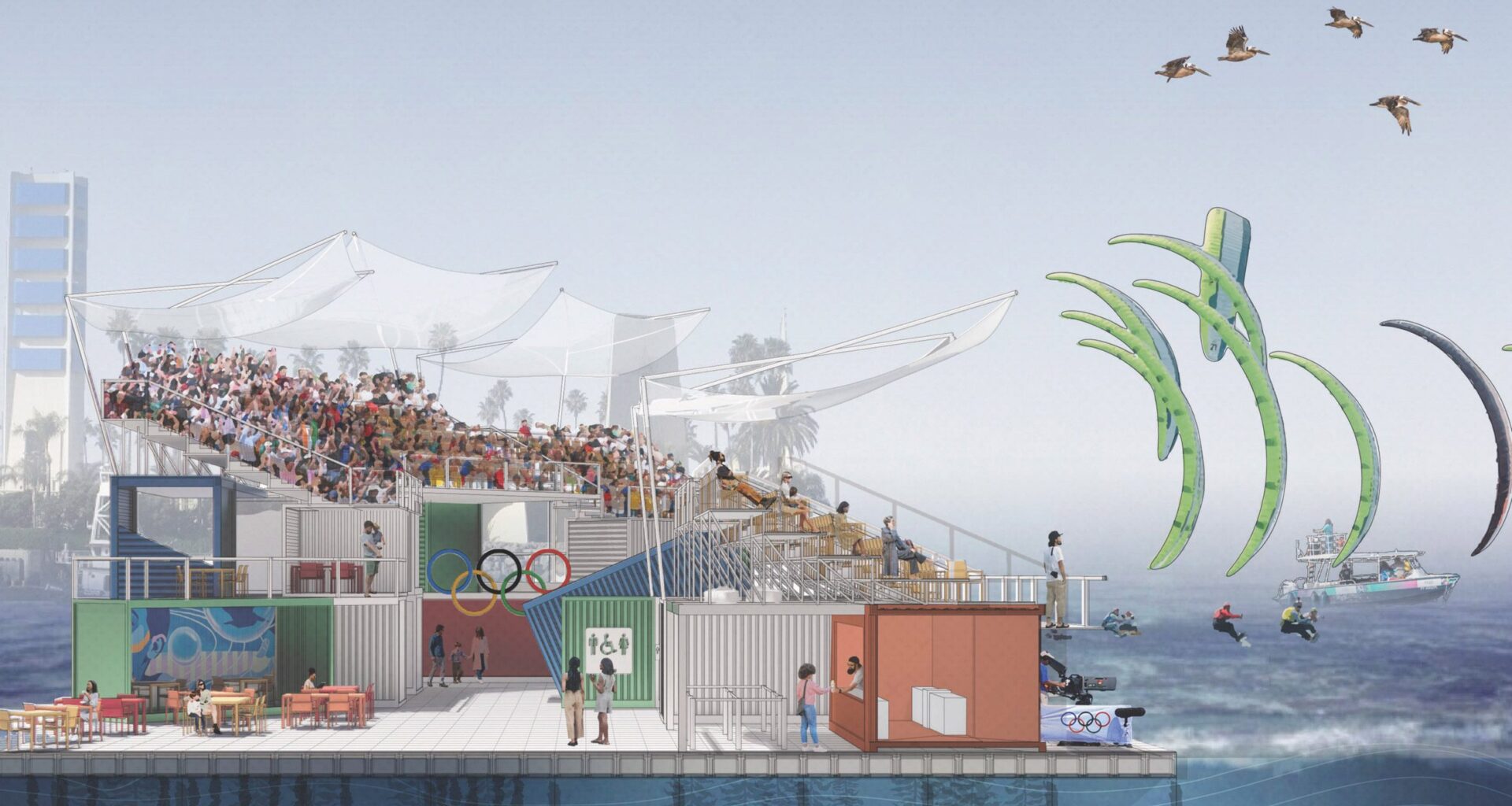
The Waterfront of LA28 by Bella Hoffman
“Hosting 11 Olympic and seven Paralympic sports, Long Beach’s waterfront becomes a site where global spectacle intersects with long-term ecological and urban transformation.
“Floating grandstands reinterpret California’s coastline, projecting the games’ ceremonial presence onto the water and bringing spectators into intimate proximity with typically inaccessible aquatic sports.
“Confronting pollution conveyed by the LA River, the proposal employs recycled materials and existing maritime infrastructure to cultivate new underwater habitats.
“After the games, these structures are reconfigured as public athletic facilities, environmental learning centres and community commerce hubs, reframing the Long Beach waterfront as a lasting civic and ecological asset.”
Student: Bella Hoffman
Course: LA28: Radical Re-Use, Resilience and the ‘No-Build’ Olympics
Tutor: Gillian Shaffer Lutsko
Partnership content
This school show is a partnership between Dezeen and University of Southern California. Find out more about Dezeen partnership content here.