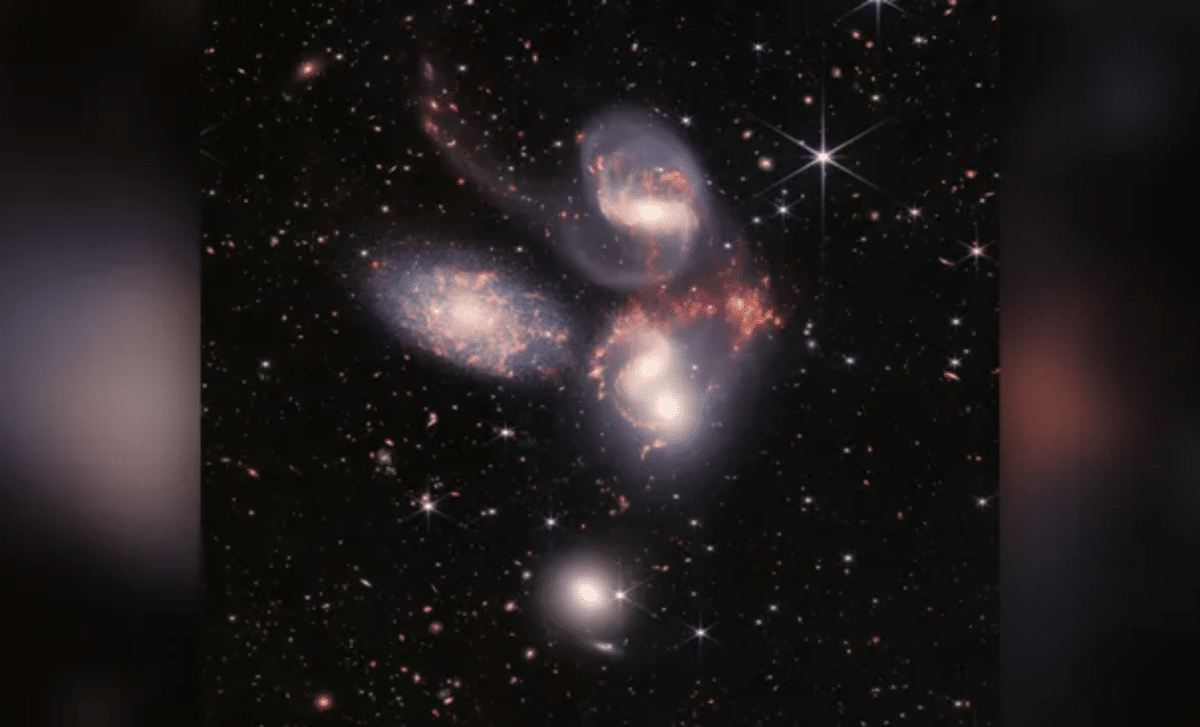
The James Webb Space Telescope has identified an extraordinary system of five galaxies merging when the universe was only about 800 million years old, according to a study published in Nature Astronomy. The discovery reveals a level of cosmic complexity that challenges long-standing models of early galaxy formation and suggests that large, dynamic structures emerged far earlier than expected.
A Crowded Collision In A Young Cosmos
The newly observed system consists of five compact, actively star-forming galaxies packed into a remarkably small region of space. Their proximity indicates that they are gravitationally bound and in the process of merging, forming what astronomers describe as an extreme and unexpected configuration for such an early epoch. Observations from JWST show that the galaxies are separated by only tens of thousands of light-years, a distance that places them far closer together than most neighboring galaxies in the modern universe.
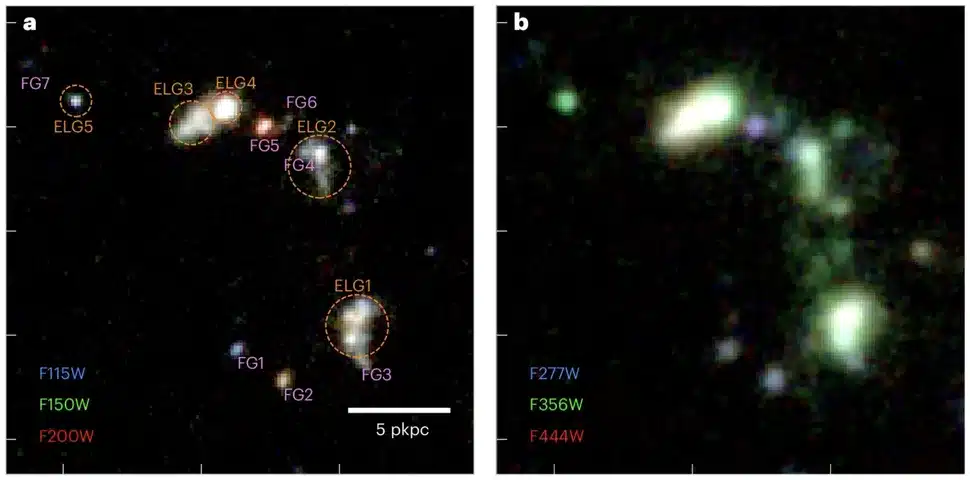 Two views of the five-galaxy crash spotted by JWST in the early universe. The individual galaxies are labeled ELG1–ELG5, and located an estimated 800 million years after the Big Bang. (Image credit: NASA, ESA, CSA, and STScI / Hu et al.)
This level of crowding was assumed to be rare in the universe’s infancy, a time when galaxies were thought to be smaller, simpler, and more isolated. As lead author Dr. Weida Hu of Texas A&M University explained,
“What makes this remarkable is that a merger involving such a large number of galaxies was not expected so early in the universe’s history, when galaxy mergers were thought to [be] simpler and usually involve only two to three galaxies.”
The finding points to a far more dynamic early universe than theoretical models had predicted.
Intense Star Formation And Chemical Maturity
Beyond the sheer number of galaxies involved, the system stands out for its physical and chemical properties. The galaxies are producing stars at a combined rate of roughly 250 solar masses per year, a level of activity that far exceeds typical star formation rates at that time. This rapid stellar production has enriched the system with heavier elements such as oxygen, materials forged in stellar interiors and dispersed through galactic interactions.
The presence of these elements indicates that multiple generations of stars had already lived and died, enriching both the galaxies and their surrounding environment. Data analyzed from Nature Astronomy show that gas containing oxygen and hydrogen extends beyond the galaxies themselves, suggesting that gravitational interactions are pushing enriched material into intergalactic space. This process highlights how early mergers may have shaped not only galaxies, but also the larger cosmic environment they inhabit.
Why This Discovery Challenges Galaxy Formation Models
Standard models of galaxy assembly propose a gradual buildup, where small galaxies merge over long periods of time to form larger systems. The five-way merger disrupts this picture by demonstrating that complex, multi-galaxy interactions were already underway less than a billion years after the Big Bang. The discovery implies that matter in the early universe clustered more rapidly and efficiently than simulations have suggested.
Coauthor Professor Casey Papovich emphasized the broader implications of the finding, stating,
“By showing that a complex, merger-driven system exists so early, it tells us our theories of how galaxies assemble — and how quickly they do so — need to be updated to match reality.”
The result strengthens growing evidence from JWST that the early universe was capable of producing massive, mature-looking galaxies at astonishing speed.