
Vaccination against influenza and COVID-19 currently lags among people 50 and older, according to a national survey.
Forty-two percent of people over 50 haven’t gotten either flu or COVID-19 vaccines in the past six months, according to the University of Michigan’s National Poll on Healthy Aging survey. According to data, only 29% have received both vaccinations and only 27% have received a flu shot.
The poll also asked about COVID-19 vaccination since it became available in 2021: 49% of people over 50 said it’s been more than a year since their last dose, and 15% said they’ve never received it.
The leading reason people over 50 gave for not getting updated vaccines?
They didn’t think they needed them.
In all, 28% of people over 50 who didn’t get a flu vaccine in the past six months, and 29% of those who didn’t get a COVID-19 vaccine in the past year or ever, gave this as the main reason.
That’s despite clear evidence showing that staying up to date on both vaccines reduces the risk of serious illness and death in older adults, whose immune systems need regular “reminders” with updated vaccines tailored to recent mutations in the viruses.
Coming in second among reasons for not getting vaccinated recently were worries about the vaccines’ side effects (19% for flu and 27% for COVID-19), followed by a belief that the vaccines aren’t effective (18% and 19%, respectively).
Far fewer (10% for flu and 6% for COVID-19, respectively) said they just didn’t think of it. A few (4% and 3%) wanted to wait, and from 1% to 4% cited time, cost, insurance, availability or eligibility concerns.
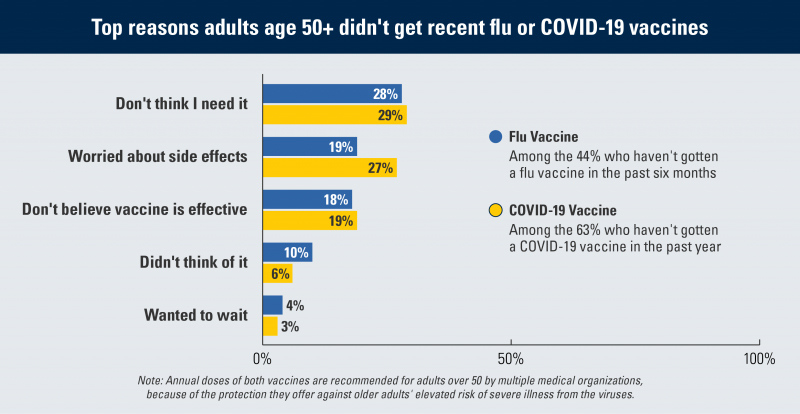 Credit: University of Michigan. From the University of Michigan National Poll on Healthy Aging: Reasons given for not getting vaccinated by adults over 50 who said they had not gotten a flu shot in the last 6 month and/or a COVID-19 shot in the last year when asked in late December 2025 to mid-January 2026.
From late December 2025 to mid-January 2026, the poll team asked 2,964 US adults age 50 and over if they’d gotten a flu vaccine dose in the last six months, and when their most recent COVID-19 vaccination was. Then, the team asked those who hadn’t sought vaccination recently their main reason why.
In addition to revealing reasons older adults didn’t get updated vaccines, the new poll data show some key differences in vaccination among different groups of people 50 and over.
The oldest adults (age 75 and over)– those with the highest risk of hospitalization and death from both viruses – had the highest rates of updated vaccination.
In all, 46% of those age 75 and up said they had gotten a COVID-19 vaccine in the last six months, compared with 37% of those age 65 to 74 and 20% of those age 50 to 64.
Flu vaccination was even higher in all age groups, with 76% of those in the oldest age bracket having gotten the latest flu shot, compared with 64% of those age 65 to 74 and 42% of those in their 50s and early 60s.
“These findings suggest that we must do a much better job helping people in their 50s and up understand that they will benefit from getting these updated vaccines each year, that the vaccine side effects are mild and short-lived, and that even if they later get infected and develop symptoms, vaccination means they won’t get as sick,” said Jeffrey Kullgren, MD, MPH, MS, the poll’s director, an Associate Professor of Internal Medicine at the U-M Medical School and a primary care physician at the VA Ann Arbor Healthcare System.