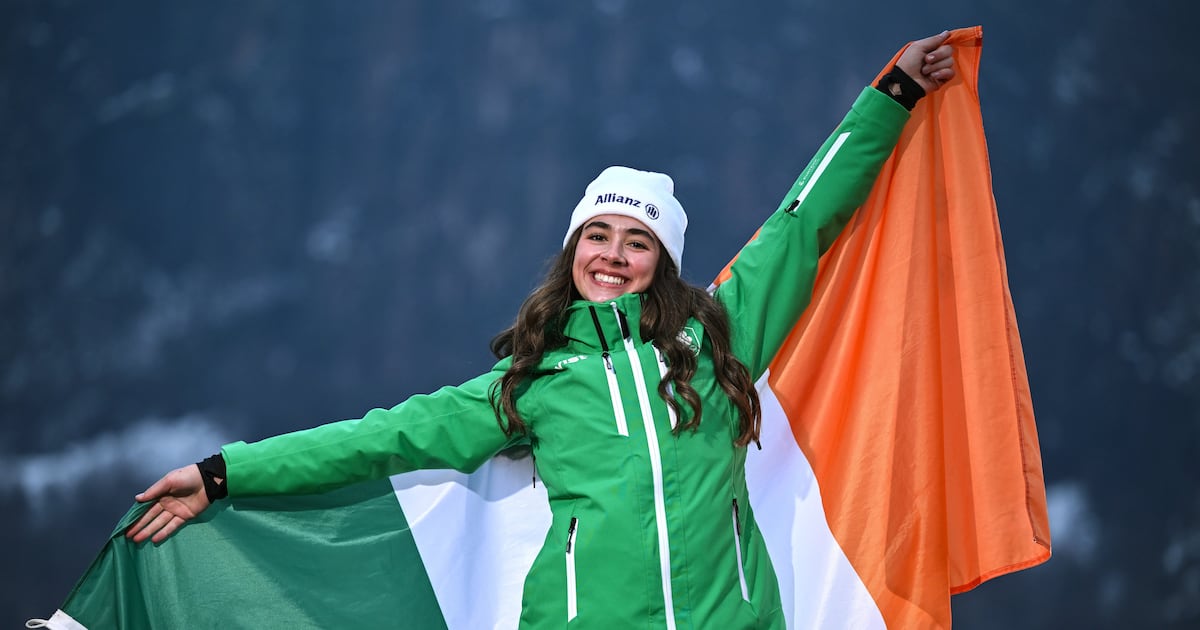
When Anabelle Zurbay says her earliest memory is learning to tie on her ski boots at age two, it’s little wonder she’s made her first Winter Olympics at age 17. Not that it’s been a straightforward journey to Milan Cortina 2026.
Born in Minnesota, Zurbay relocated to Colorado with her family at age 10, a move solely designed to better her skiing prospects. She then pursued her Irish Olympic eligibility thanks to her grandmother Rosaleen McCarthy Miskella, who grew up in Rosemount in Co Westmeath and now resides in Wisconsin.
She’ll be among the youngest competitors in the slalom and giant slalom events and is the only woman among the four-strong Irish team. She will also carry the Irish flag in Friday’s opening ceremony event in Cortina, one of the four clusters of venues across northern Italy.
“I’ve been skiing since I could first walk,” she says. “My earliest memory is putting on ski boots, learning to ride the trail lift. And just always being on the snow. Then I remember my first couple of races, at age six, because I won them all.”
The Gen Z skier is also far too young to appreciate Ireland’s curious history at the Winter Olympics, or to understand some of the perceptions – which have at times felt as much of a contradiction as a Jamaican bobsleigh team.
Nor does Zurbay fit the common picture of the well-heeled diaspora, or of those coming from a more gilded age. It’s only been three decades since modern Ireland first cast herself as a Winter Olympic nation, and since then the finest hour came with Clifton Hugh Lancelot de Verdon Wrottesley, or simply Lord Wrottesley for short.
Fourth in the skeleton event in Salt Lake City in 2002, Wrottesley opened fresh possibilities on the snow and ice.
Ten years earlier, in Albertville in 1992, Ireland competed for the first time, with Terry McHugh and Pat McDonagh qualifying in the two-man bobsleigh. The Winter and Summer Games have been decoupled in the Olympic cycle since 1992, and that year McHugh competed in both, throwing the javelin in Barcelona five months after Albertville.
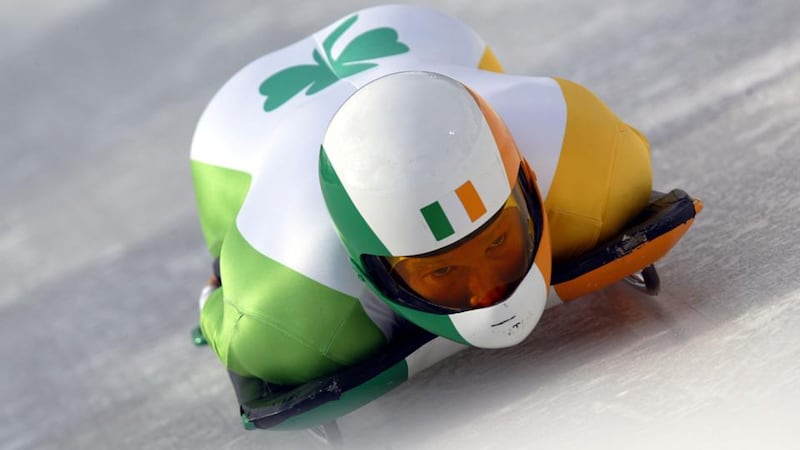 Lord Wrottesley takes to the ice in the the skeleton event during the Salt Lake City Winter Olympic Games in 2002 at the Peaks Ice Arena in Provo, Utah. Photograph: Donald Miralle/ Getty Images
That bobsleigh team was the dream of Larry Treacy, a British-born entrepreneur with Irish parents and a passion for winter sports. Still, access to facilities and funding is the biggest obstacle to Irish Winter Olympic hopefuls. Dublin is currently the only European capital city without a permanent ice facility.
Zurbay does have her parents to thank for ensuring she reached her full potential. Sarah and Dale Zurbay spent 30 years coaching at a small ski school in Minnesota, before moving to the ski town of Vail, in Colorado, in 2019. Her older brother William is an equally accomplished skier, also representing Ireland.
[ Three sporting events to watch this week: Your handy guide to sport on televisionOpens in new window ]
She now attends the Vail Ski and Snowboard Academy, combining daily on-snow training with her regular schoolwork. It’s the only public school in the US that runs a programme like it.
“We moved out to Colorado because it [the skiing] was getting a bit more serious than what Minnesota could offer. In my school, it’s actually kind of normal to become an Olympian. Most of my teachers are pretty accommodating with my busy schedule. I’m one of three from my school, this year, across different nations.”
Of the four-strong Irish team in Milan Cortina, only Cormac Comerford is entirely home-grown, the Dublin native competing in all four Alpine skiing events: the downhill, super-G, giant slalom, and slalom.
Thomas Maloney Westgård, born on the island of Leka in Norway to a Galway mother and Norwegian father, will return for his third Winter Olympics in cross-country skiing, carrying the Irish flag in the Predazzo opening ceremony. Ben Lynch, who was born in Dublin before his family moved to Vancouver when he was three, is selected in the freestyle skiing half-pipe.
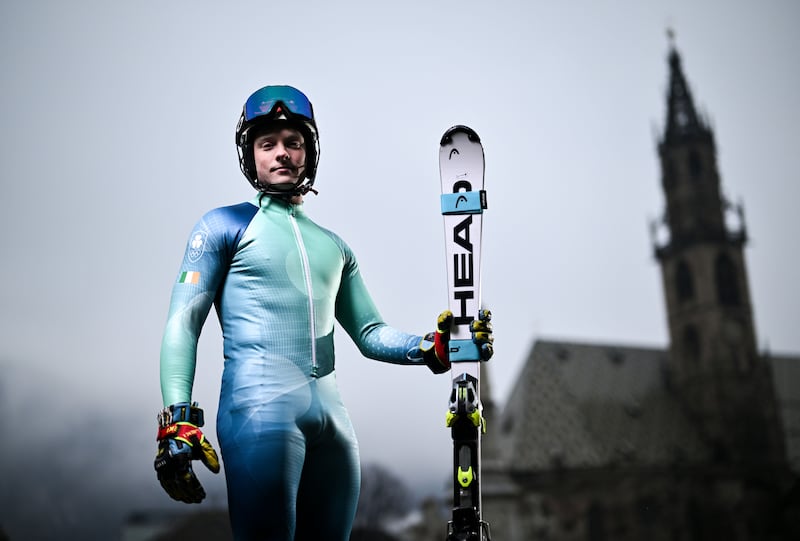 Team Ireland alpine skier Cormac Comerford in Piazza Walther at Milano Cortina. Photograph: David Fitzgerald/Sportsfile
An equally keen gymnast in the off-season, Zurbay will compete on the revered Olympia delle Tofane slope in Cortina, hers among the most demanding of Winter Olympic events, physically and technically.
“You just take a deep breath, let yourself go, and try to remember the tricky spots. Then just see how fast you can make it down. Balance is important, and that’s something I’ve definitely got from gymnastics, and flexibility. You also need lots and lots of confidence, and definitely grit, so much grit, for sure that is key.”
Sport Ireland don’t provide international carding funding to Winter Olympic athletes, although Team Ireland winter athletes and national federations have benefited from €200,000 in funding between 2023 and 2026.
The Olympic Federation of Ireland (OFI) have also given their full backing to the Prime Arena development in Cherrywood in south Co Dublin, set to include two Olympic-sized ice rinks, potentially the country’s first permanent training ground for future Winter Olympians.
Team Ireland schedule
Friday, February 6th: Opening Ceremony, Milan.
Saturday 7th: Cormac Comerford, downhill Alpine skiing, Bormio.
Sunday 8th: Maloney Westgård, 10km + 10km skiathlon (cross- country), Predazzo.
Wednesday 11th: Comerford, super-G (Alpine skiing), Bormio.
Friday 13th: Maloney Westgård, 10km free (cross-country), Predazzo.
Saturday 14th: Comerford, giant slalom runs 1&2 (Alpine skiing), Bormio.
Sunday 15th: Anabelle Zurbay, giant slalom run 1&2 (Alpine skiing), Cortina.
Monday 16th: Comerford, slalom run 1&2 (Alpine skiing), Bormio.
Wednesday 18th: Zurbay, slalom run 1&2 (Alpine skiing), Cortina.
Thursday 19th: Ben Lynch, half-pipe qualification (freestyle skiing), Livigno.
Friday 20th: Lynch, half-pipe final (freestyle skiing), Livigno.
Saturday 21st: Maloney Westgård, 50km classic (cross-country), Predazzo.
Sunday 22nd: Closing ceremony, Verona.