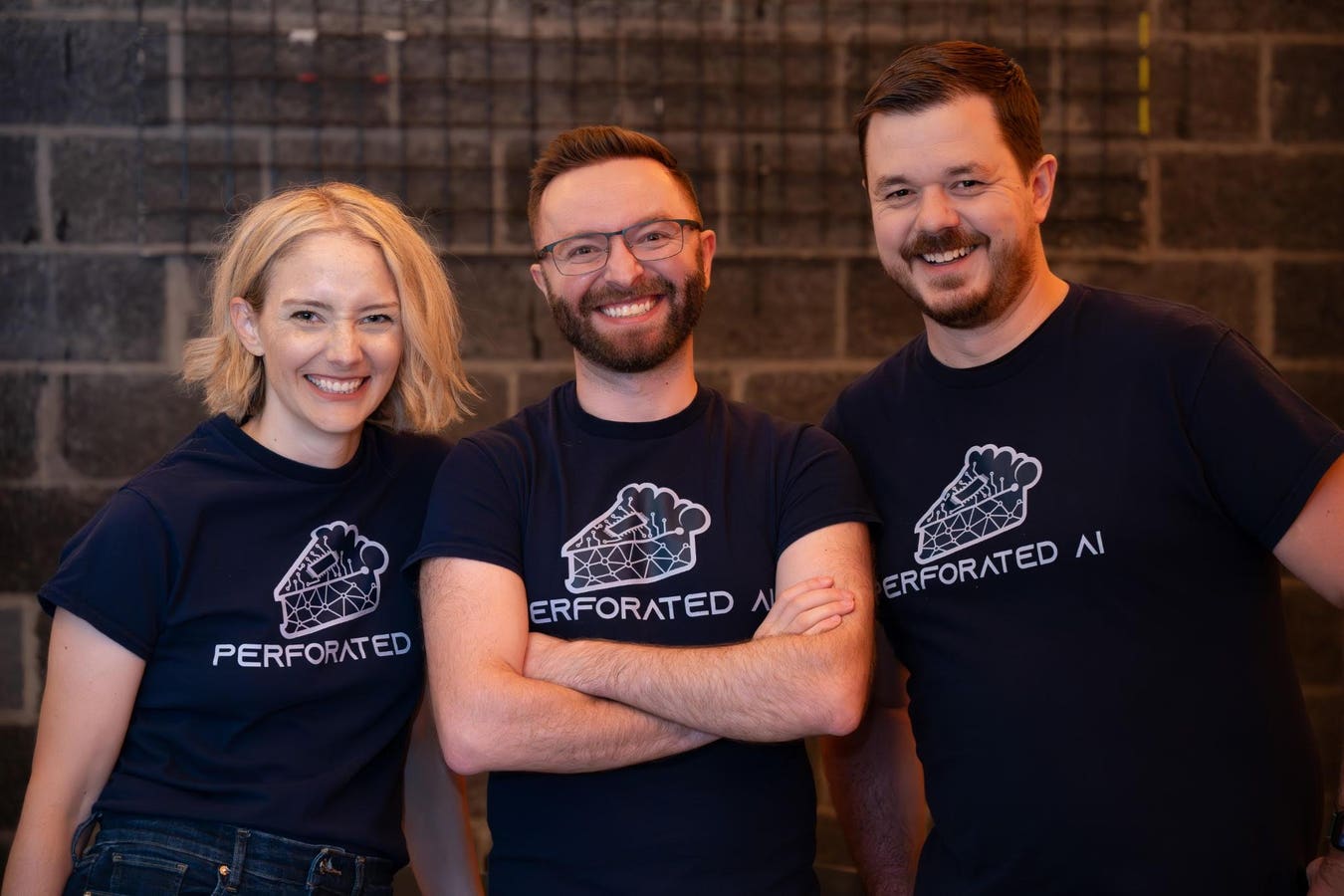
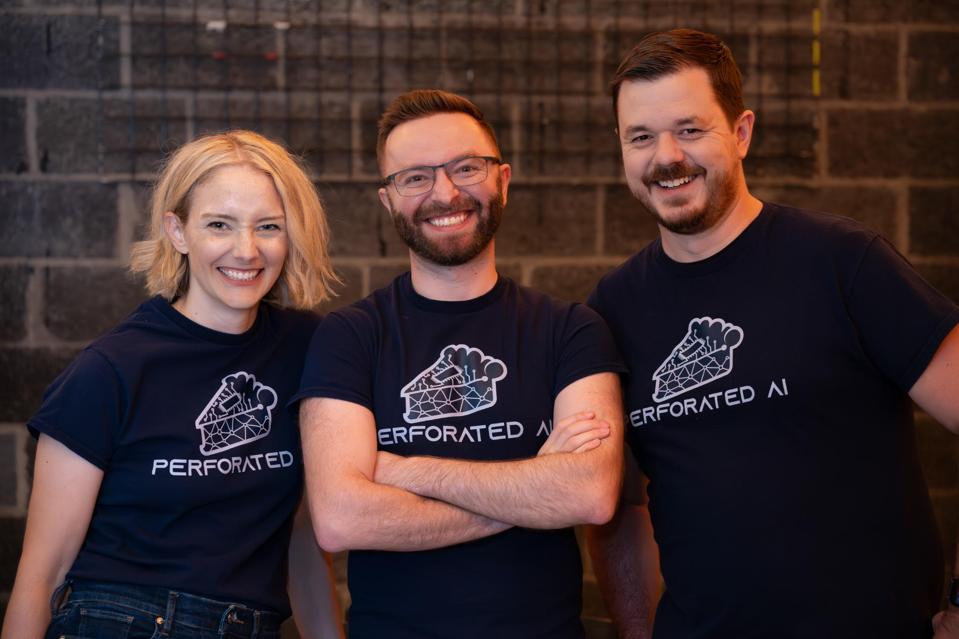
The team at Perforated AI
Perforated AI
For more than eighty years, deep learning has relied on a simplified model of brain function. The 1943 McCulloch-Pitts model of the neuron fueled breakthroughs in image recognition, speech synthesis and language understanding. But modern neuroscience has evolved since then. Now, a Pittsburgh startup thinks the AI field is due for an update.
Perforated AI, co-founded by neuroscientist and computer scientist Dr. Rorry Brenner, aims to bridge this difference. Its approach adds structures inspired by dendrites, the branching extensions of neurons, to standard neural networks. The company calls it Perforated Backpropagation, and says the method doesn’t just improve training speed. In tests, it cuts compute costs by as much as 38 times, without hurting accuracy.
“We’ve been using the same artificial neuron since 1943,” Brenner told me. “Once I learned how dendrites worked in biological systems, I thought, how is no one already doing this?”
A Different Perspective on Neural Computation
Traditional deep learning models sum inputs, weight them and pass them through a threshold function. That model misses how dendrites actually behave. In living brains, dendrites spot patterns, filter out noise and trigger local spikes that shape how the neuron fires. One dendritic tree can handle the work of thousands of simple virtual neurons.
Perforated AI doesn’t replace neurons. Their approach leaves those original neurons in place and adds auxiliary dendrite units alongside them. During training, these units learn to anticipate and correct leftover mistakes. After training, the dendrites freeze and serve as fixed correctors for each neuron.
Tests run by researchers at Carnegie Mellon and elsewhere suggest it works. In one hackathon proof-of-concept, a model was reduced in size by 90% while maintaining the same accuracy. On smaller benchmarks the redesigned networks improved accuracy by up to sixteen percent.
Why this matters
Running today’s large language models is expensive. OpenAI’s ChatGPT reportedly costs several hundred thousand dollars per day in cloud fees. Big providers such as Google Cloud and AWS profit heavily from AI workloads that consume high-end GPUs.
Perforated AI sees an opening here. Brenner notes “Our biggest multiplier is cost. One hackathon run cut compute expense thirty-eight-fold with only a ten-times smaller model footprint.” If that performance holds at scale, teams of any size could train and serve models on local hardware rather than rent massive clusters.
In one Google Cloud trial, a modified BERT-tiny ran 158 times faster on CPUs alone. That speed makes AI tasks feasible on devices without GPUs, from factory floors to remote clinics.
New ways to speed up models
AI engineers have long looked for ways to squeeze performance out of models. Tools like pruning, quantization, and knowledge distillation all reduce model size or speed up inference. But most of them work by taking a trained model and compressing it after the fact. They often trade performance for speed, and they can be finicky, tuned for specific architectures, with results that don’t always hold across tasks.
Perforated AI takes a different route. It doesn’t slim the model down later. It builds efficiency into the learning process itself. By giving each neuron extra power up front, networks do more with fewer units. Brenner argues that shrinking the model sacrifices detail, but his design strengthens every unit.
So far, the results look promising. Unlike many compression techniques, this method doesn’t just preserve accuracy, it sometimes improves it. Some tests show consistent gains on real tasks, not just synthetic benchmarks.
Roadblocks and Challenges
At present, the tooling works only with PyTorch. Labs and startups that rely on TensorFlow, Keras or custom frameworks must wait. Brenner claims implementation takes minutes in PyTorch but acknowledges wider support will require more work.
Perforated AI has filed patents on its method and published a library on GitHub. The company is targeting the MLOps market, where firms like Weights & Biases dominate by helping engineers optimize training workflows. The company is running a private enterprise beta and plans to charge about $2,400 per developer seat each year.
If dendritic networks catch on, they could reset how firms budget for compute. The industry trend has chased ever larger models on ever larger GPU farms. That favors deep pockets. Smaller outfits now devote up to 80% of their funding to cloud computing costs. If Perforated AI’s technology cuts that bill even in half, new players could train models at modest cost on-site.
Brenner says, “Savings would translate to fewer required GPUs. That enables folks to build their own infrastructure who would otherwise use cloud services because, with traditional ML methods, setting it up themselves would be prohibitively expensive.”
A growing movement
Perforated AI plans to expand framework support, publish benchmark results from third parties and integrate with enterprise pipelines. Convincing the wider AI community will require clear evidence that dendritic units deliver on both speed and accuracy.
Perforated AI is not alone in rethinking neural building blocks. A recent Nature Communications paper argued that dendritic computation lies at the heart of human thought. Other groups have proposed architectures such as Kolmogorov-Arnold networks that challenge the old neuron template.
What all of these efforts have in common is a willingness to break from the 80-year-old template that’s defined artificial neurons for generations.
“If evolution concluded that a smaller number of more complicated units was the way to go, then it is a direction worth exploring for our AI models,” Brenner points out.
If compute budgets continue to shrink and performance keeps climbing, the argument may no longer need a push.