
 Euclid’s capture of our galaxy’s bulge. Credit: ESA
Euclid has taken the largest and most detailed photo ever made of our Milky Way galaxy’s center in visible light, capturing more than 60 million stars in just over a day.
The image gives astronomers something they have never had at this scale: a clean, early look at the same stars NASA’s Roman telescope will soon monitor for hidden planets. As those stars drift and line up in the years ahead, scientists can use Euclid’s snapshot to verify faint planet signals and weigh worlds that may be cold, distant, and nearly impossible to find any other way.
The Bulge
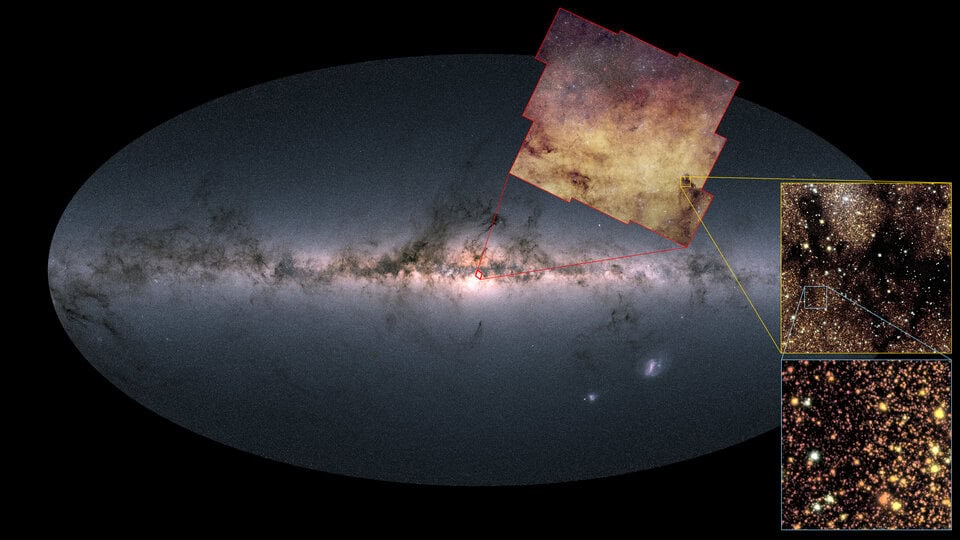 Location of Euclid’s survey. Credit: ESA
Euclid normally looks far beyond the Milky Way. Its main job is to map billions of galaxies and track how dark matter and dark energy shape the universe.
But on March 23, 2025, astronomers aimed it at the Milky Way’s galactic bulge — the bright, packed region around the galaxy’s center. In about 26 hours, Euclid’s visible-light camera stitched together nine “pointings,” each covering more sky than the full moon.
 Infographic of Euclid’s galactic bulge survey. Credit: ESA
The result was this sharp, enormous view of stars, nebulae, star clusters, and dark clouds of gas and dust.
Euclid can separate individual stars in a field where ground-based telescopes struggle with Earth’s atmosphere and overwhelming crowding. ESA says Euclid’s visible-light sharpness is comparable to Hubble’s wide-field camera, but each Euclid pointing covers an area 270 times larger.
“It was never built with this science in mind,” said Dr. Eamonn Kerins, an astrophysicist at the University of Manchester’s Jodrell Bank Centre for Astrophysics, according to The Guardian. “But it has proved to be a superb facility for the work.”
How a Star Can Reveal a Planet
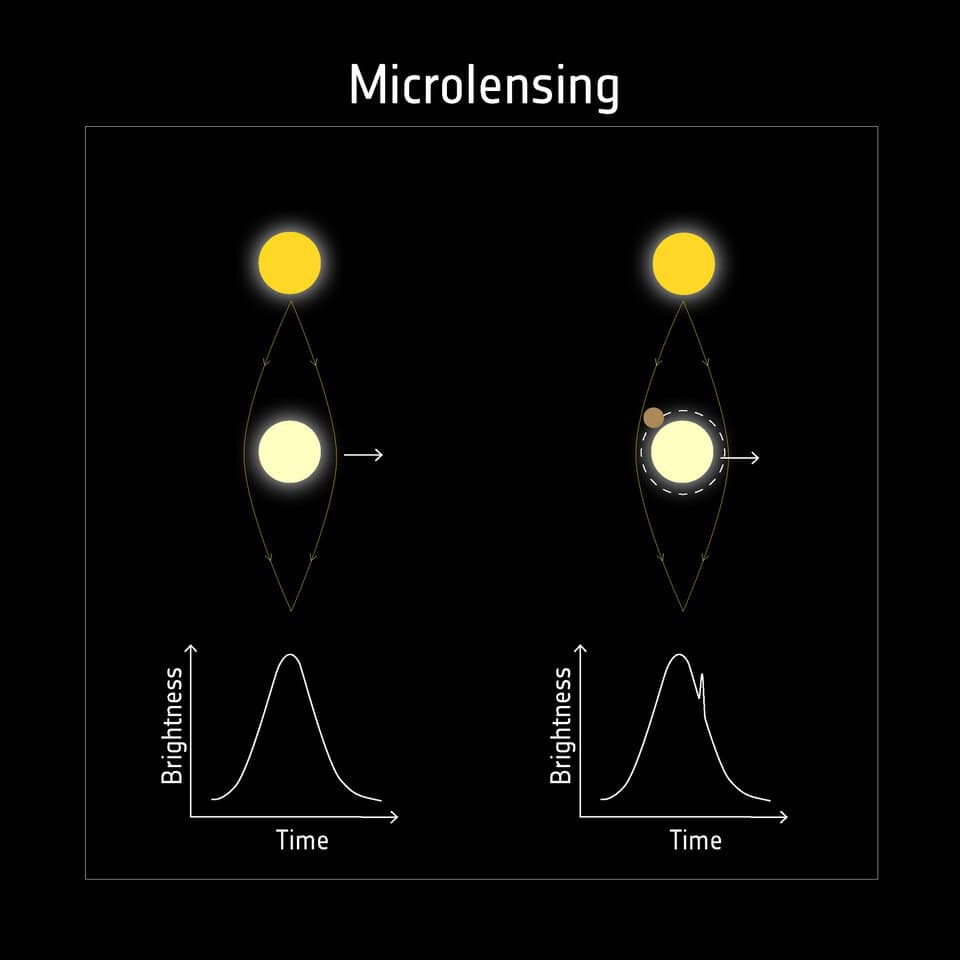 Infographic explaining microlensing planet detection. Credit: ESA
The new image will support a planet-hunting method called microlensing. When one star passes in front of another, the nearer star’s gravity bends and brightens the background star’s light. If a planet orbits the nearer star, its gravity adds a small extra wrinkle to that signal.
×
Thank you! One more thing…
Please check your inbox and confirm your subscription.
That faint change can reveal a world no telescope can see directly.
“To catch microlensing, you need to observe parts of the sky that are crowded with stars, such as close to the centre of our galaxy,” Jean-Philippe Beaulieu of the Institut d’Astrophysique de Paris and the University of Tasmania said in a statement. “During the last twenty years, almost 300 exoplanets have been discovered using this technique, all with ground-based telescopes and all towards the centre of our galaxy. This image from Euclid includes 51 known planetary systems—and it will assist in studying many more that will be found.”
Euclid did not find new planets in this one-day view. A microlensing event usually takes more than 20 days of monitoring. But the image gives astronomers a record of the stars before future alignments.
 A nebula found with Euclid. Credit: ESA
“In 24 hours, Euclid has already captured the stars involved in all the future microlensing events that the Roman space telescope will detect, but before the stars and planets involved have aligned,” said Natalia Rektsini of the Institut d’Astrophysique de Paris.
When Roman or another telescope later spots a microlensing event, researchers can compare that data with Euclid’s earlier image, measure how fast the stars moved and use that motion to confirm the planet and calculate its mass.
The Cold Worlds Microlensing Finds Best
Video of Euclid’s findings. Credit: ESA.
Many planet-hunting methods favor large, hot planets that orbit close to their stars. Microlensing can find colder planets farther out, including worlds more like Uranus or Neptune.
“This technique is unbiased, we discover whatever is out there,” Rektsini added. “It is uniquely suited to discover cold exoplanets. And we expect every star in the Milky Way to host at least one such planet.”
Two known systems stand out to the Euclid team.
OGLE-2005-BLG-390Lb, found 20 years ago, is an icy world that Dr. Beaulieu compares to a famous frozen planet. “[It’s] a bit like Hoth from Star Wars. After all this time, I’m excited that Euclid might finally allow us to measure its precise mass,” he said.
Another system, OGLE-2013-BLG-341Lb, contains two stars and a planet. By combining earlier Keck and Hubble observations with Euclid’s new view, scientists may finally separate the stars clearly enough to confirm the planet’s mass.
“This data fires the starting pistol in a new age of exoplanet discovery, where we go from knowing about 6,000 exoplanets to finding more than 100,000 across the galaxy,” Kerins said.
Euclid’s galactic detour may also serve other studies, from brown dwarfs and binary stars to stellar motion and dust in the Milky Way.
For a mission built to map the invisible scaffolding of the cosmos, its brief look inward has delivered a new way to weigh hidden worlds.