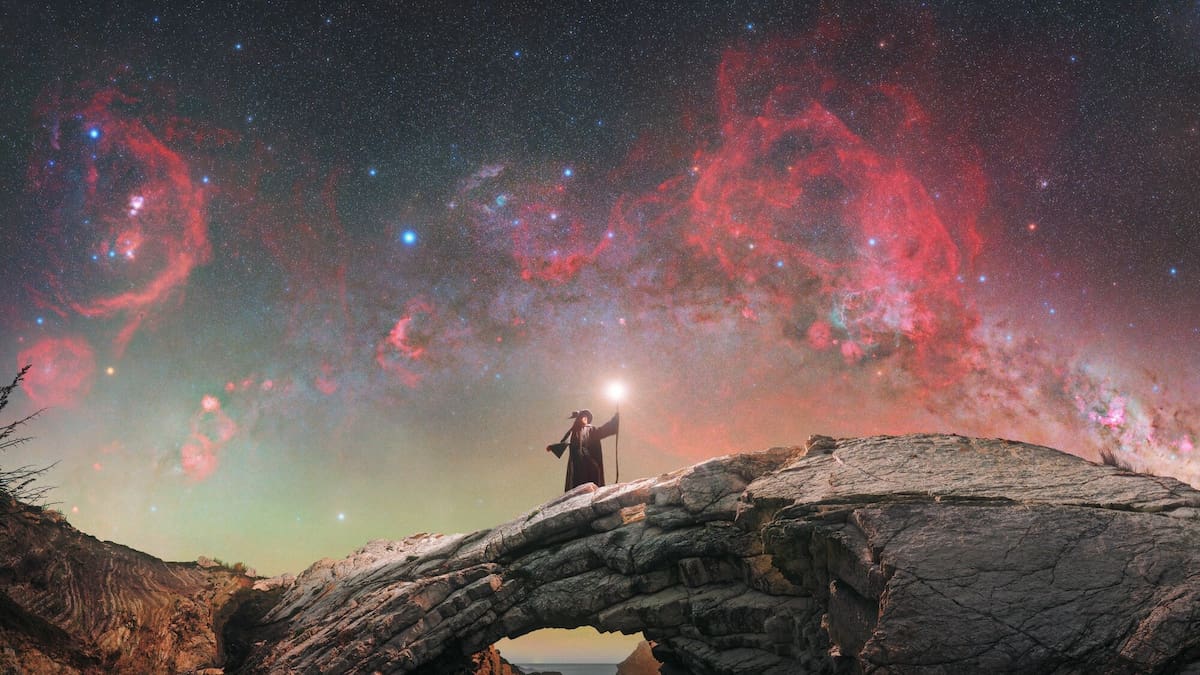
Known as Galactic Kiwi, McKay spent the past year trying to “perfect” his new photographic niche, combining the styles of deep sky and Milky Way photography.
He was awarded Milky Way Photographer of the Year in 2022 and again this year. He won the New Zealand Astrophotography Competition’s night scape category last year and was recently shortlisted for the ZWO Astronomy Photographer of the Year 2026, regarded as the world’s largest competition of its kind.
Mt Ruapehu, Tongariro and Taranaki are McKay’s favourite spots to shoot.
“I tend to drive to a remote spot where it’s clear and set the camera up,” McKay said.
“It’s better than waiting for the weather to come to you.”
His composite images capture local landscapes beneath high-definition images of space, aiming to provide viewers with context about where things sit in the sky above.
McKay’s final “piece of the puzzle” is adding nebulae — interstellar clouds of gas and dust, hard to see with the human eye.
The Carina Nebula and Orion Nebula (Te Hao o Rua) are among the brightest nebulae visible from Earth.
McKay captures them through full-colour panoramas of dust in space using a dual-band filter, which eliminates all light except the two spectra nebulae consist of — Hydrogen-alpha and Oxygen III.
“It’s about enhancing what’s actually there, and not generating something that isn’t,” he said.
“I don’t like to fake anything or do generative AI, if I can absolutely help it.”
Opportunities to capture night sky images increase during Matariki and around the winter solstice, the longest night of the year.
McKay spent his Matariki weekend on Tongariro.
“It just happened to align with good weather over a long weekend, so it was really just a no-brainer.”
The moon was also well aligned and not too bright, he said.
“I was actually quite lucky because all we had was a little crescent moon.
“It was lighting up the snowy mountains for me, which was quite special.”
McKay recalls creating two of his favourite images across the region.
Last month, he captured a “surreal and unexpected” panorama of aurora australis over Kai Iwi Beach, despite nearby light pollution.
A panorama of aurora australis and the Milky Way over Kai Iwi Beach in June. Photo / Evan McKay
“I knew right after dark you’d get the Milky Way arch, kind of, centred over south, and of course the aurora is in the south.”
Another of his favourite images was taken on a recent venture to Hangatahua (Stony) River on Taranaki maunga.
“There’s a particular alignment where you can get the Milky Way just erupting out of the mountain.”
Good weather was forecast, and it was potentially one of the last days he could get the alignment, he said.
“So I thought I might as well go for it.
“Although there wasn’t much snow on the mountain in early June this year, the low clouds partially wrapping around the maunga more than made up for it.
“Sometimes it’s worth revisiting familiar locations. While the stars might remain constant, the landscape is never quite the same, and each visit tells its own story.”
McKay said the number of satellites in the sky had increased significantly over his years as a night sky photographer.
“They’re an eyesore. They’re just extremely distracting. I don’t like having the satellite trails all through my images.”
McKay uses the statistical method of sigma-clipping to remove them from his images.
Exploring the night sky through astrophotography had opened his eyes to the scale of things, he said.
“You see pictures from Hubble of all these nebulae and galaxies and stuff, but you don’t really know where they are in the sky … you’re actually looking at such tiny, little parts of the sky.”
McKay plans to automate more of his “incredibly time-consuming” star data collection process and buy a four-wheel-drive vehicle.
“Some of the places I go are a little bit more adventurous.”
Noam Mānuka Lazarus (Ngāti Whātua o Kaipara) is a multimedia journalist at the Whanganui Chronicle.