
a temporary world beneath the kites
In Weifang, China, thousands of people spread across an open field each spring and spend the afternoon looking up. Tropical fish drift beside Shin Ramyun packets, while kites stretching as far as 300 meters cross the sky. Janice Chan photographs this strange scale from the ground, keeping the airborne forms within the larger world of spectators and vendors gathered across the field.
Her series, dubbed Most People Came to Watch the Sky, follows the annual Weifang International Kite Festival through its surrounding atmosphere. Chan, a Hong Kong-based Kiwi architectural designer and photographer, gives as much space to the people waiting beneath the flights as she does to the kites themselves. The project finds its energy in that shared attention. An empty field becomes a public room for a few hours, with thousands of heads tilted upward.
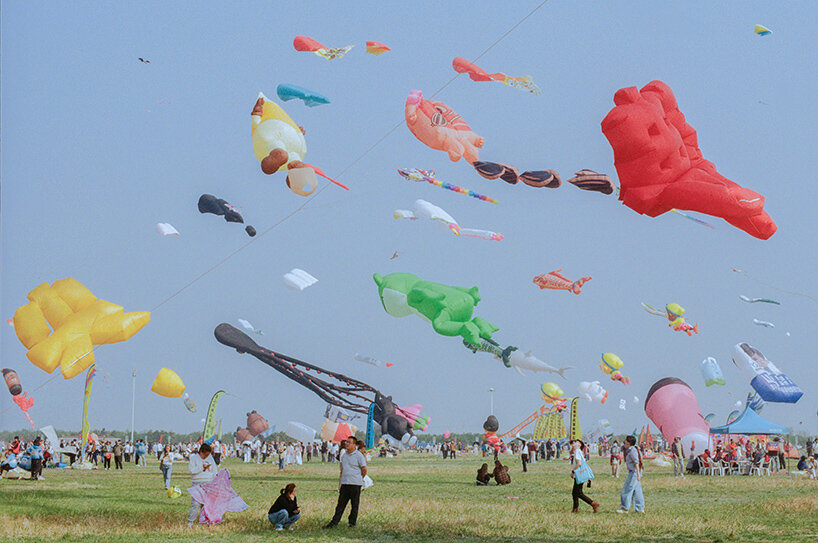
Janice Chan photographs the annual kite festival in Weifang, China | images © Janice Chan
weifang’s airborne craft
Kite-making reaches back to Micronesia and East Asia between the fifth and fourth centuries BCE. Early forms served ritual and fishing purposes, before moving into military use and scientific experiment. The Weifang International Kite Festival, captured here by photographer Janice Chan, began in 1984 and has grown into the largest festival of its kind.
Weifang’s local craft brings that long history into the present. Traditional examples use bamboo frames covered with paper or silk, with painted surfaces adding graphic detail that remains legible from the ground. Contemporary makers increasingly work with nylon and newer structural systems, allowing larger three-dimensional bodies to hold their shape in the air. At festival scale, the kite reads as an airborne structure. It has to lift under wind while resisting the pull of its tether, then flex as the direction changes.
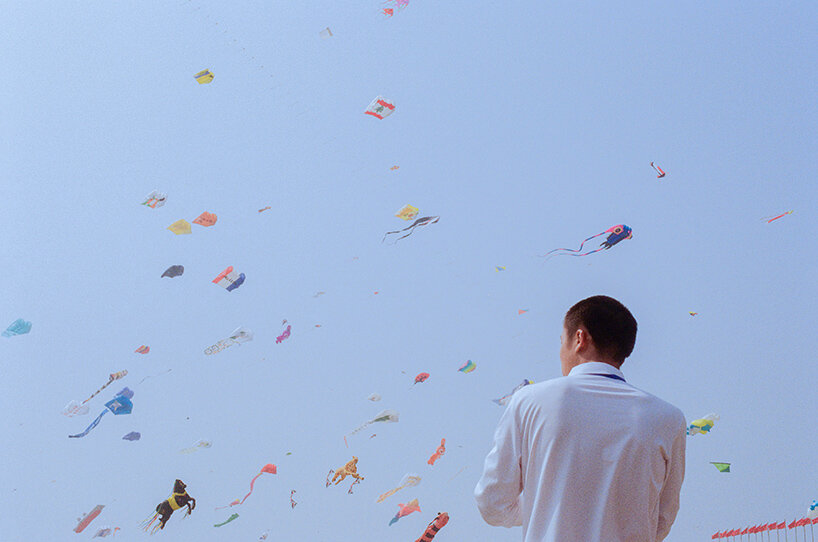
colossal kites drift above spectators gathered across the open field
photographing the feeling of the day
Janice Chan shot the series with a Nikon F4 loaded with Kodak Gold 200, hoping for the bright spring weather that eventually fills the photographs. She kept the editing light and left the colors close to their original brightness, allowing the pale sky to occupy large portions of each frame. Her images stay with what she calls ‘a long afternoon outside with nowhere particular to be.‘ The kites retain their absurdity because the surrounding day feels ordinary.
Chan’s architectural background informs where her attention lands. She looks at places through the people who inhabit them and the activity gathering around their edges. That interest appears here through figures sitting or walking across the field, food stalls operating beneath the flights and crowds waiting for the next form to rise.
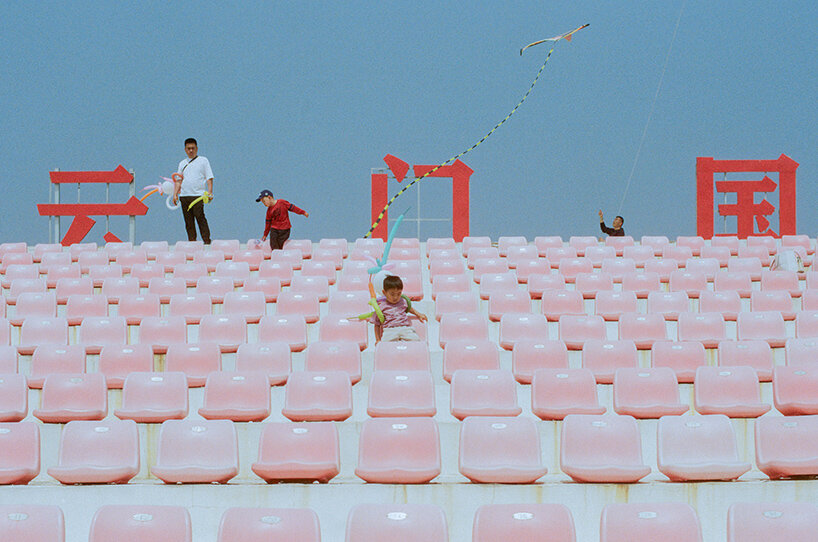
the photographer gives equal space to the activity taking place below
when the sky becomes somewhere to play
Kite flying relies on an unstable agreement between the person holding the line and the moving air above. The flier pulls and releases while the wind keeps making its own decisions. A hand can guide the path, though each gust changes it. That partial control gives the festival its playful spirit. The sky is open, but every flight draws a temporary route through it.
Chan’s photographs place that exchange inside a larger public scene. Some people fly and others watch, and both roles shape the field. For an afternoon, Weifang offers a public space built through shared attention instead of permanent construction. The sky becomes a surface for design, and looking becomes a form of participation.
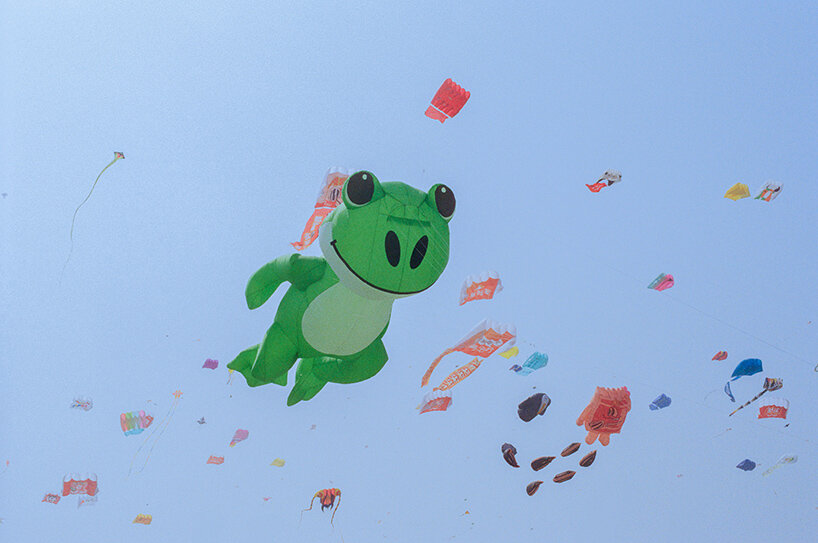
tropical fish and familiar food packaging appear among the airborne figures
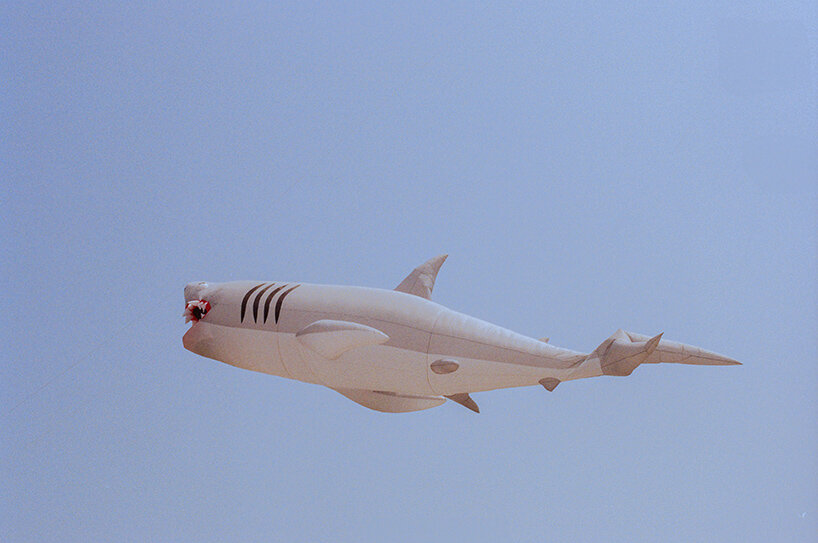
some kites stretch as far as 300 meters (nearly one thousand feet) across the sky