Ireland
  • Europe
    • FR
    • DE
    • IT
    • ES
    • BE
    • NL
    • LU
    • CH
    • DK
    • PL
    • UK
  • Headlines
  • Ireland
  • World
  • Business
  • Technology
  • Entertainment
  • Sports
  • Science
  • Health
  • Artificial intelligence
  • Arts and design
  • Books
  • Business
  • Celebrities
  • Computing
  • Economy
  • Entertainment
  • Entrepreneurship
  • Environment
  • Fitness
  • Gadgets
  • Genetics
  • Headlines
  • Health
  • Healthcare
  • Internet
  • Ireland
  • Jobs
  • Markets
  • Medication
  • Mental health
  • Mobile
  • Movies
  • Music
  • Nutrition
  • Personal finance
  • Physics
  • Science
  • Space
  • Sports
  • Technology
  • TV
  • Virtual reality
  • Wildlife
  • World
Ireland
  • Europe
    • FR
    • DE
    • IT
    • ES
    • BE
    • NL
    • LU
    • CH
    • DK
    • PL
    • UK
  • Headlines
  • Ireland
  • World
  • Business
  • Technology
  • Entertainment
  • Sports
  • Science
  • Health

Browsing Tag

Ion

15 posts
HHealth
New generation of CRISPR shows safer path to treating genetic diseases
Read More

Molecular keyhole discovery offers new hope for personalized pain therapies

  • April 21, 2026
Researchers at VIB, VUB, and KU Leuven have identified a tiny binding site, a molecular ‘keyhole’, in the TRPM3 ion channel, a crucial sensor…
SScience
Scientists reveal how the body senses cold and menthol
Read More

The molecular mechanism that turns cool temps into nerve signals

  • March 26, 2026
When you reach into a bucket of ice, open your front door on a snowy day, or feel…
HHealth
New generation of CRISPR shows safer path to treating genetic diseases
Read More

New review reveals complex polygenic architecture underlying common epilepsies

  • March 11, 2026
An insightful mini-review published in Genomic Psychiatry synthesizes the rapidly expanding landscape of molecular genetic research on common…
HHealth
Gut neurons drive immune responses through adrenomedullin 2
Read More

Ion channel TRPV4 found to regulate relief after scratching an itch

  • February 23, 2026
When you scratch an itch, something tells your brain when to stop. That moment of relief, when scratching…
HHealth
Blue and green pills
Read More

A pill that confirms you actually swallowed your medicine

  • January 12, 2026
By using a temporary Faraday-cage coating that dissolves in minutes, the SAFARI capsule delivers highly specific proof of…
SScience
Scientists identify a molecular switch that controls water flow in the gut
Read More

Scientists identify a molecular switch that controls water flow in the gut

  • January 10, 2026
Although constipation and diarrhea may seem like opposite problems, they both hinge on the same underlying issue: how…
HHealth
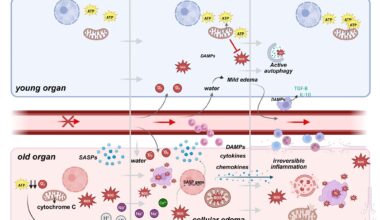
Cellular responses to ischemic reperfusion injury in young vs older donor organs. During ischemia, the deprivation of oxygen and nutrients leads to mitochondrial dysfunction and energy loss. In young cells, mitochondrial resilience helps sustain ATP production, ameliorating damage. Old cells, in contrast, experience significant ATP depletion, relying heavily on anaerobic metabolism, which leads to lactate buildup, pH reduction, and cellular stress. Upon reperfusion, the restoration of blood flow triggers oxidative stress as mitochondria generate excessive reactive oxygen species (ROS). Young cells compensate for those events through robust antioxidant systems, maintaining cellular integrity. Conversely, in old cells, impaired antioxidant defenses result in unregulated ROS production, furthermore damaging membranes, organelles, and DNA. Additionally, old cells release pro-inflammatory genes, amplifying local inflammation. Consequences are particularly severe in aged vascular endothelial cells, with ion pump dysfunction (e.g., Na⁺/K⁺ ATPase) causing ionic imbalances and cellular edema. This disruption exacerbates ischemic injury, progressing to irreversible damage. In contrast, young cells effectively resolve edema and inflammation through mechanisms that include macrophage945 mediated clearance of Damage-Associated Molecular Patterns (DAMPs) and anti-inflammatory cytokine release (e.g., IL-10 and TGF-β), allowing recovery and tissue repair. In old cells, persistent ROS generation, unresolved inflammation, and DAMP accumulation lead to irreversible inflammation, organelle collapse, and eventual cell death. Created in BioRender. Kayumov, M. (2025) https://BioRender.com/m23u7ro .
Read More

Scientists outline how organ rejuvenation strategies could solve the donor shortage

  • December 12, 2025
New insights into cellular aging, perfusion technologies, and senescence-targeting treatments show how aging organs could be revived, turning…
SScience
Polβ enzyme found to protect developing brain from harmful DNA mutations
Read More

Groundbreaking mouse cortex model opens new frontiers in neuroscience

  • November 17, 2025
Harnessing the muscle of one of the world’s fastest supercomputers, researchers have built one of the largest and…
HHealth
Amino acid metabolism shapes the tumor immune microenvironment and therapy response
Read More

New NIH grants fuel research in oral cancer treatment and pain relief

  • November 8, 2025
Researchers at the School of Dentistry at UT Health San Antonio, the academic health center of The University…
HHealth
Tumor microbiota identified as predictors of prognosis in gastrointestinal cancers
Read More

Trojan horse strategy using cesium nanosalts shows powerful anti-cancer effects

  • November 5, 2025
Recently, a team led by Academician Hongjie Zhang, Researcher Shuyan Song, Associate Researcher Pengpeng Lei, and Dr. Ran An…
SScience
New adaptive finger brace could improve recovery for joint injuries
Read More

New adaptive finger brace could improve recovery for joint injuries

  • October 15, 2025
A friend’s struggles with arthritis and the finger braces used to manage it inspired research by a Carnegie…
HHealth
Nanostructures boost CRISPR delivery for genetic medicine
Read More

Nasal spray of gold nanoparticles delivers lithium directly to the brain

  • October 9, 2025
In the form of a ‘nasal spray’, tiny gold particles act as carriers, delivering a treatment directly to…
Ireland
www.europesays.com