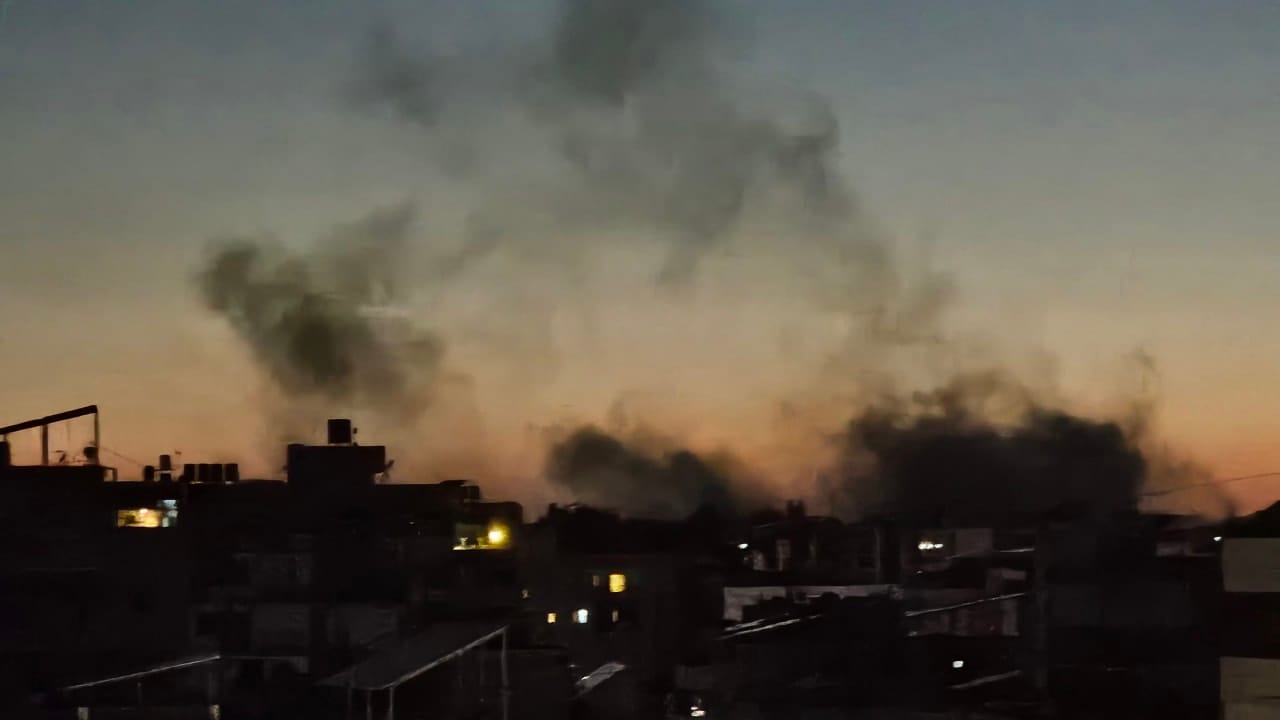
Prime Minister Benjamin Netanyahu and Defense Minister Israel Katz on Thursday night said they had ordered the IDF to try to assassinate Hezbollah’s Radwan special forces commander in Beirut.
This attack was the first in Lebanon’s capital in weeks, following the ceasefires with Iran on April 7 and with Hezbollah on April 17.
Lebanese media first reported on the attack.
Arab media reported that Azzam al-Haya, son of Hamas leader Khalil al-Haya, was present at the site of the strike. Sources are conflicted on whether he was wounded or killed. Hammam Khalil al-Haya, another son of Khalil al-Haya, was killed in the Israeli strike on Qatar in 2025.
Netanyahu and Katz said that Radwan is responsible for the attacks on Israeli northern residents.
They added that no terrorist has immunity and that the “long arm of Israel would get to every enemy and murderer.”
Further, they said they would keep the government’s promise to restore security for Israel’s northern residents.
A senior source told The Jerusalem Post that the deputy commander of the Radwan force as well as other senior officials were also at the compound targeted by the IDF.
A senior official told the Post that the IDF had attacked a Hezbollah headquarters that issued instructions for ceasefire violations and ordered attacks on northern Israeli communities.
Previous attacks on Radwan commanders
Since 2023, Israel has killed multiple top Radwan commanders, but fewer top officials recently.
In November 2025, in the most aggressive strike by Israel against Hezbollah since the November 2024 ceasefire, an IDF airstrike killed Hezbollah military commander Ali Tabatabai in the heart of Beirut.
Multiple senior Hezbollah commanders have been killed since, but not at the level of the top Radwan commander.
For almost a week after the April 17 ceasefire, the IDF and Hezbollah overwhelmingly limited friction between the sides.
‘The ceasefire that is not a ceasefire’
However, as Iran and the US started to fight more in the Strait of Hormuz, the Lebanese government started to hold public meetings with Israel, and the IDF continued to hunt down Hezbollah fighters in parts of southern Lebanon under its control, Hezbollah started to attack northern Israeli towns again, and escalated its attacks on IDF soldiers.
If the IDF had hoped, as a senior IDF source put it on Tuesday, that the ceasefire would only apply north of the Litani River and within Israel, but not in southern Lebanon in between the two, Hezbollah was not having it.
Further, if the IDF believed that Hezbollah was so desperate to avoid attacks in Beirut that it would turn the other cheek from other attacks, and also would not be able to seriously threaten IDF soldiers in southern Lebanon, the Lebanese terror group’s use of FPV drones has shown that it can unfortunately charge a heavy price.
So with the IDF driving Hezbollah out of or killing its small groups of remaining fighters in Naqoura, Ras al-Bayada, and other parts of southern Lebanon, what does “the ceasefire, which is not a ceasefire,” as one IDF official put it on Tuesday, look like?
On Tuesday, the Post embedded with the IDF for a visit to both Naqoura and an IDF position in the Ras al-Bayada region, reaching around 10 kilometers deep into southern Lebanon, all on the coast.
Most of what the Post saw showed heavily destroyed villages along the way- a feature of Hezbollah keeping weapons in most houses in the majority of these villages, said IDF senior sources.
Despite that picture, IDF officials said that Christian villages, like Alma a-Shaab, have been left intact, since Hezbollah did not set up positions or store weapons there.
That means that Christian Lebanese civilians should be able to return to their homes standing when the current conflict is resolved.
The area is under the control of IDF Division 146, commanded by Brig. Gen. Beni Aharon, with two of his senior commanders being Col. Aviel Balachsan, commander of the 226 Paratroopers Reservist Brigade, and Lt. Col. Lior Chasid, commander of Battalion 9.