
After being at war with Hamas, Hezbollah and Iran, Israel is now in a ceasefire against all three enemies.
The Israel Defense Forces has certainly caused significant damage to its adversaries on all those fronts, but by no means has the threat dissipated.
While ceasefires brokered by US President Donald Trump — and largely imposed on Israel — are officially still in place, they remain extremely precarious.
The direction of all the post-October 7, 2023, wars is up in the air, but there are truths we can identify in order to make sense of what has been accomplished, where Israel stands, and what could happen in the next stage.
Israel has not won in Gaza…
Speaking at a conference one year ago, then-strategic affairs minister Ron Dermer promised that in twelve months’ time, Israel “will have won” the war that began on October 7.
Get The Times of Israel’s Daily Edition
by email and never miss our top stories
By signing up, you agree to the terms
In Gaza, Prime Minister Benjamin Netanyahu and other top Israeli officials have been consistent about the aims of war, beyond the return of all the hostages — “that Hamas can no longer act, that it no longer has governance or military capacities and that Gaza cannot be a threat to Israel.”
“Hamas will be disarmed — either the easy way or the hard way,” Netanyahu threatened on another occasion.

Strategic Affairs Minister Ron Dermer speaks at the Jewish News Syndicate conference in Jerusalem, April 28, 2025. (Chaim Goldberg/Flash90)
None of those aims has been achieved. Hamas continues to hold almost half of Gaza’s territory, but more importantly, governs virtually every Gazan.
And its leaders say openly they won’t give up their weapons. “Criminalizing the resistance, its weapons, and those who carried it out is something we should not accept,” senior Hamas leader Khaled Mashaal said in February, only the latest in a series of Hamas officials to make clear that talk of disarmament is a fantasy.

Palestinian gunmen from Hamas and Islamic Jihad gather next to Eid al-Fitr prayers in Gaza City, Friday, March 20, 2026. (AP/Abdel Kareem Hana)
Since then, Nickolay Mladenov, leading Trump’s Board of Peace, has been talking with Hamas leaders for weeks, and gave the group until April 11 to accept the Board’s proposal for it to gradually hand over all of its arms.
Instead, the terror group submitted a counteroffer to the Board of Peace, insisting that the issue of its weapons only be addressed as part of a framework culminating in the establishment of a Palestinian state.
Hamas is showing no sign of loosening its grip on Gaza, and there is no evident path to removing it as the most powerful force in the Strip. Israeli officials might engage in the occasional palaver about going back to war in Gaza, but there is absolutely nothing indicating that a return to high-intensity combat against Hamas is a possibility anytime in the foreseeable future.
…or in Lebanon…
Hezbollah, hammered by Israeli assassinations and a limited ground invasion, agreed to a humiliating ceasefire in November 2024. Under the terms of that truce, Hezbollah was required to vacate southern Lebanon and be replaced by the Lebanese military, as well as give up its weapons.

Lebanese President Joseph Aoun gestures to journalists at the Presidential Palace, in Baabda, east of Beirut, Lebanon, May 21, 2025. (AP Photo/Hassan Ammar, File)
A new, anti-Hezbollah government came to power in the wake of the ceasefire, which tasked the Lebanese army with disarming Hezbollah by the end of the year. Far less capable than Hezbollah, the Lebanese Armed Forces has done some work in clearing some sites of weapons in southern Lebanon, but has not touched the bulk of the group’s arsenal in the rest of the country.
Still, the assessment in Israel was that Hezbollah was so badly beaten, it would remain cowed for the foreseeable future. After all, it didn’t do anything during the 12-day war in June 2025.
But Iran’s Revolutionary Guards quietly rebuilt Hezbollah’s military command, plugging gaps with Iranian officers and changing the command structure.

A Hezbollah party supporter holds a large postcard with the images of the group’s leaders assassinated by Israel, Hashem Safieddine (L) and Hassan Nasrallah (C) and current leader Naim Qassem, during a solidarity rally in Beirut’s southern suburbs on April 25, 2026 (IBRAHIM AMRO / AFP)
Hezbollah surprised Israel by showing its renewed fighting spirit, jumping into the US-Israeli war with Iran on March 2, firing hundreds of rockets and drones at northern Israel.
Israel responded by sending thousands of troops into Lebanon in a steadily expanding offensive. Many saw this as the opportunity to finally deal Hezbollah the fatal blow Israel failed to deliver in 2024.
When Trump imposed a halt to the campaign against Iran, Israel insisted that it would keep fighting Hezbollah, and that now it could shift its full focus on the resurgent group.

IDF Chief of Staff Lt. Gen. Eyal Zamir (left) in southern Lebanon’s Khiam, May 6, 2026. (Israel Defense Forces)
IDF Chief of Staff Lt. Gen. Eyal Zamir described the fight against Hezbollah as the military’s “primary combat zone.”
And Netanyahu insisted in early April that the Iran ceasefire “does not include Lebanon.”
Less than two weeks later, it did. Trump announced a 10-day ceasefire in Lebanon, and Netanyahu was left to defend his willingness to agree to the truce by pointing out how much Israel has done in weakening Hezbollah over the last two years.
Trump then announced a three-week extension to the ceasefire, amid efforts to get Lebanon’s President Joseph Aoun to Washington to meet directly with Netanyahu.
Israel is still fighting Hezbollah in southern Lebanon, and on Wednesday carried out its first strike in Beirut in nearly a month.

People gather at the site of an Israeli airstrike that targeted Beirut’s southern suburbs Haret Hreik neighborhood, on May 6, 2026. An Israeli strike in Lebanon’s eastern Bekaa valley killed four people on May 6, while the Israeli army said it struck Hezbollah targets in the south, after warning residents of a dozen towns to evacuate. (Photo by Ibrahim AMRO / AFP)
Yet nothing Israel is doing is putting Hezbollah’s survival as a political force or military organization in danger. If anything, the dynamics since the Iran war have been working in Hezbollah’s favor.
Before the campaign, Israel had the legitimacy to attack Hezbollah across the country, while the Shiite group took its lumps quietly. Now Israel has limits on where it can operate due to the ceasefire, while Hezbollah is striking Israeli troops with increasing bravado.
And no peace agreement is about to emerge between the Lebanese state and Israel. Aoun can’t even agree to meet Netanyahu, given the Hezbollah threat of violence.
…or in Iran
On the first day of Operation Rising Lion, Netanyahu said that “the goal of the operation is to put an end to the threat from the Ayatollah regime in Iran.”
The core of that effort was to target the nuclear and ballistic missile program.
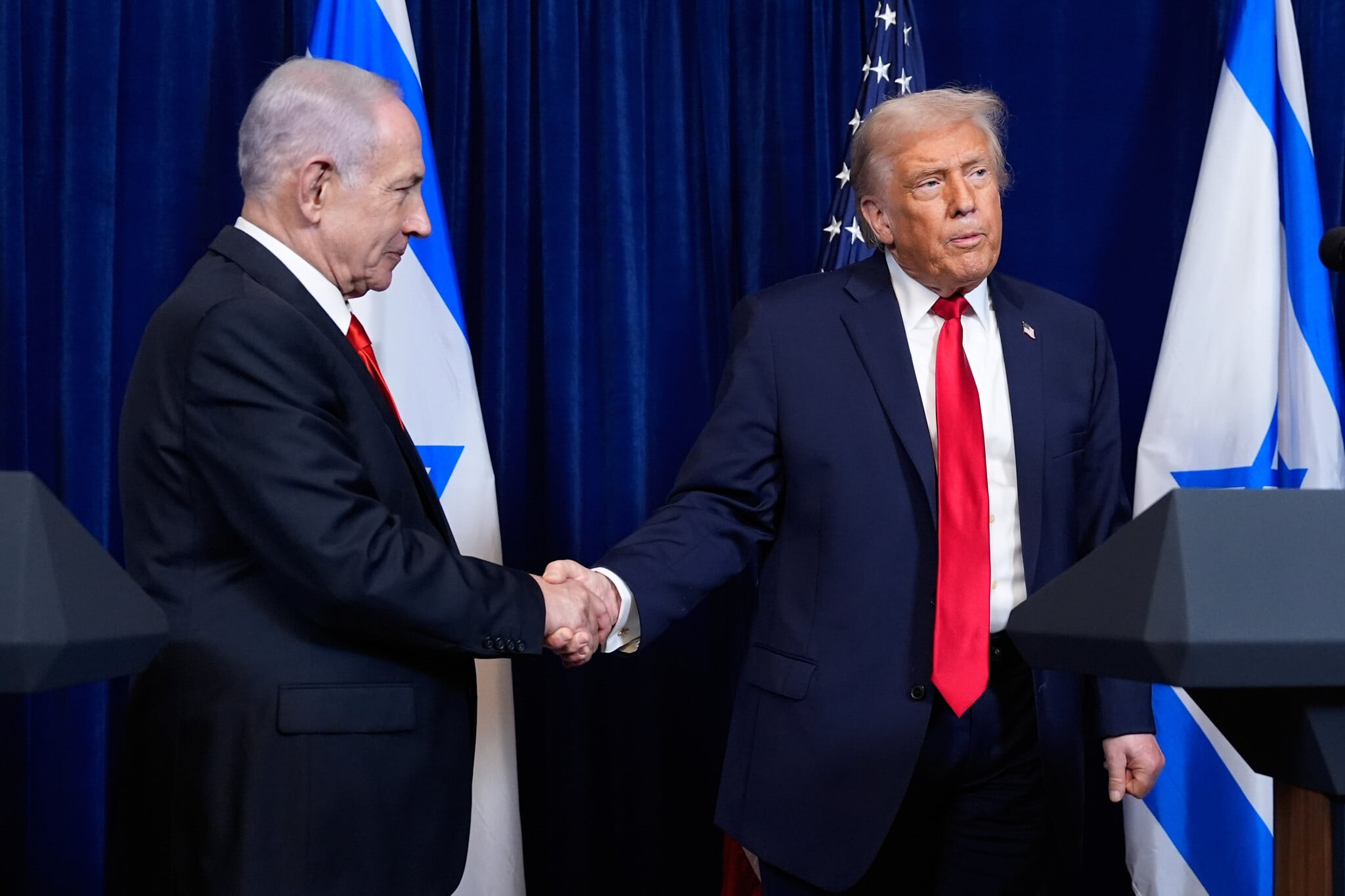
US President Donald Trump (R) shakes hands with Prime Minister Benjamin Netanyahu as Trump listens to a question from a reporter at the end of a news conference at Mar-a-Lago, on December 29, 2025, in Palm Beach, Florida. (AP Photo/Alex Brandon)
Though Netanyahu didn’t lay it out explicitly as a war aim, it was clear that he hoped — even expected — that the regime would fall. Israel, he said, would “create conditions that will enable the brave Iranian people to cast off the yoke of this murderous regime.”
“This operation will continue as long as necessary,” Netanyahu promised.
Iran’s military and leadership were badly damaged, without a doubt.
But US intelligence assesses that Iran likely still has access to around 70 percent of its pre-war ballistic missile stockpiles, and around 60 percent of its missile launchers.

Part of a missile fired from Iran toward Israel is seen after it hit the ground in the Golan Heights, April 7, 2026. (Maor Kinsbursky/Flash90)
Iran’s nuclear program, hit hard in June 2025, wasn’t set back in any meaningful fashion this time around. American assessments indicate that the time Iran would need to build a nuclear weapon has not changed since last summer. Iran’s 440 kilograms of highly enriched uranium remain in the country, with no agreement or plan to remove it.
Moreover, military capabilities can be rebuilt, especially if — in the context of an agreement with the US — money is flooding into a country that has consistently shown it will prioritize rearmament over the welfare of its citizens.
Nor are there any indications that the regime is facing collapse. It has shown coherence and stability, and now even Netanyahu has stopped talking about the Iranian people rising up.

In this photo released by the Pakistan Prime Minister Office, Iran’s Parliament Speaker Mohammad Bagher Ghalibaf, left, meets with hand with Pakistani Prime Minister Shehbaz Sharif, in Islamabad, Pakistan, April 11, 2026 (Pakistan Prime Minister Office via AP)
An agreement with Trump would cement the regime’s standing even further and allow it to start easing economic pressures facing the public.
Netanyahu himself admitted that Israel “has more goals to complete,” in a video statement released after the ceasefire between the US and Iran took effect.
Trump really, really does not want to go back to war
The US president might issue bombastic threats against Iran every day — Iran will be “blown off the face of the earth” if it strikes US vessels; he will bomb “at a much higher level and intensity” if Tehran refuses a deal — but it’s plain that he is desperate to avoid a return to war.

US President Donald Trump talks to reporters before he boards Air Force One at Palm Beach International Airport in West Palm Beach, Florida, May 2, 2026, en route to Miami. (AP Photo/Matt Rourke)
Last month, he indicated clearly that he wouldn’t extend the original two-week ceasefire. “I don’t want to do that. We don’t have that much time,” he said. “I expect to be bombing because I think that’s a better attitude to go in with.”
Then, hours before the truce was about to expire, he unilaterally extended it indefinitely, saying it was a Pakistani request. In the meantime, Iran is maintaining its effective blockade of the Strait of Hormuz.
Even Iran’s repeated bombing of the United Arab Emirates, a close ally of both the US and Iran, didn’t move Trump. Instead of making good on his bombast, he made excuses for Iran, insisting that it had not violated the ceasefire.
“[It was] not heavy firing,” Trump said. “They were shot down for the most part.”
Trump seems desperate for a deal, pushing back red lines, ignoring violations, and giving optimistic forecasts that Iranians reject.
Iran does not seem especially afraid
Tehran is acting like it recognizes that Trump is done fighting. Even if it has not read the situation correctly, leaders in Tehran believe they have survived the worst of what Israel and the US can throw at them.

In this picture obtained from Iran’s ISNA news agency on May 4, 2026, two men sitting in a skiff are seen fishing near a vessel anchored in the Strait of Hormuz off Bandar Abbas in southern Iran. (Amirhossein KHORGOOEI / ISNA / AFP)
While Trump baldly broadcasts his desire for a deal, Iran acts like it couldn’t care less either way, and there is nothing to indicate it has changed its negotiating position much.
As before the war, Tehran is still willing to make limited concessions on its nuclear program in exchange for sanctions relief.
Even a reported month-long Memorandum of Understanding meant to end the war and lay the groundwork for talks — without requiring Iran to permanently end its nuclear enrichment — wasn’t enough for Iran. An Iranian spokesman called it “more of an American wish list than a reality.”
Iran will keep its missiles and proxies
From the outset of the war on Iran, the White House has said that ending Tehran’s support for armed proxies and destroying its ballistic missile program were key war aims.
“We’re ensuring that the Iranian regime cannot continue to arm, fund, and direct terrorist armies outside of their borders,” said Trump on day 3 of the war.

Domestically built Iranian missiles are displayed as part of a permanent exhibition in a recreational area of northern Tehran, Iran, March 24, 2026. (AP Photo/Vahid Salemi)
“The United States is conducting an operation to eliminate the threat of Iran’s short-range ballistic missiles and the threat posed by its navy… That is the clear objective of this mission,” Secretary of State Marco Rubio insisted the same day.
Neither appears to be part of any deal being negotiated between the US and Iran, which seems to solely deal with Iran’s nuclear program, judging by Trump’s comments.
Asked about Iran’s ballistic missiles in an interview this week, Trump offered weakly, “Look, missiles are bad, but yeah, and they do have to cap it, but this is about they cannot have a nuclear weapon.”
He also refused to pledge that Iran would be stopped from funding proxies, only saying that they wouldn’t be in a position economically to do so, given the damage being done to Iran’s energy infrastructure.
There will be no relief for Israel’s reservists
Faced with enemies on its borders that aren’t going anywhere, Israel has chosen the most manpower-heavy response.

IDF reservists of the 226th Paratroopers Brigade operate in southern Lebanon, in a handout photo issued on April 29, 2026. (Israel Defense Forces)
It isn’t looking to defeat Hamas or Hezbollah on the battlefield through a sharp and decisive ground campaign. For years, that approach guided tiny Israel in its wars against Arab armies, allowing reservists to get back to their jobs and families after wars that lasted only weeks, at most.
Instead, Netanyahu has chosen the strategy of buffer zones over Israel’s borders — in Gaza, Lebanon, and in Syria. Each one needs multiple brigades to maintain, on top of demands along the border and in the West Bank.
That burden, as it has since October 7, 2023, falls on reservists as well as active-duty formations. Reserve brigades are carrying out their sixth extended deployments in 2.5 years, making it impossible to get back into routine at home, school, or the office.

Ultra-Orthodox Jews walk through a forest, breaking down barriers to enter Meron on Lag B’Omer, after the site was closed by police following Home Front Command restrictions, May 5, 2026. (David Cohen/Flash90)
And the major potential reservoir of ground troops isn’t going to be tapped either. Some 80,000 ultra-Orthodox men aged between 18 and 24 are currently believed to be eligible for military service, but have not enlisted. The IDF has said it urgently needs 12,000 recruits — mostly combat troops — due to the strain on standing and reserve forces caused by the multi-front war of recent years.
A coalition bill that would ostensibly increase military conscription in the Haredi community ultimately enshrines continued exemptions for full-time yeshiva students. Even that flawed legislation faces an uncertain future.
According to a Haredi news site, Netanyahu recently requested that ultra-Orthodox lawmakers agree to put off the unpopular legislation until after the 2026 elections, telling senior ultra-Orthodox lawmakers in a private meeting that his coalition does not have a majority to push the bill through.
Netanyahu can’t use national security as his main campaign pitch
Netanyahu saw the fact that October 7 happened on watch as his major political vulnerability.
He has sought to address that problem in a number of ways — shifting responsibility to the security services, changing records, and preventing the establishment of an apolitical commission of investigation.

Suhayb Razem held by a Hamas terrorist at the Nova festival site, October 7, 2023. (Screenshot: Youtube, 27a clause of copyright law)
The prime minister’s most credible case was supposed to have been his success in fighting back, in Gaza, Lebanon and Iran. He might have been in power during the worst massacre of Jews since the Holocaust, but only he could have led such an effective response, the argument goes. Under his leadership, Israel has killed enemy leaders, brought back all the hostages from Gaza, and dramatically weakened its adversaries.
Because of Israel’s successes, rebels in Syria saw the opportunity to topple the Bashar Assad regime, a key Iranian asset.
Netanyahu survived tensions with the Joe Biden Administration, then forged an even closer relationship with Trump than he had during his first term, which culminated in a jointly planned air campaign against Tehran.

Opposition Leader Yair Lapid (right) and former prime minister Naftali Bennett at a press conference announcing their joint run in the coming elections, in Herzliya, central Israel, April 26, 2026. (Chaim Goldberg/Flash90)
That’s the start of an effective message, but with the wars on hold and their achievements in doubt, he’ll have to find another lane.
So far, it has been the tired but effective tactic of using latent fears about Arab voters to attack the Naftali Bennett-Yair Lapid alliance.
It will be up to the Israeli public to decide, come election day, whether Israel’s achievements in the post-October 7 wars are sufficient to keep Netanyahu in office.