
Politicians, said Emma Goldman, will promise you heaven before being elected, and once elected, will give you hell.
It was no reason to be the radical anarchist she was, but her insight was nonetheless true. Then again, this does not mean politicians should not make promises. They should make promises and keep them.
Sadly, that’s not what is happening in our unfolding electoral contest. Yes, every candidate will readily tell you that he (no “she” in this race, so far) is better than the rest, and some will also fire an occasional broadside like “I will close down Channel 14” (Yair Golan) or “I will fire politically driven police officers” (Naftali Bennett). But these aren’t plans.
A political plan is, for instance, what then-opposition leader Yitzhak Rabin presented before his landslide victory in spring 1992, when he promised to build highways and interchanges, raise social spending, hike teachers’ and doctors’ pay, and pass a universal healthcare law. Whether or not one liked these ideas, they added up to a plan. What matters is not that Rabin fulfilled every promise of his plan. What matters is that it made him win.
Can today’s opposition produce such a plan’s equivalent, and if so – what should it say?
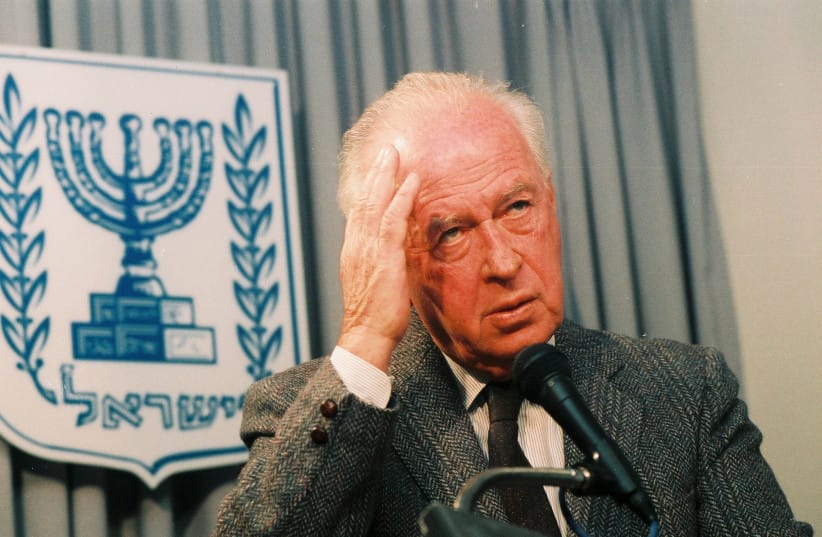 Portrait of Yitzhak Rabin (credit: FLASH90)Much more daunting than before
LED BY FOUR prime ministerial contenders, the task ahead of today’s opposition is much more daunting than what Rabin faced last century.
Rabin’s rival, Yitzhak Shamir, was easier to defeat than Benjamin Netanyahu, though it should be noted that when defeated, Shamir was the same age, 76, that Netanyahu is now. Much more crucially, the national mood those days, though clouded by the First Intifada, was nothing like the anger, perplexity, and despair that the past three years’ events have spawned. People now need more than a new face. They need a new spirit.
Yes, Ariel Sharon trounced Ehud Barak despite having presented no plan, but that worked because everyone knew who Sharon was, and how badly Barak had failed. Now, that kind of evasion can’t work.
Israelis are craving a gospel. And the gospel should not be about any candidate’s appearance, eloquence or pizazz. It should be about a plan, a plan of four parts. The first will be about our postwar recovery.
Promise of massive construction in the western Negev
THE PLAN will open with a promise of massive construction in the western Negev and the northern border, crowned by generous assistance to devastated businesses and farms. Titled “No One is Left Behind,” this program will undo Netanyahu’s failure to furnish Galilean houses with the bomb shelters that they deserve more than any other Israeli.
Having agreed on this, the four candidates will then proceed to their plan’s second item: constitutional reform.
Two candidates, Bennett and Yisrael Beytenu leader Avigdor Liberman, did say that they would pass a constitution. That’s a good start, but it’s short on details. The candidates don’t need to present a prospective constitution’s text, or even its guidelines. What they should say is how they would assemble a constitutional convention, what issues they will ask it to tackle, and under what deadline.
The candidates can agree that they will give this forum, say, one year to draft a blueprint that will delineate the Supreme Court’s power, stipulate the justices’ selection system, define the judiciary’s relations with the executive branch, and prescribe the kind of majority that constitutional amendments would require. The blueprint will then be reviewed by the government and taken to a referendum.
There is, of course, much more to be said about this challenge, but such a statement is more than enough in terms of a commitment that the four candidates can share and present.
The plan’s third part should be an education revolution.
Anyone who has rubbed shoulders with our school system knows it is sick. Too many schools are too big, too many teachers are substandard, too many students are violent, and scholastic achievements are steadily declining.
The four candidates can jointly promise their government will shrink schools, cap the number of students per classroom, let schools run their budgets independently, and empower principals to freely hire, fire, and salary teachers according to their skills, motivation, and performance.
The plan’s fourth item should be a social contract.
The past three years’ events brought to a boiling point the absurdity whereby a minority who neither work nor serve get from the state as much, and in some ways more, than the majority who do work and serve.
Netanyahu’s aspiring successors have long detected the public’s wrath in the face of this travesty of justice. They did not, however, present a plan of action, least of all one they collectively debated and endorsed. Now is the time to do that, by vowing that any funding to any educational institution will be given only to those who send their graduates to some kind of national service.
Such, in brief, will be the plan’s four practical parts. But above and beyond the plan’s clauses will hover its overarching aim, which should also be the opposition’s chief promise: national reconciliation.
Personal, deliberate, and merciless
THE NETANYAHU era’s most revolting feature has been the prime minister’s personal, deliberate, and merciless effort to create a rift in Israeli society.
Netanyahu’s pitting of Israeli citizens, classes, institutions, and tribes against one another has been so brazen, consistent, and effective that its damage is second only to his political responsibility for the October 7, 2023, disaster.
Reversing this damage is thus the most urgent aim that should guide Netanyahu’s aspiring successors. The era of social injustice, civic abuse, and political audacity can be brought to an end by a coalition of patriots who will restore mainstream Israelis’ control of Israel’s future and destiny.
That, in fact, should be the foursome’s name for their prospective coalition. “The reconciliation government” might sound a bit clunky in English, but the Hebrew memshelet hapiyus will sound sharp, inspire action, and instill hope.
The writer, a Hartman Institute fellow, is the author of Ha’Sfar Ha’Yehudi Ha’Aharon (The Last Jewish Frontier, Yediot Sefarim, 2025), a sequel to Theodor Herzl’s The Old New Land.