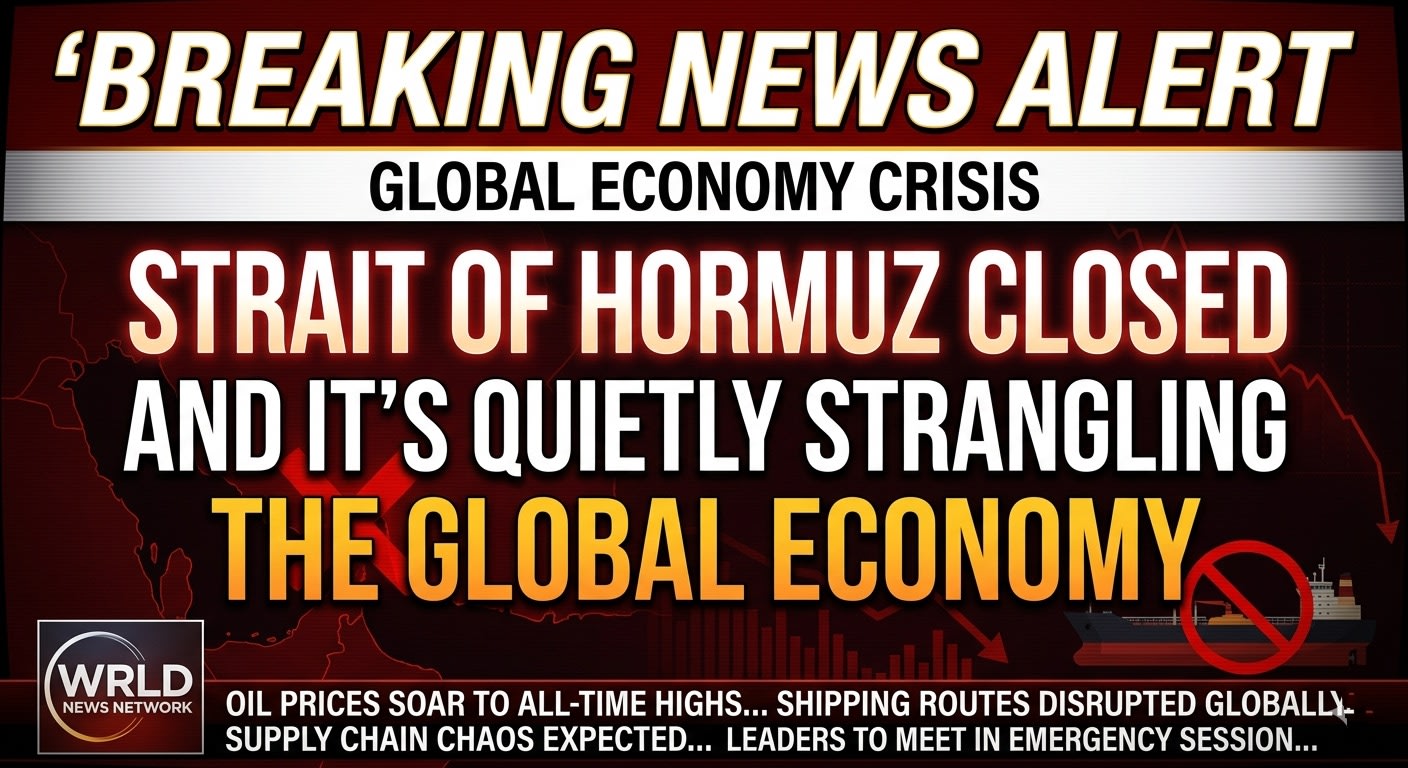
Most people could not locate the Strait of Hormuz on a map.
Yet this narrow stretch of water — barely 21 miles wide at its narrowest navigable point — has become the most economically consequential chokepoint on Earth. Since its effective closure on February 28, 2026, following the escalation between Iran, the United States, and Israel, the strait has quietly transformed into the pressure valve of the global economy.
And the effects are now spreading far beyond the Middle East.
While headlines focus on missile strikes, diplomatic threats, and military deployments, the deeper story is economic suffocation. The closure of Hormuz is not producing one dramatic global collapse overnight. Instead, it is causing something arguably more dangerous: slow, compounding instability that touches fuel prices, inflation, shipping costs, industrial production, and even food supply chains around the world.
The Waterway That Powers Modern Civilization
Before the crisis erupted, the Strait of Hormuz functioned as one of the most important arteries in global trade.
Roughly 20% of the world’s seaborne oil exports passed through it every month. Around one-fifth of global liquefied natural gas shipments also relied on the strait. Oil tankers from Saudi Arabia, the UAE, Kuwait, Iraq, and Qatar moved through those waters daily, carrying the fuel that powers economies from Europe to Asia.
Approximately 3,000 vessels transited the strait each month before the conflict intensified.
Today, traffic has collapsed to roughly 5% of normal levels.
That single statistic alone explains why energy markets remain on edge despite emergency interventions from governments and central banks.
The Global Price Shock
The consequences are now visible almost everywhere.
Fuel prices have surged across Europe and Asia. Electricity generation costs have climbed sharply in countries heavily dependent on imported energy, particularly Japan, South Korea, and India. Manufacturers are facing rising operating expenses, airlines are struggling with jet fuel costs, and shipping companies are recalculating entire trade routes.
The International Energy Agency and its member nations have already released approximately 400 million barrels from strategic petroleum reserves in an attempt to calm markets and prevent panic buying.
But reserve releases can only buy time.
They cannot fully replace the massive volume of oil and gas normally flowing through Hormuz every day. Traders know this. Investors know this. Energy companies know this.
And so prices remain volatile.
War-risk insurance premiums for vessels entering the region have exploded. For operators of very large crude carriers, insurance costs for a single voyage through the Gulf have increased by hundreds of thousands of dollars. Many commercial shipping firms simply no longer consider the route financially viable.
As a result, ships are avoiding the area entirely.
The world is now witnessing what happens when the most important energy chokepoint on Earth becomes economically radioactive.
Russia’s Quiet Windfall
One of the most politically explosive consequences of the crisis is who benefits from it.
While Western governments struggle to stabilize energy markets and defend shipping lanes, Russia has emerged as an indirect financial winner.
Despite years of sanctions and attempts to isolate Moscow economically, Russian oil exports continue moving through alternative routes outside the Gulf. Higher global energy prices have significantly boosted Russian revenues, strengthening the very state many Western governments spent years trying to economically weaken.
The irony is difficult to ignore.
A conflict partially justified by geopolitical security concerns is now enriching one of the West’s primary strategic rivals.
For critics of the intervention, this has become a symbol of unintended consequences in modern geopolitics: wars launched to contain instability often redistribute power in unpredictable ways.
The Humanitarian Crisis Hidden Behind Economics
Yet perhaps the most overlooked aspect of the Hormuz crisis is the human cost.
More than 300 commercial vessels remain stranded inside the Persian Gulf, unable to safely transit in either direction. Thousands of sailors — including large numbers of Indian, Filipino, Pakistani, and African crew members — have effectively become trapped at sea.
Many have spent weeks confined aboard ships waiting for diplomatic breakthroughs that never arrive.
These are not soldiers or politicians. They are ordinary workers caught inside a geopolitical confrontation far beyond their control.
Meanwhile, the United States has reportedly redirected dozens of commercial vessels and disabled several ships as part of its maritime pressure campaign against Iranian-controlled ports. Iran, in turn, has described its leverage over Hormuz as strategically equivalent to “an atomic bomb” — a tool powerful enough to force the world to negotiate on its terms.
A Standoff the World Cannot Ignore
Perhaps the clearest sign of how dangerous the situation has become is the reluctance of major powers to escalate further.
China, Japan, South Korea, and several NATO allies have declined to fully join the U.S.-led naval escort operation known as Operation Project Freedom. Their hesitation reflects a growing fear that direct military confrontation with Iran could ignite a wider regional war with catastrophic global economic consequences.
For now, the world remains trapped in a dangerous stalemate.
Every delayed tanker, every disrupted shipment, and every spike in oil prices adds more pressure to an already fragile global economy.
And until the Strait of Hormuz reopens at scale, that pressure will continue building — quietly, relentlessly, one shipment at a time.