
An IDF reservist was killed in a Hezbollah drone attack in northern Israel, the Israel Defense Forces said on Monday.
The slain soldier was named as Warrant Officer (res.) Alexander Glovanyov, 47, a driver in the Transport Center’s 6924th Battalion, from Petah Tikva.
The attack took place around 4 p.m. on Sunday, when several explosive-laden drones launched by Hezbollah struck in Israeli territory near Manara, close to the border with Lebanon. One of the drones killed Glovanyov, according to an IDF probe.
Defense Minister Israel Katz said that “Alexander served in the reserves out of a sense of true mission to defend the State of Israel and the residents of the north.”
“I embrace his family in their difficult time and ask to strengthen our heroic soldiers who continue their mission against the terrorist organization Hezbollah, Katz added.”
Get The Times of Israel’s Daily Edition
by email and never miss our top stories
By signing up, you agree to the terms
Petah Tikva mayor Rami Greenberg said that “we share in the family’s heavy grief and we will help with everything necessary.”

Smoke rising from southern Lebanon during an Israeli military operation, May 10, 2026. (Ayal Margolin/Flash90)
Glovanyov is the fifth soldier to be killed in southern Lebanon despite the ongoing ceasefire.
The terror group carried out several other drone attacks on Monday morning. The IDF said it attempted to intercept several Hezbollah drones over an area of southern Lebanon where troops were deployed.
There were no reports of any injuries.
Hours later, the IDF issued evacuation warnings for nine villages in southern Lebanon ahead of airstrikes targeting Hezbollah.
Residents of Rihan, Jarjouaa, Kfar Roummane, Nmairiyeh, Arab Salim, Jmaijmeh, Mashgharah, Qellaya, and Harouf were instructed to evacuate at least a kilometer away.
“In light of the Hezbollah terror organization’s violations of the ceasefire agreement, the IDF is forced to act against it with force and does not intend to harm you,” warned army spokesman Col. Avichay Adraee.
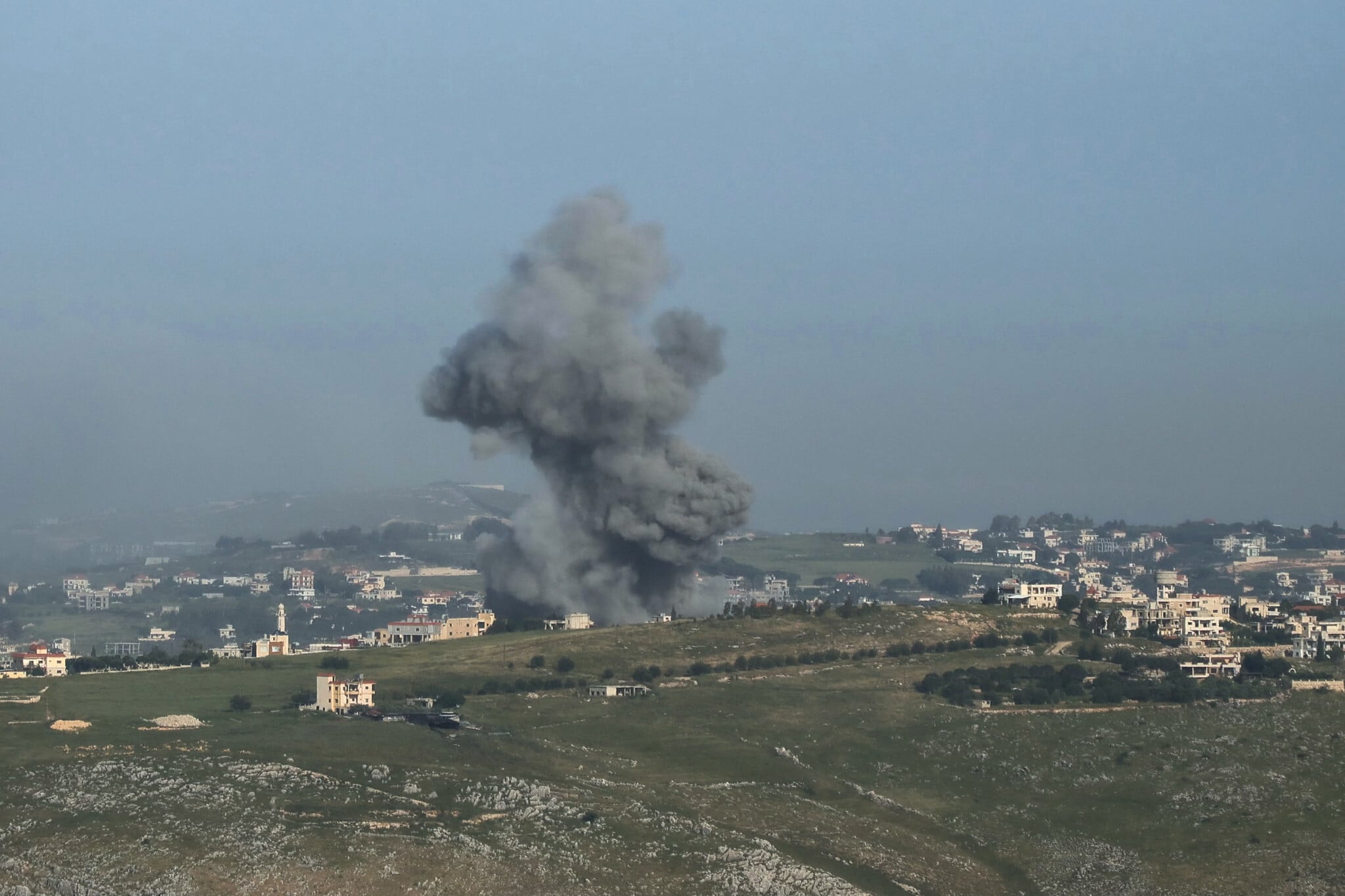
A photograph taken from the southern Lebanese area of Marjayoun shows smoke as it rises from the site of an Israeli airstrike that targeted the village of Kfar Tibnit on May 11, 2026. (Photo by AFP)
Meanwhile, the IDF said it was investigating an airstrike that targeted suspected Hezbollah operatives in the Nabatieh area of southern Lebanon on Saturday that killed civilians.
Lebanon’s health ministry reported that a Syrian man and his 12-year-old daughter were killed by Israeli drone strikes while riding a motorcycle in Nabatieh.
In response to a query by The Times of Israel, the IDF said that it had identified several suspects leaving a building known to be used by Hezbollah for military activity.
“To remove the threat, troops carried out precise strikes on the suspects near the building,” the military said.

Israeli military vehicles are seen along the Israeli border with Lebanon during an Israeli military operation, May 10, 2026. (Ayal Margolin/Flash90)
The IDF added it was aware of civilians harmed by the strike, adding that the incident is under further investigation.
Lebanese media reports at the time said that the drone repeatedly targeted the girl even after she fled the initial strike.
The US-mediated ceasefire between Israel and Hezbollah, which started on April 17, was extended on April 24 for an additional three weeks, US President Donald Trump announced at the time. His announcement came as Israeli and Lebanese diplomats met for US-brokered talks. Under the terms of the ceasefire, Israel can strike against immediate threats and in self-defense.
Last week, IDF Chief of Staff Lt. Gen. Eyal Zamir said during a visit to troops posted in southern Lebanon that there “is no ceasefire.”
Zamir’s comments came amid a reported push from Jerusalem to get the US to limit the historic direct talks with the Lebanese government to a two-week timeframe, and to sign off on a large-scale IDF campaign against Hezbollah if the talks fail.
Fighting erupted when Hezbollah began attacking across the border after Israel and the US launched their joint campaign against Iran on February 28 in a bid to destabilize the regime and destroy its nuclear and ballistic missile capacities. Israel launched massive airstrikes in Lebanon in response to the Hezbollah terror group’s rocket barrages.
Despite the ceasefire, Hezbollah has fired rockets and drones at northern Israeli communities, though most attacks have been on troops in southern Lebanon or on the Israeli side of the border.
Which gorgeous bird do you prefer?

THIS MONTH ONLY: Join our reader support group for as little as $6/month and receive an exclusive tote bag featuring one of Israel’s native birds.
Choose between the Duchifat (orange), Israel’s national bird, or the Shaldag (blue), a beloved symbol of the Israeli landscape.
As a member of the Times of Israel Community, you’ll also enjoy:
An ad-free experience of our site and podcasts.
Exclusive access to award-winning films via DocuNation.
Weekly letters from founding editor David Horovitz.
Join ToI Community & claim my bag
Already a member? Sign in to stop seeing this
You appreciate our wartime journalism

You clearly find our careful reporting of the Iran war valuable, at a time when facts are often distorted and news coverage often lacks context.
Your support is essential to continue our work. We want to continue delivering the professional journalism you value, even as the demands on our newsroom have grown dramatically during this ongoing conflict.
So today, please consider joining our reader support group, The Times of Israel Community. For as little as $6 a month you’ll become our partners while enjoying The Times of Israel AD-FREE, as well as accessing exclusive content available only to Times of Israel Community members.
Thank you,
David Horovitz, Founding Editor of The Times of Israel
Already a member? Sign in to stop seeing this