
Ukraine’s Ambassador to Israel questioned on Monday why Israel appeared uninterested in Kyiv’s help in tackling the growing threat of Hezbollah attack drones.
In an interview with the Ynet news site, Yevgen Korniychuk said Israel is missing an opportunity to learn from Ukraine’s expertise honed during years of war battling Iranian-made drones launched by Russia.
“We are fighting from a different angle against the same axis of evil,” Korniychuk said.
“Unfortunately, we do not see much interest or appetite from the Israeli leadership in this field. I do not want to speculate about the reasons for that,” he added.
Ukraine has become highly adept at drone warfare in recent years during its war with Russia’s invading forces, and has offered to provide help to Israel in combating the threat, though Jerusalem has resisted, looking to maintain its longstanding policy of walking a tightrope between Moscow and Kyiv.
Get The Times of Israel’s Daily Edition
by email and never miss our top stories
By signing up, you agree to the terms
“When meeting people from different parts of Israeli society, I often hear frustration over the fact that Israel is missing an opportunity to save more of its soldiers’ lives,” Korniychuk told the news outlet. “Most Israelis support Ukraine and do not understand why Ukrainians are able to deal with drones and Israel is not.”
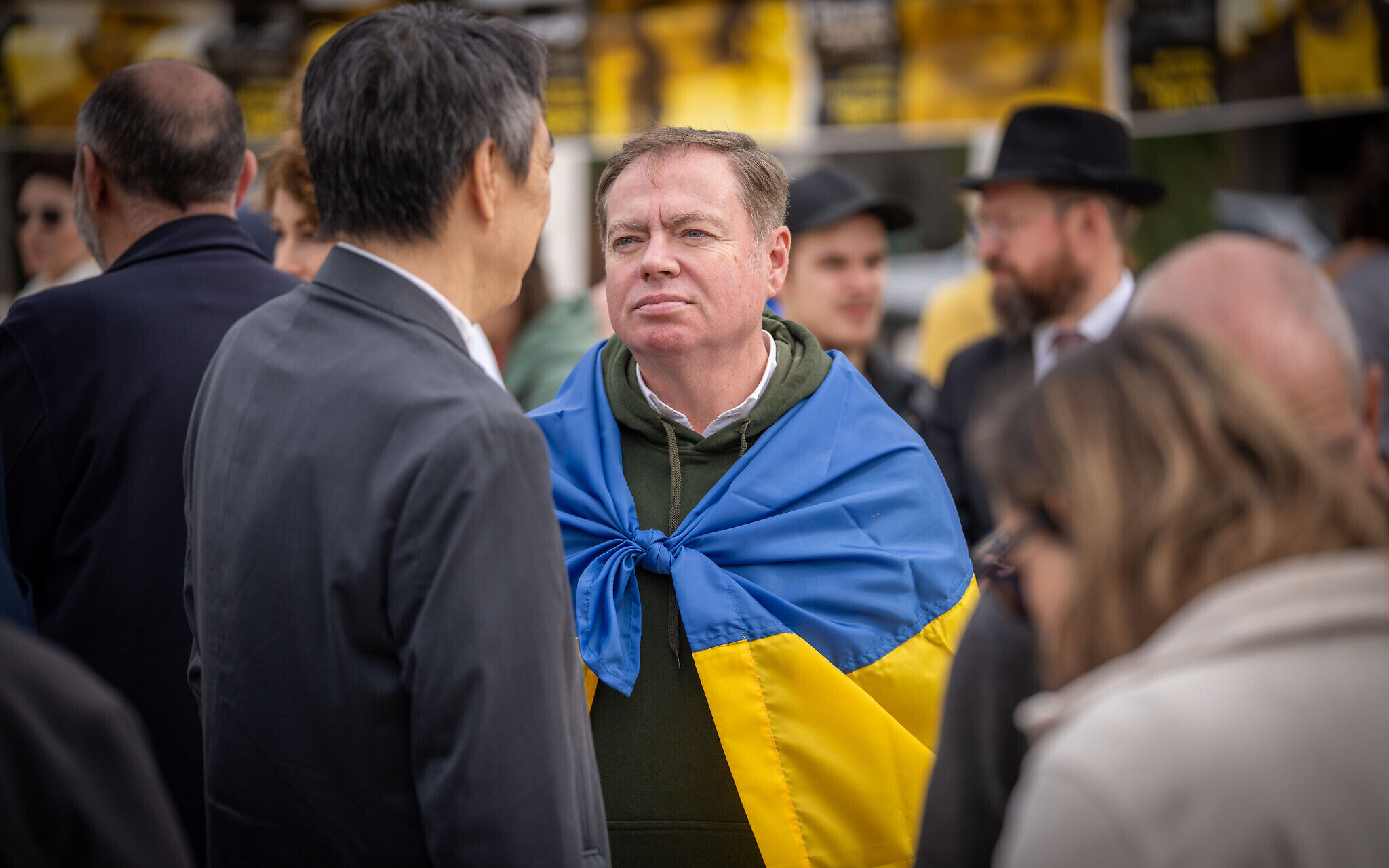
File: Ukraine’s Ambassador to Israel Yevgen Korniychuk attends a ceremony marking the two years anniversary of the Russian invasion of Ukraine, in Tel Aviv, on February 23, 2023. (Erik Marmor/Flash90)
According to Ukrainian President Volodymyr Zelensky, Kyiv has offered its expertise, arguing that his country’s fight against Russia and Israel’s fight against Iran and its proxies are linked, due to the tight military and political ties between Moscow and Tehran.
“I think Russia is supporting Iran directly, 100 percent,” he said in an interview in March. And yet, he said, “nobody asked me to help.”
Kyiv’s forces neutralize hundreds of the Iranian-designed drones launched by Russia every day, and as Iran started firing off drones across the Middle East in retaliation for the US-Israeli attacks, Zelensky quickly deployed more than 200 of his anti-drone experts to at least four states.
Zelensky himself paid high-profile visits to Saudi Arabia, the United Arab Emirates, Qatar, Jordan, and Syria — becoming one of the first foreign leaders to visit the region during the war.
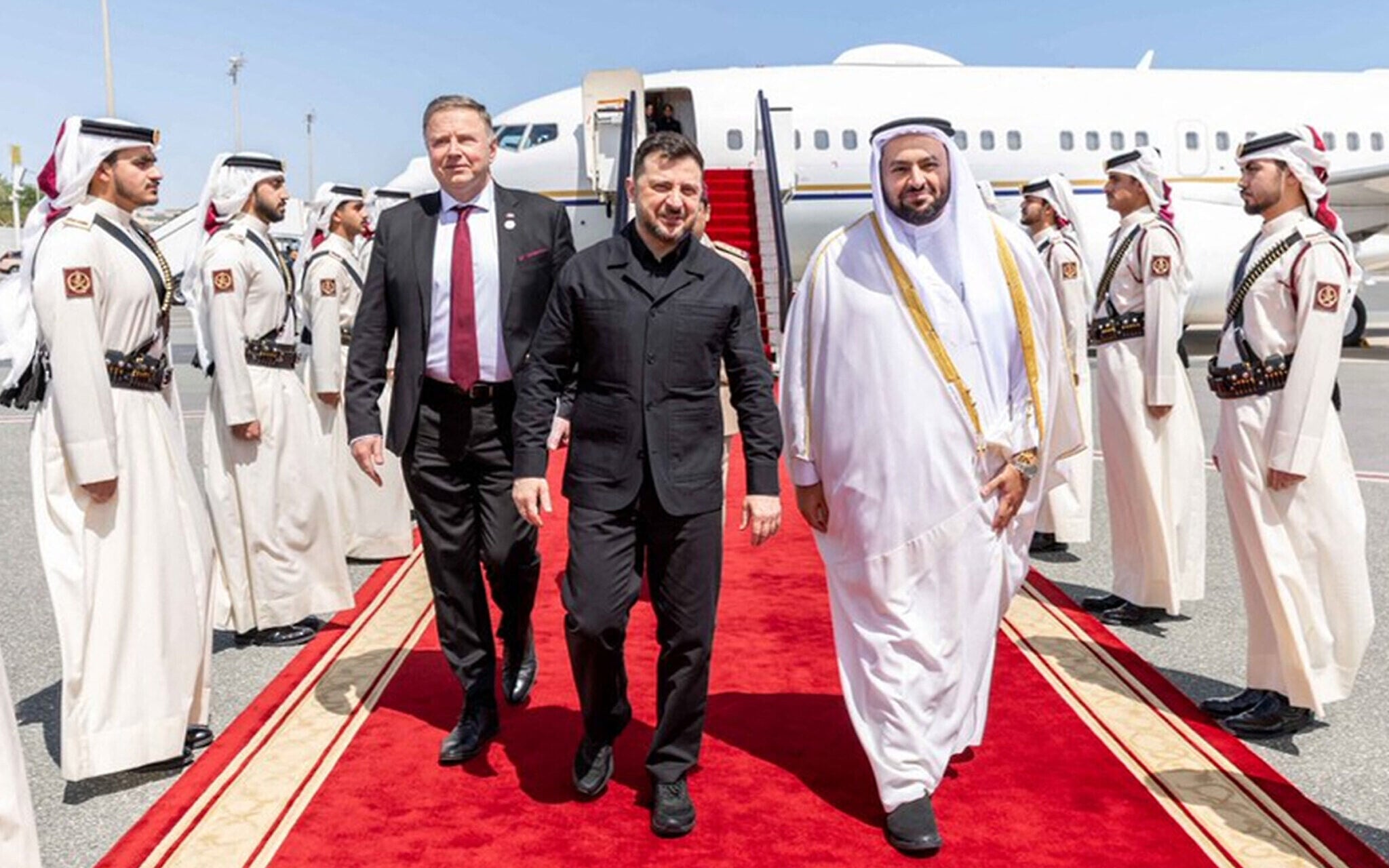
Ukraine’s President Volodymyr Zelensky, center, is received by Qatar’s Minister of State for Foreign Affairs Mohammed bin Abdulaziz bin Saleh al-Khulaifi, right, and Ukraine’s Ambassador to Qatar Andrii Kuzmenko upon arrival at Doha International Airport on March 28, 2026. (Qatar News Agency / AFP)
Meanwhile, Israel appears to still be looking internally to combat the growing threat of Hezbollah’s first-person view (FPV) drones, as they continue to be used to target troops several times a day.
IDF Chief of Staff Lt. Gen. Eyal Zamir convened a high-level discussion Sunday with defense and intelligence officials on the matter, with no complete operational solution to the threat having been found yet, Channel 12 reported on Monday.
According to the report, Zamir told representatives from the Defense Ministry, the Directorate of Defense Research and Development (MAFAT), the Military Intelligence Directorate, IDF Ground Forces Command, and other technological units that there were no budgetary limitations on efforts to find solutions.
In recent weeks, troops operating near the Lebanese border have come under near-daily attacks from Hezbollah’s explosive drones that have killed and wounded soldiers. On Sunday, IDF reservist Warrant Officer (res.) Alexander Glovanyov, 47, was killed in a Hezbollah drone attack in northern Israel.
The terror group has made frequent use of small first-person view (FPV) drones in its attacks on Israeli troops. Some of the drones are guided using a spool of fiber-optic cable, which makes them immune to efforts to electronically jam their signal.

IDF troops of the Golani Brigade operate in southern Lebanon, in a handout photo issued on April 27, 2026. (Israel Defense Forces)
Last week, the chief of the Ground Forces, Maj. Gen. Nadav Lotan, appointed a senior officer to be responsible for finding solutions for the drone threat troops are facing in southern Lebanon.
To counter the fiber-optic FPV drones, the IDF has deployed passive physical defenses in southern Lebanon, such as netting above troops, vehicles, and outposts. According to the military, these measures have proven effective when troops “maintain operational discipline.”
The IDF has also deployed mobile radars to southern Lebanon, which are adapted to identify drones flying at different ranges and alert forces, who can then attempt to shoot them down.
The military is examining and implementing several methods of shooting down the drones by ground troops, including shotguns at short ranges, special ammunition that disperses in the air, and automated turrets.
Emanuel Fabian and agencies contributed to this report.
Which gorgeous bird do you prefer?

THIS MONTH ONLY: Join our reader support group for as little as $6/month and receive an exclusive tote bag featuring one of Israel’s native birds.
Choose between the Duchifat (orange), Israel’s national bird, or the Shaldag (blue), a beloved symbol of the Israeli landscape.
As a member of the Times of Israel Community, you’ll also enjoy:
An ad-free experience of our site and podcasts.
Exclusive access to award-winning films via DocuNation.
Weekly letters from founding editor David Horovitz.
Join ToI Community & claim my bag
Already a member? Sign in to stop seeing this
You’re a dedicated reader

That’s why we started the Times of Israel – to provide discerning readers like you with must-read coverage of Israel and the Jewish world.
So now we have a request. Unlike other news outlets, we haven’t put up a paywall. But as the journalism we do is costly, we invite readers for whom The Times of Israel has become important to help support our work by joining The Times of Israel Community.
For as little as $6 a month you can help support our quality journalism while enjoying The Times of Israel AD-FREE, as well as accessing exclusive content available only to Times of Israel Community members.
Thank you,
David Horovitz, Founding Editor of The Times of Israel
Already a member? Sign in to stop seeing this