
Crude oil prices rallied hard this week as traders focused on the growing supply threat tied to the U.S.-Iran conflict. July WTI crude oil futures settled Thursday at $97.91, gaining $6.79, or 7.45%, for the week. Prices traded in a wide range between $92.84 and $99.09 as the market reacted to war headlines, tighter inventories, and inflation concerns. The biggest driver remained the shutdown of the Strait of Hormuz, a key shipping route for global crude exports.
Crude Oil News Today: Strait of Hormuz Shutdown Keeps Supply Fears Elevated
The war between the United States and Iran continued to dominate trading activity. Fighting that started in late February has now disrupted a major portion of global oil flows. The closure of the Strait of Hormuz has cut off access to roughly one-fifth of the world’s seaborne crude shipments, creating major stress across energy markets.
Early in the week, comments from U.S. officials suggesting the ceasefire situation remained unstable triggered fresh buying. Reports of tanker seizures and naval clashes added more fuel to the rally. Even though OPEC+ announced production increases in recent weeks, traders saw little immediate benefit because many barrels still cannot move efficiently through the Gulf region.
Shipping costs also climbed as suppliers rerouted cargoes around Africa to avoid conflict zones. Longer travel times tightened prompt supplies and kept buyers aggressive. That helped support the strong bullish tone…
Crude oil prices rallied hard this week as traders focused on the growing supply threat tied to the U.S.-Iran conflict. July WTI crude oil futures settled Thursday at $97.91, gaining $6.79, or 7.45%, for the week. Prices traded in a wide range between $92.84 and $99.09 as the market reacted to war headlines, tighter inventories, and inflation concerns. The biggest driver remained the shutdown of the Strait of Hormuz, a key shipping route for global crude exports.
Crude Oil News Today: Strait of Hormuz Shutdown Keeps Supply Fears Elevated
The war between the United States and Iran continued to dominate trading activity. Fighting that started in late February has now disrupted a major portion of global oil flows. The closure of the Strait of Hormuz has cut off access to roughly one-fifth of the world’s seaborne crude shipments, creating major stress across energy markets.
Early in the week, comments from U.S. officials suggesting the ceasefire situation remained unstable triggered fresh buying. Reports of tanker seizures and naval clashes added more fuel to the rally. Even though OPEC+ announced production increases in recent weeks, traders saw little immediate benefit because many barrels still cannot move efficiently through the Gulf region.
Shipping costs also climbed as suppliers rerouted cargoes around Africa to avoid conflict zones. Longer travel times tightened prompt supplies and kept buyers aggressive. That helped support the strong bullish tone across crude futures.
Oil Prices Forecast Supported by Strong Inventory Draws
The latest U.S. Energy Information Administration report added another bullish layer to the market. Commercial crude inventories posted a larger-than-expected decline, while storage levels at the Cushing, Oklahoma, delivery hub also dropped sharply.
Gasoline inventories moved lower as global buyers searched for non-Gulf fuel supplies. U.S. exports remained extremely strong, preventing domestic stockpiles from rebuilding despite healthy American production levels.
Refineries continued operating at elevated rates to meet seasonal fuel demand and rising export needs. Product supplies tightened further as summer driving demand increased.
The inventory data confirmed what traders were already seeing in the futures market: global supplies remain tight, and available spare capacity is limited while the conflict continues.
International Agencies Warn of Ongoing Supply Deficits
Both the International Energy Agency and OPEC released reports pointing to continued stress in oil balances through 2026. The IEA warned that global markets could face major supply deficits in the coming quarters if Gulf disruptions continue.
The agency also noted that inventories have already been falling for months. According to the report, current stock draws could accelerate if exports remain restricted.
OPEC lowered its global demand growth outlook slightly because high energy costs are starting to slow economic activity. Even so, member countries are still struggling to increase output enough to offset lost Gulf supplies.
These reports reinforced the idea that the oil market is operating with very little margin for error. Any additional disruption could quickly send prices higher.
China Demand and Federal Reserve Policy Stay in Focus
Demand concerns remained part of the conversation throughout the week. High fuel costs are beginning to slow consumption growth in transportation, manufacturing, and petrochemicals.
China stayed in focus after U.S. and Chinese officials held talks in Beijing during the week. Traders watched closely for signs that China could help reduce tensions or support efforts to stabilize shipping routes. While discussions appeared constructive, there were no major breakthroughs tied to reopening Gulf export lanes.
At the same time, rising oil prices continue to feed inflation concerns. Stronger inflation data increased expectations that the Federal Reserve may keep interest rates elevated longer than previously expected.
A stronger U.S. dollar created some pressure on commodities late in the week, but the physical supply shortage remained the dominant market force.
Weekly Light Crude Oil Futures
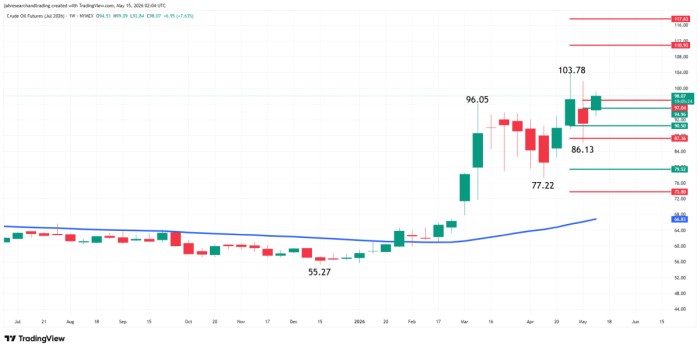
Trend Indicator Analysis
The main trend is up according to the weekly swing chart and moving average analysis. Despite the volatility the past two months, sellers have not been able to take out any significant bottoms, which is helping to keep the uptrend intact. A trade through $103.78 will signal a resumption of the uptrend. A sustained trade under $77.22 will shift momentum to the downside.
The 52-week moving average is $66.84 and the nearest main bottom is at $55.27. Since these levels are not likely to be taken out over the near-term, the market will remain in “buy the dip” mode until the trend changes to down.
The short-term range is $103.78 to $86.13. The market is currently straddling its retracement zone at $94.96 to $97.04.
The intermediate range is $77.22 to $103.78. Its retracement zone at $90.50 to $87.36 was tested successfully last week on the plunge to $86.13. Buyers quickly regained it following the move and re-established support, while reaffirming the “buy the dip” strategy.
The long-term range is $55.27 to $103.78. Its retracement zone at $79.52 to $73.80 is the last major support area before the 52-week moving average at $66.94. Inside this zone is the last main bottom at $77.22. This area will be very attractive to buyers if ever tested.
The potential support areas look more structured than the tops, which suggests a floor is forming that could provide support even after the war ends. The previous tops were all formed by speculative spikes that were gone in a flash. This suggests that trying to pick an eventual top will be a difficult task.
Weekly Technical Forecast
The direction of the Weekly July Crude Oil futures contract for the week ending May 22 is likely to be determined by trader reaction to $97.04 to $94.96.
Bullish Scenario
A sustained move above $97.04 will signal the presence of buyers. This move could create the upside momentum needed to break out over $103.78, with $110.93 the next objective.
Bearish Scenario
A sustained move under the pivot at $94.96 will indicate the presence of sellers. This could create the downside pressure needed to retest the retracement zone at $90.50 to $87.36. If the selling is strong enough to take out the minor swing bottom at $86.13, then look for the weakness to extend into $79.52 to $73.80.
Oil Prices Projections Point to Continued Volatility
The oil market enters next week carrying a heavy geopolitical risk premium. As long as the Strait of Hormuz remains restricted, traders are likely to keep pricing in tight supplies and possible shortages.
A major diplomatic breakthrough could trigger a fast selloff if normal shipping routes reopen. However, continued fighting would likely keep inventories falling and support higher crude prices.
U.S. production helps soften some of the damage, but it cannot fully replace missing Gulf exports in the near term. Global stockpiles are already tightening, leaving the market vulnerable to additional shocks.
The current trend still favors the bulls. Supply disruptions, falling inventories, and limited spare production continue to outweigh weaker demand signals and macroeconomic pressure. Unless tensions ease significantly, oil price forecast models will likely remain supportive of elevated crude prices and continued volatility across energy markets.
Technically, a sustained move over $97.04 targets $103.78, then $110.93. A sustained move under $94.96 could revisit $90.50 to $87.36.
If prices collapse through $86.13, then wait for a move to $79.52 to $73.80 before considering a long position again. Even with a war settlement, I believe issues in the area will keep traders in buy-the-dip mode, although the trading range will widen.