
China has moved to protect its supply of the world’s most used industrial chemical, with ramifications for everything from food production to fashion and mobile phones.
Sulphuric acid is a crucial ingredient in the manufacture of batteries, clothing and phosphate fertilisers, and is also used to treat drinking water, purify petroleum, and produce some metals and computer chips.
China is a key exporter, but it relies on imported sulphur — itself a by-product of oil refining and smelting — to make it.
In 2025, about half of the global sulphur supply came from the Middle East.
With trade disrupted, Beijing has banned exports of sulphuric acid to shore up its domestic supply.
It means Australian manufacturers are facing a difficult choice: either stock up on the highly corrosive and combustible chemical or go without their key ingredient.
The key ingredient’s key ingredient
In Geelong in south-western Victoria, textile manufacturer LoomTex is trying to keep its heritage of weaving, dying and milling alive through sustainable fabrics.
Chief executive Samantha Van Zyl said sulphuric acid was one of several chemicals relied on in research and development.

Samantha Van Zyl says sulphuric acid is a necessary ingredient in making textiles. (Supplied: Loomtex)
“It’s critical as an auxiliary step in the lab … for fibre innovation,” she said.
The supply disruption puts the company in a difficult position.
Ms Van Zyl said they were left with the choice to either order more sulphuric acid than normal, which puts them above the threshold for storing dangerous goods, or not have enough supply.
“Increasing to the dangerous goods limit actually means that we’re changing the shape of our business,” she said.
“We’d have to bring in WorkSafe Victoria; the fire hazards and safety risks on site as a chemical risk profile completely change.
“It’s not something that can be done overnight.”

Samantha Van Zyl says LoomTex is struggling to source three types of acid, including sulphuric. (Supplied: Kate Ballis)
Ms Van Zyl said that without the acids, production would suffer, and she could lose customers to overseas manufacturers.
“That’s a vulnerability and a risk I don’t think that we would look to take at this point in time,” she said.

LoomTex relies on multiple types of acid in its production process. (Supplied: Stu Ross/Milk Video)
Sulphuric acid is made in two ways: either by using sulphur or as a by-product of metal smelting.
Head of sulphur and sulphuric acid research at Argus Consulting Services, Meena Chauhan, said the acid was produced worldwide, but China was the lead exporter.
“Last year, they exported close to 5 million tonnes for the first time,” she said.
“It’s a substantial volume in that global trade flow.”
China relies on importing sulphur, a by-product from oil refining and gas processing, to make sulphuric acid.
In 2025, about 73 million tonnes of sulphur were produced globally.
“We estimated that Middle Eastern trade represented about 50 per cent of global trade flows,” Ms Chauhan said.
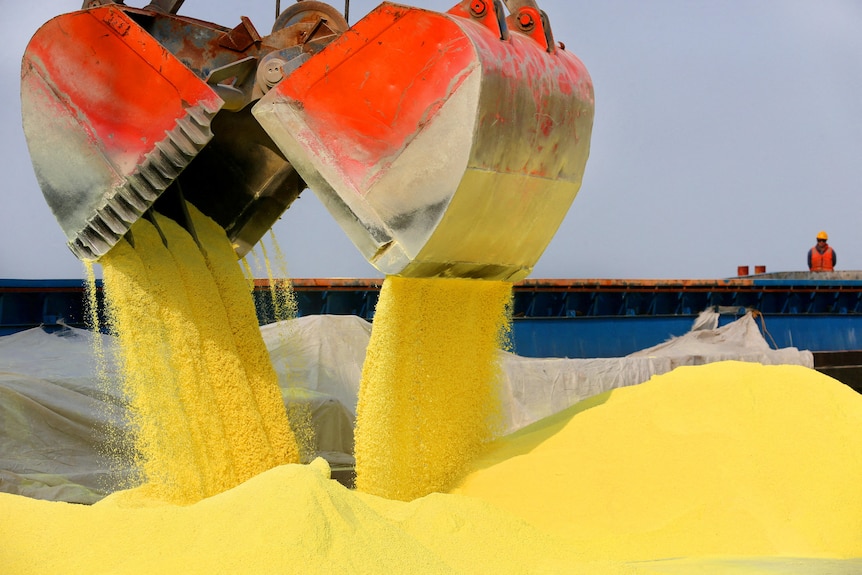
The Middle East represents more than half of the global sulphur trade. (Reuters)
She said the effect of the Iran war on supply was twofold: the closed Strait of Hormuz stopped vessels carrying it, and damage was caused to refineries and processors in the region that produced it.
“Some sites are being taken offline because of damage; in other cases because of precautionary measures,” she said.
She said China’s ban on exporting sulphuric acid, which came into effect on May 1, was an attempt to protect their “downstream industries” from disruption.
Attention is turning to other sulphur-exporting countries like Canada for an alternative supply, but Ms Chauhan said there were issues with logistics and volume.
Australia produces some sulphuric acid for its domestic market from metal smelting in Queensland, but not at the grade Ms Van Zyl’s textile lab requires.
But local supplies may help the leading end user of both sulphur and sulphuric acid — the fertiliser industry.
Building block of food security
North West Phosphate mines phosphate rock and concentrate in Queensland, which is used by fertiliser manufacturers throughout South-East Asia.
Chairman John Cotter said sulphuric acid was a critical element for his customers.

John Cotter says changes in the fertiliser trade might affect his business. (ABC North West Qld: Emily Dobson)
“Most of those producers use sulphur mixed with water to create sulphuric acid mixed in with phosphate rock,” he said.
“That gives you the basic ingredients for all of the fertiliser blends that you find in the shops.”
So far, his business had not been impacted, but Mr Cotter expected it to happen soon.
“For suppliers like us, we’re worried that if [customers] can’t get the other basic ingredient to manufacture, then we might have to divert to other markets,” he said.
“These are the sort of structural changes in the trading market of commodities globally that we’re seeing as a result of the conflict.”
Ms Chauhan said Mr Cotter’s fears were warranted.
Versatility and variability
Sulphuric acid did not become the world’s most widely used industrial chemical based on its versatility alone.
As the by-product of a by-product, historically, it has also been pretty cheap.
But with demand for both chemicals also coming from the metal industry, which can absorb higher prices, Ms Chauhan said fertiliser production could not compete.
“In some markets, South Africa, we’ve seen [reduced production],” she said.
“We’ve seen in North Africa as well, a key fertiliser producer announcing that they’re going to have a reduction in their output of fertilisers.”
Once the Strait of Hormuz is reopened, Ms Chauhan said shipments of oil and gas would likely be prioritised over sulphur, potentially dragging out shortages for years.
Additionally, she said sulphur producers had reported it could be years before damaged facilities were back to pre-war capacity.
Before the war, the oil and gas industry had been expanding in the Middle East, which would also have increased production, but Ms Chauhan said those projects were also now on hold.
“The war is impacting revenues, impacting the timelines for these projects that will now likely end up with delays through until next year, potentially even beyond next year,” she said.
Back in the Geelong textile warehouse, Samantha Van Zyl is carrying on, despite the odds.
“It is a bit stacked up [against you],” she said.
“But you just wake up, put a smile on your face and pull up your sleeves and get into it,” she said.
“It’s all we can do, really.”

LoomTex uses sulphuric acid in its dye process. (Supplied: Stu Ross/Milk Video)