
For the past two and a half years, rarely a day has gone by that Bashar Eid has not feared that settler violence would claim his life or his property in Burin, a Palestinian village near Nablus in the northern West Bank.
In November, Eid was wounded in the neck and hospitalized after coming under attack from extremist settlers as he tended his olive grove outside the town.
More recently, two settlers attempted to set his property on fire. He suffered severe burns across his body, rendering him physically unable to work and incapable of providing financially for his wife and three daughters.
“I sit at home all day, I don’t work… I don’t know what to do… My home is a prison,” he told The Times of Israel. “My oldest daughter is in university… How will I provide her the money [for her studies]?”
Eid’s story reflects a broader reality facing many Palestinians across the West Bank, where things seem bleaker than they have in decades.
Get The Times of Israel’s Daily Edition
by email and never miss our top stories
By signing up, you agree to the terms
But despite being pushed into a corner by rising settler violence, an expanded Israeli military presence, worsening economic conditions, and the absence of a viable political horizon, Palestinians have not lashed out in a way many had predicted a despairing population would.
For decades, Israeli policymakers have been guided by the idea that Palestinians would turn to violence if deprived of hopes for a brighter future. Yet, violent incidents targeting Israelis in the West Bank have fallen off by over 80 percent in the last five years, even as attacks on Palestinians have more than doubled.
But as conditions turn more and more dire, Israeli officials, analysts and Palestinian voices alike warn the current situation may not last.
Central Command chief Maj. Gen. Avi Bluth recently warned that rising settler violence in the West Bank, which he called “Jewish terrorism,” could spark a Palestinian uprising.
“It’s quite a miracle the Palestinian public is still indifferent… but it won’t remain indifferent forever,” he reportedly said.
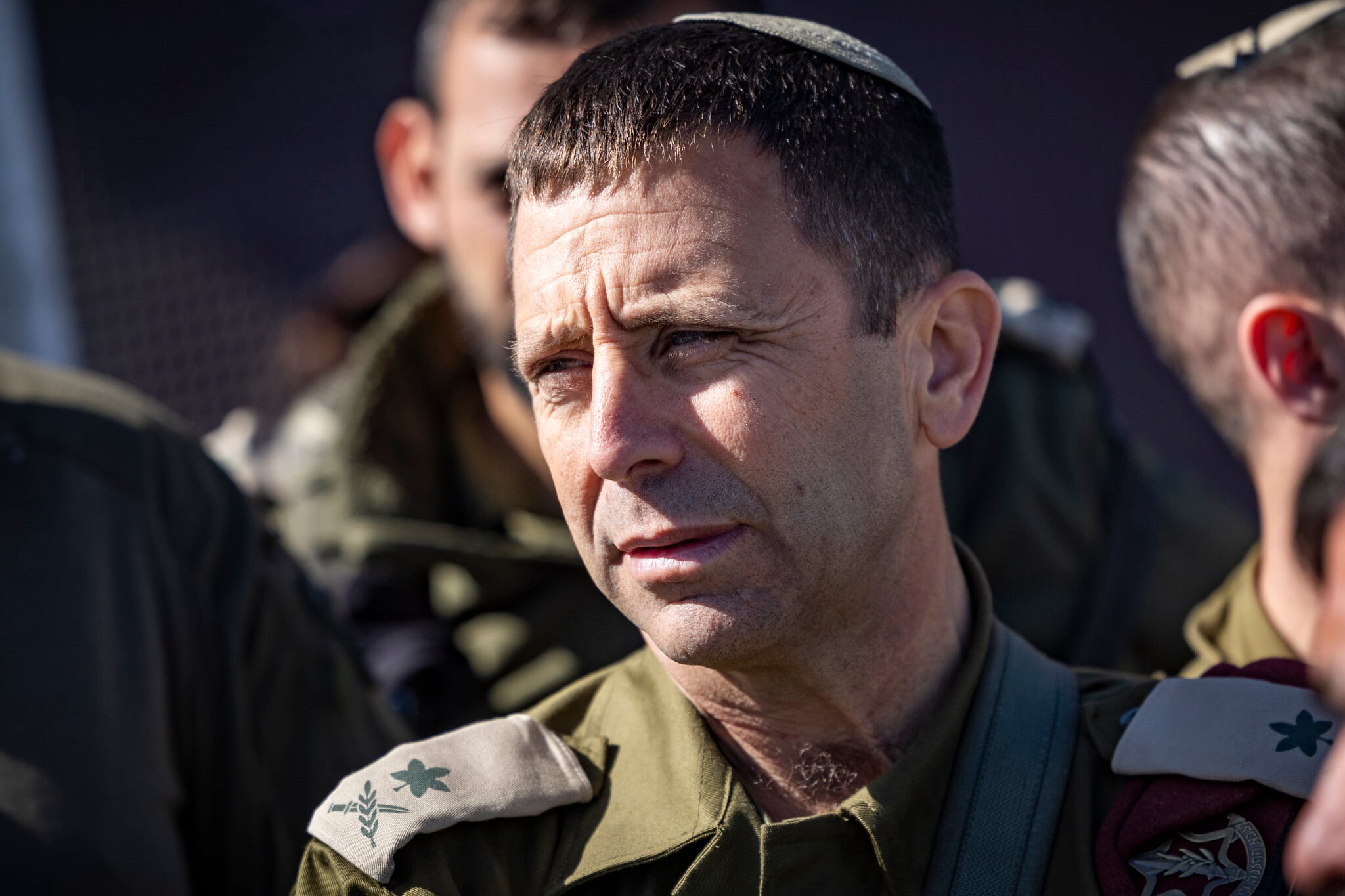
IDF Central Command chief Maj. Gen. Avi Bluth watches as Palestinians pass through the Qalandia checkpoint on their way to attend Ramadan prayers at Jerusalem’s Al-Aqsa Mosque, February 20, 2026. (Chaim Goldberg/ Flash90)
Similarly, Hani Odeh, former mayor of the West Bank village of Qusra, which has come under repeated attack, recently told The Times of Israel that sustained settler violence would ultimately lead to a violent backlash.
“In the end, there will be an explosion,” he said. “It’s not reasonable to attack residents day after day. You can’t bear it.”
Settler attacks reach new heights
Eid’s 20-dunam (five-acre) grove sits some 300 meters (980 feet) away from the illegal Israeli outpost of Givat Ronen, which was built a decade ago on a hilltop overlooking his property.
But according to Eid, it was after Hamas’s October 7, 2023, onslaught, which triggered a stifling intensification of security restrictions in the West Bank, that settler violence began reaching unprecedented levels.
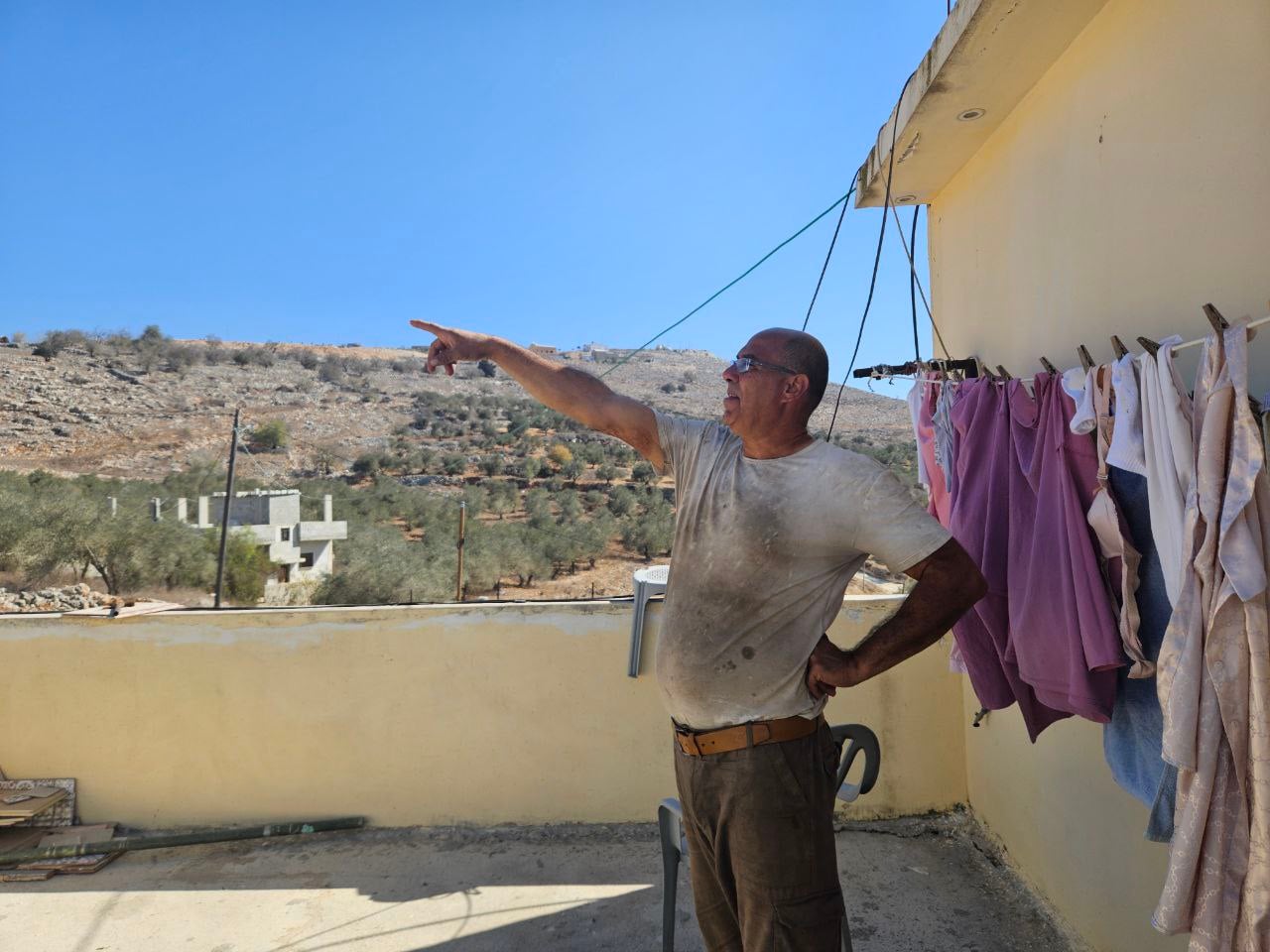
Bashar Eid on the roof of his home in the village of Burin near Nablus in the West Bank on October 30, 2025 (Nurit Yohanan/Times of Israel).
Data released earlier this year from the Israel Defense Forces and Shin Bet shows that settler attacks rose by 27% in 2025 compared to the previous year, though they still fell below 2023 levels. Severe incidents of “nationalistic crime” — classified by Israeli security bodies as terrorism — jumped by more than 50% over 2024.
Findings by the United Nations Office for the Coordination of Humanitarian Affairs showed a similar trend, with cases of “attacks by Israeli settlers against Palestinians that resulted in casualties and/or property damage” having sharply increased in recent years. In 2025, OCHA recorded 1,828 such incidents, compared to 1,449 in 2024, 1,291 in 2023 and 852 in 2022.
While OCHA’s figures do not fully align with those published by the IDF and Shin Bet — likely due to differing criteria and methodologies used to classify incidents — both datasets point to settler violence being a constant pressure on West Bank Palestinians.
The Yesh Din organization, which opposes the settlement movement and monitors settler violence, reported that during the recent 40 days of hostilities with Iran alone, there were 378 incidents of extremist settler violence against Palestinians and their property in the West Bank, with eight Palestinians killed and 200 injured.
The attacks, which occur on a daily basis, largely go unchecked, fueling a sense of impunity among settler extremists. Critics blame the government, which includes far-right politicians who back settlement expansion and appear to have little desire to rein in the violence.
Settlers attack Burin resident and olive farmer Bashar Eid, alongside volunteer workers on his farm, hitting them with rods, throwing stones and setting a vehicle on fire, August 2025. (Courtesy)
Palestinians have not responded in kind. Palestinian terror attacks — including shootings, stabbings and car-rammings — have seen a downward trend in recent years, with no major attacks reported so far in 2026.
The military attributes the decline to “sustained offensive activity” in areas considered to be hotspots of terrorism in the West Bank, especially the refugee camps in the north of the territory, where the army has remained deployed since the beginning of 2025 and, as of now, has no plans to leave.
“We’ve killed 1,500 terrorists in three years. So how come there is no intifada?… Because 96% of the 1,500 killed [in the West Bank] were involved in terrorism, only 4% were not,” Bluth reportedly said in a recent closed forum.
But his comments belie the fact that previous rounds of sustained Palestinian violence — the two intifadas and a wave of stabbings and car-rammings a decade ago — while punctuated by high-profile bombings and shootings, were characterized by widespread grassroots attacks like stone-throwings and unplanned knifings, which such IDF raids would have little direct effect in stymying.
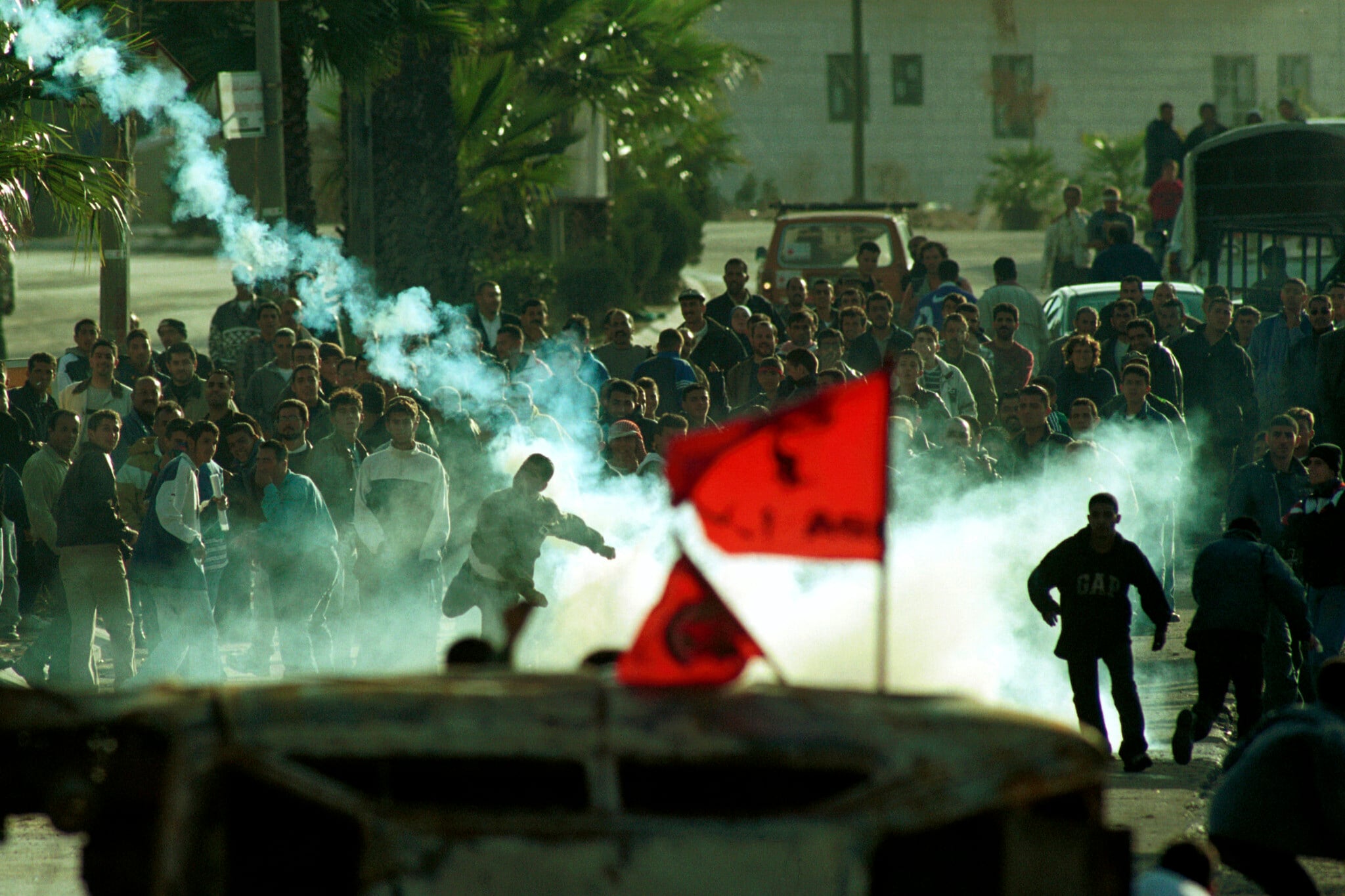
Palestinians shoot tear gas at the Israeli army in Ramallah, as they clash during the first days of the Second Intifada, October 24, 2000. (Nati Shohat/Flash90)
Yet these are down sharply as well. In 2025, the army recorded 1,015 stone-throwing and Molotov cocktail attacks by Palestinians, compared to 1,230 the year prior and 3,256 in 2023. In 2021, 8,633 such attacks were reported.
According to Daniel Byman, director of the Warfare, Irregular Threats, and Terrorism Program at the Center for Strategic and International Studies, today there are heightened security measures that were absent in the past.
“The main explanation… is the very effective and aggressive Israeli intelligence, police and military effort to prevent [terror attacks],” he told The Times of Israel, while also stressing that “we’ve been hearing the Third Intifada warning for many years.”
According to Byman, any near-term escalation will take the form of “isolated attacks on a semi-regular basis,” rather than a coordinated revolt.
Palestinian pragmatism helps hold unrest at bay
Palestinian political activist and Jerusalem native Samer Sinijlawi said that one major component in containing unrest — whether organized or spontaneous — is a growing sense of pragmatism among Palestinians.
Sinijlawi pointed to relatively strong turnout in recent Palestinian local elections — around 56% according to CEC Chairman Rami Hamdallah — despite calls by Hamas and other terror groups for a boycott, as evidence of a more moderate trend.
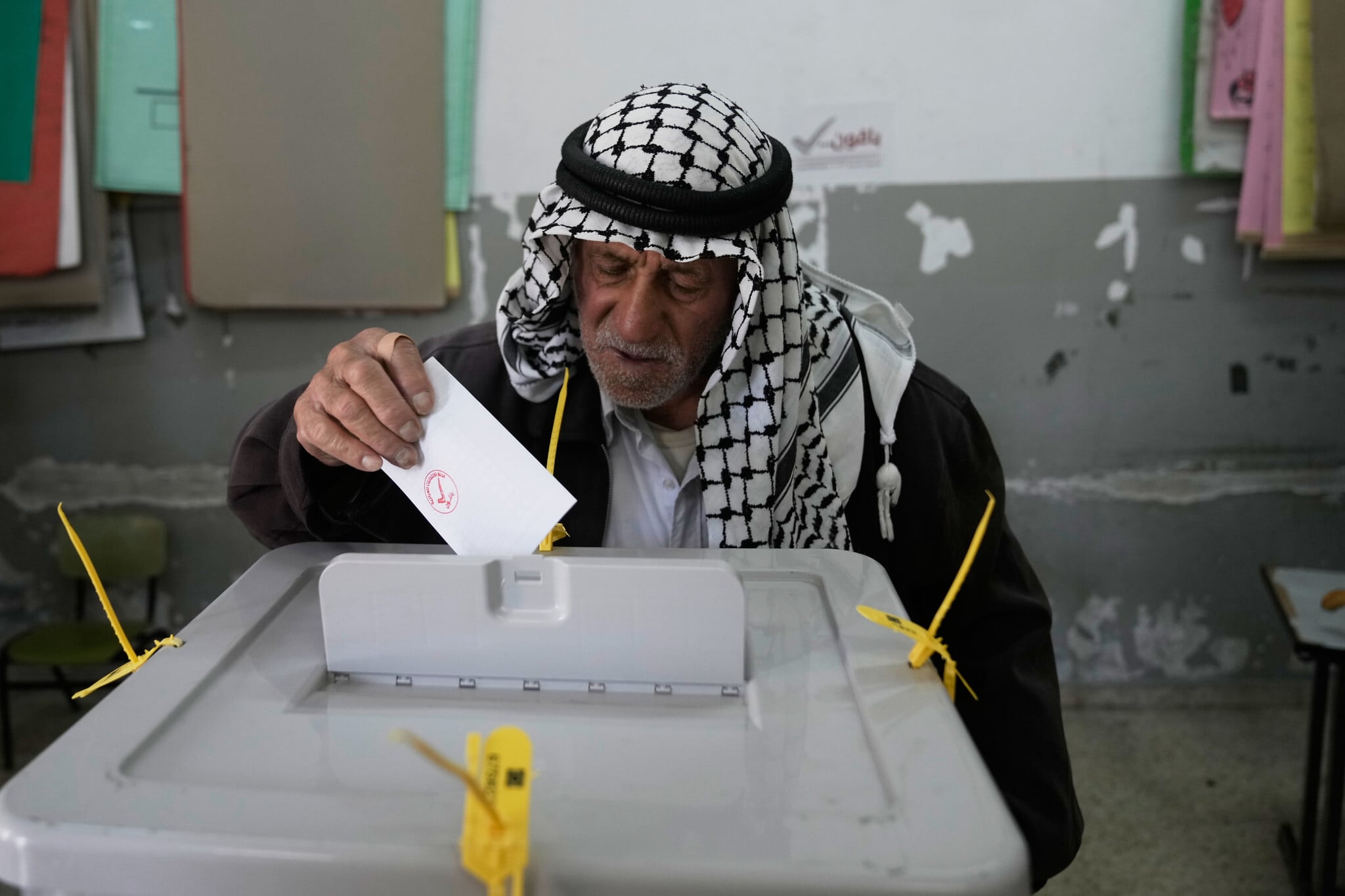
A Palestinian man votes in local elections in the West Bank village of Beit Furik, April 25, 2026. (AP/Majdi Mohammad)
“The new political current now is more moderate, more pragmatic, more nonviolent,” he said. “But we shouldn’t keep testing this.”
A 2025 survey by the Institute for National Security Studies found that 43% of Palestinians in the West Bank favor negotiations as the preferred path forward to resolve the Israeli-Palestinian conflict, while 25% support nonviolent resistance and 17% back armed struggle. Half of respondents said armed resistance had failed.
A key factor appears to be fear: 75% of respondents said they worry about the “Gazafication” of the West Bank, or a scenario in which the territory would face the kind of widespread destruction, mass displacement, and prolonged military operations seen in the Gaza Strip in response to the October 7 Hamas-led attacks.
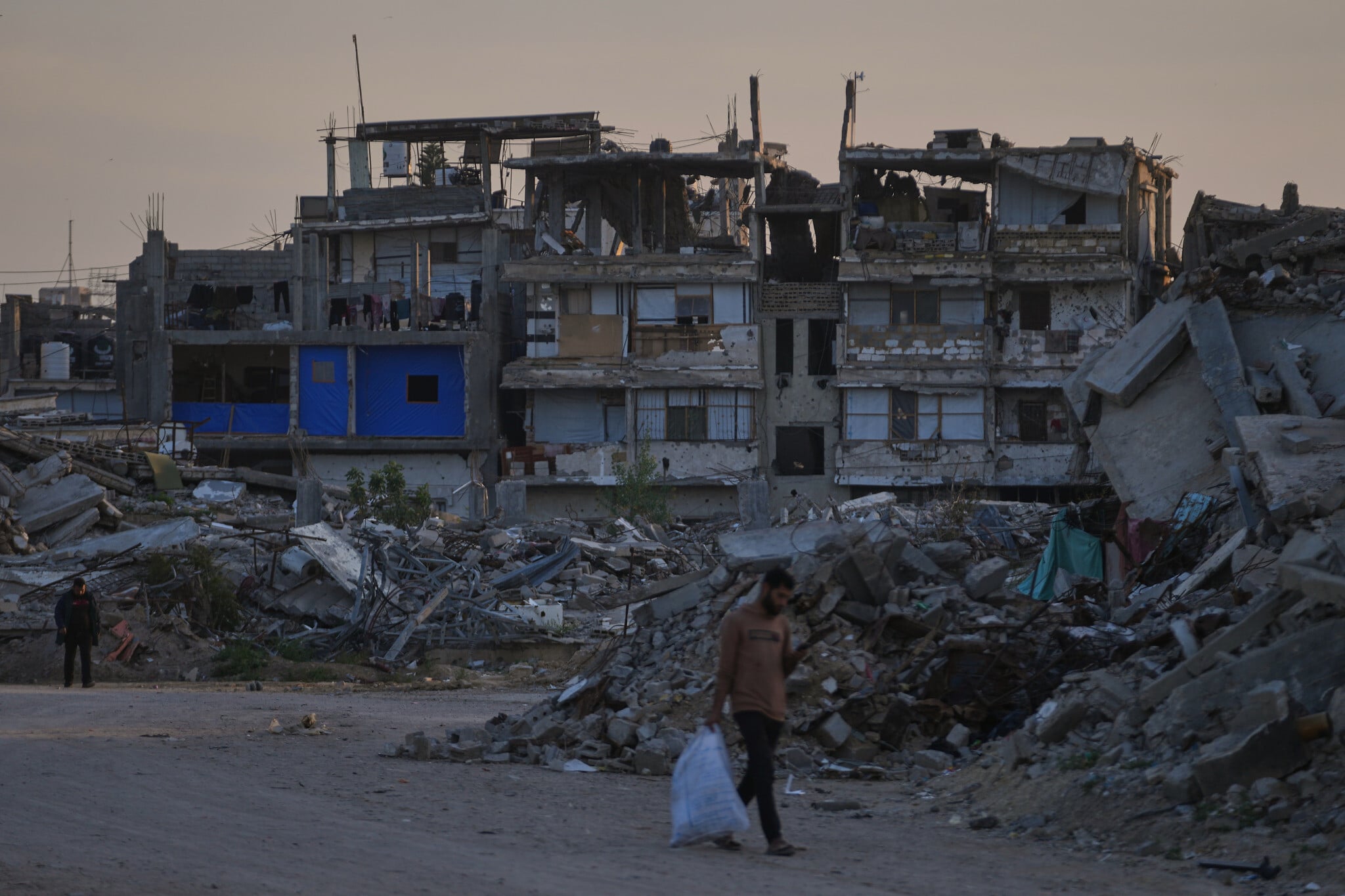
Palestinians walk along a street surrounded by buildings destroyed during Israeli air and ground operations in Khan Younis, southern Gaza Strip, on April 9, 2026. (AP Photo/Abdel Kareem Hana)
At the same time, nearly half of those polled expressed support for continuing armed struggle “for a future victory,” underscoring a tension between pragmatism and frustration.
For Sinijlawi, that balance is precarious.
“You will never expect when the explosion will come,” he warned.
According to Odeh, some Palestinians are holding out hope that upcoming Israeli elections could bring political change and a willingness to crack down on settler violence and re-engage with the peace process — but warned that if current policies continue, frustration could boil over.
“They don’t want peace,” Eid said about the current government.

Samaria Regional Council Chairman Yossi Dagan (center), Defense Minister Israel Katz, Finance Minister Bezalel Smotrich (second on Dagan’s right) and numerous other cabinet ministers, MKs and other dignitaries cut a ribbon to celebrate the reestablishment of the Sa-Nur settlement, April 19, 2026. (Roi Hadi)
In recent years, Prime Minister Benjamin Netanyahu’s government has consistently pushed policies promoting settlement expansion and Israeli control in the West Bank, while he has largely ignored the subject of peace talks with the Palestinians for over a decade.
In February, Defense Minister Israel Katz and far-right Finance Minister Bezalel Smotrich announced a series of security cabinet decisions to “dramatically” change land registration and property acquisition procedures in the West Bank, easing Jewish settlement in the territory.
Smotrich said at the time that the goal of the new measures was, in part, to “kill the idea of a Palestinian state.”
Hamas responded to the move by calling for a “rebellion across the West Bank and Jerusalem” and the “escalation” of the conflict “by all available means,” though such an escalation has yet to materialize.
The international community condemned the move, with 18 countries saying it was “part of a clear trajectory that aims to change the reality on the ground” and that such actions are “a deliberate and direct attack on the viability of the Palestinian state and the implementation of the two-state solution.”
Further compounding frustrations is a deepening economic crisis across the West Bank.
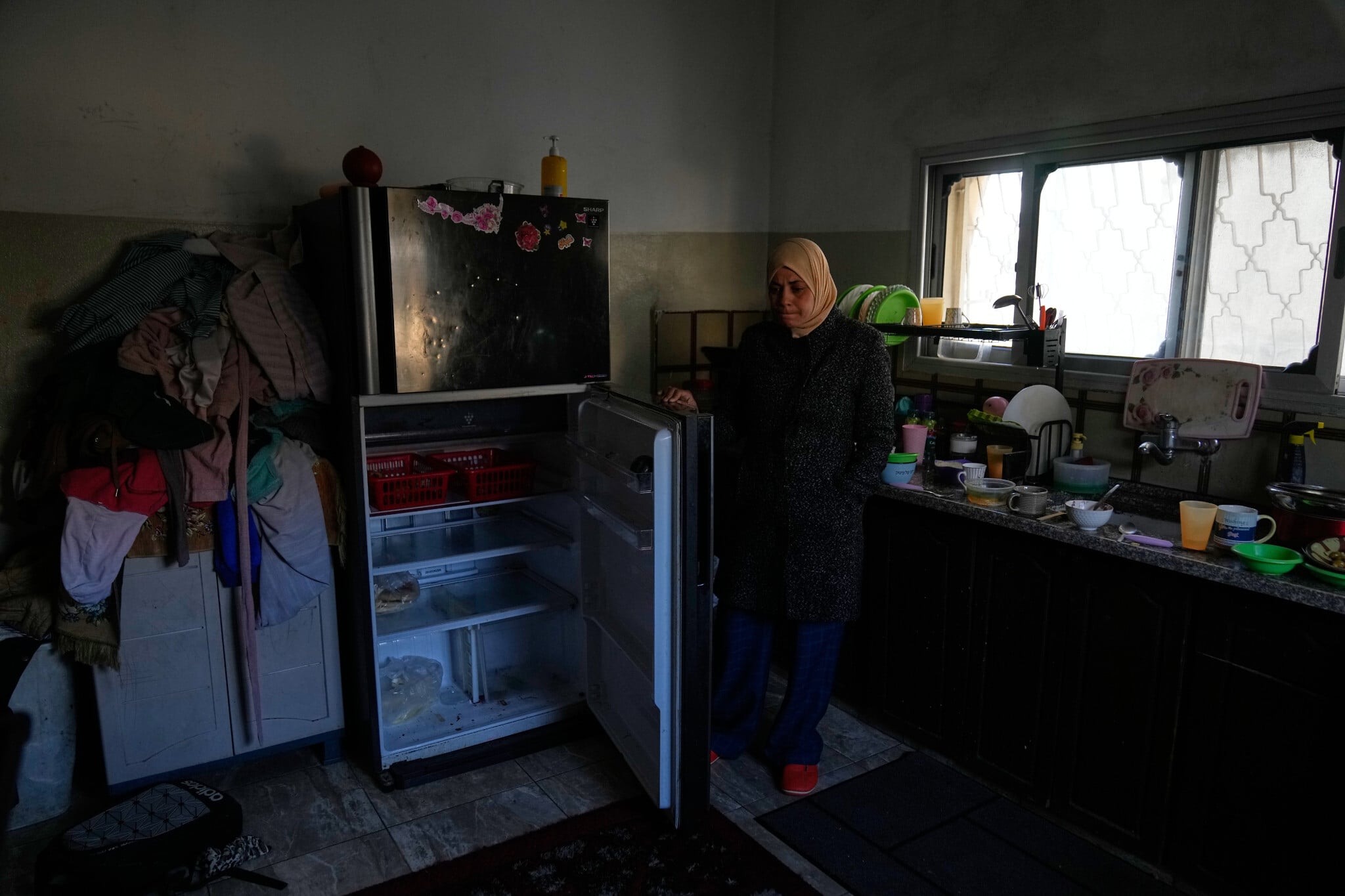
Palestinian laborer Shuhrat Barghouthi shows her empty fridge, saying that she struggles to buy food after Israel revoked work permits for Palestinians in the West Bank city of Tulkarem, January 18, 2026. (AP Photo/Nasser Nasser)
The World Bank has warned that the territory’s economy is at risk of collapse because of Israel’s restrictions on Palestinian work permits. By the end of last year, unemployment had surged to nearly 30% compared with around 12% before the war, according to the Palestinian Central Bureau of Statistics.
Since October 7, some 100,000 Palestinians have had their Israeli work permits revoked. Confined to the Israeli-controlled West Bank, where jobs are scarce and wages far lower than in Israel, they face dwindling and dangerous options as the economic crisis deepens.
“There’s no work,” Eid said bluntly.
The cumulative effect of those policies, combined with the ongoing war, has further eroded faith among many Palestinians in the possibility of a negotiated resolution.
Compared to Palestinians in Gaza, West Bank residents have grown increasingly pessimistic about the prospects for a two-state solution and long-term peace with Israel.
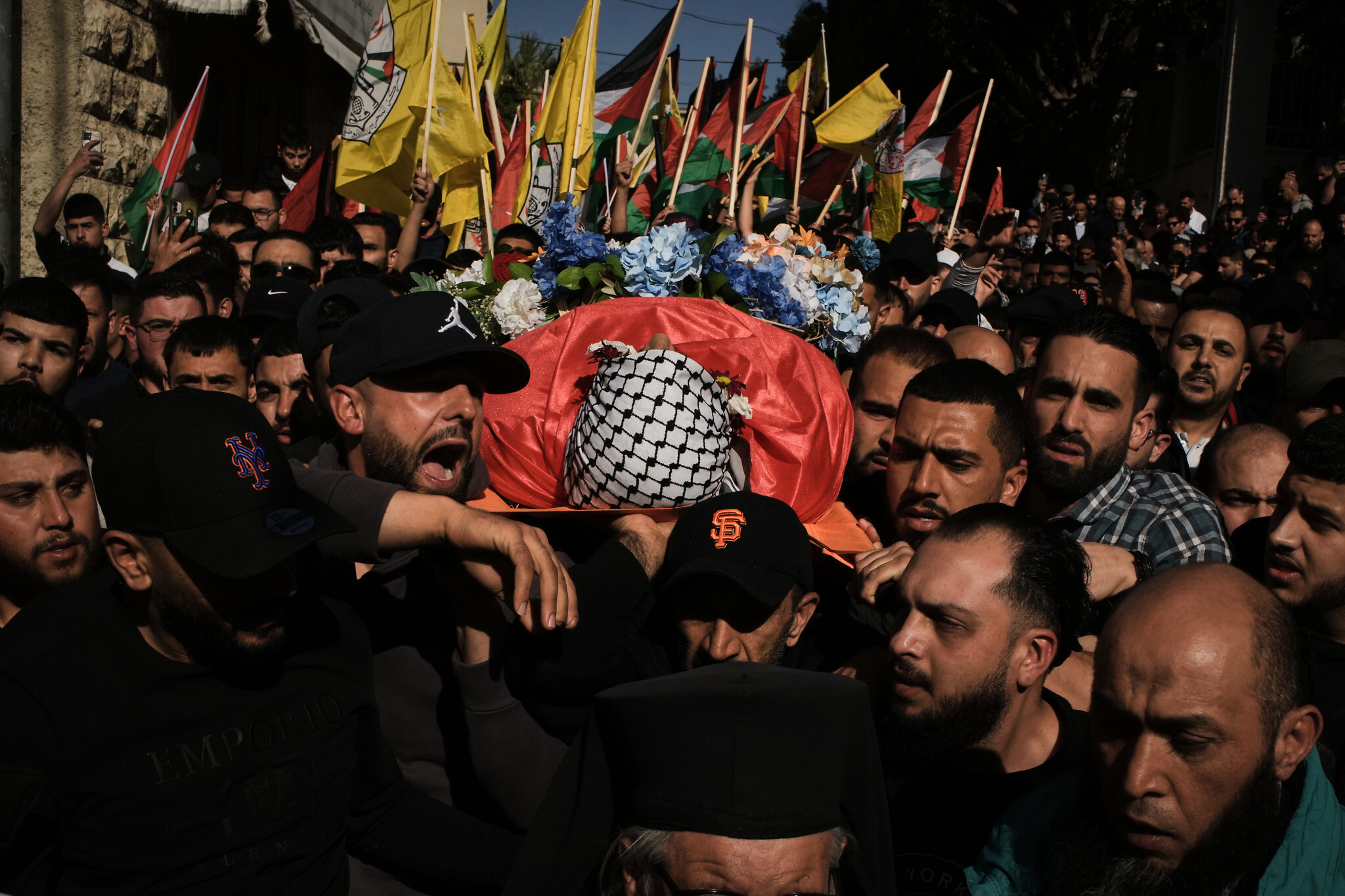
Mourners carry the body of Palestinian Awda Awawdeh, who was killed by Israeli settlers, during his funeral in the West Bank town of Deir Dibwan, Thursday, April 23, 2026. (AP Photo/Leo Correa)
According to a 2025 study by the Palestinian Center for Policy and Survey Research (PCPSR), a Ramallah-based Palestinian think tank, when respondents were presented with a detailed hypothetical two-state solution, 63% of Palestinians in the West Bank opposed it, compared to 39% in the Gaza Strip.
“Try to put yourself in the shoes of an average Palestinian… All doors for a better future are closed. The economic situation is terrible,” Sinijlawi explained. “So it is a very desperate situation.”
From intifada to moderation
The ingredients for unrest are familiar — and in the past, they have ignited far more quickly.
The First Intifada, which erupted in December 1987 after two decades of mounting Palestinian frustration over Israeli military rule, settlement expansion, economic hardship and restrictions in the West Bank and Gaza, was sparked by a car accident in Gaza’s Jabaliya refugee camp, when an Israeli truck collided with a car carrying Palestinian workers, killing four.
Immediately after the accident, a false rumor spread that the killing was intentional and that the Israeli driver wanted to avenge the death of a relative killed in a terror attack — fueling widespread anger that quickly spiraled into mass unrest.
The largely grassroots uprising, marked by strikes, demonstrations, and clashes between unarmed protesters and Israeli soldiers, lasted for years and left roughly 200 Israelis and more than 1,000 Palestinians dead before ending with the signing of the Oslo Accords in 1993.
The Second Intifada, which broke out in September 2000, came after years of failed peace efforts, deepening distrust between Israelis and Palestinians, and the collapse of the Camp David Summit, where leaders from both sides were expected to reach a final peace deal. The uprising was triggered by then-opposition leader Ariel Sharon’s highly contentious visit to the Temple Mount.
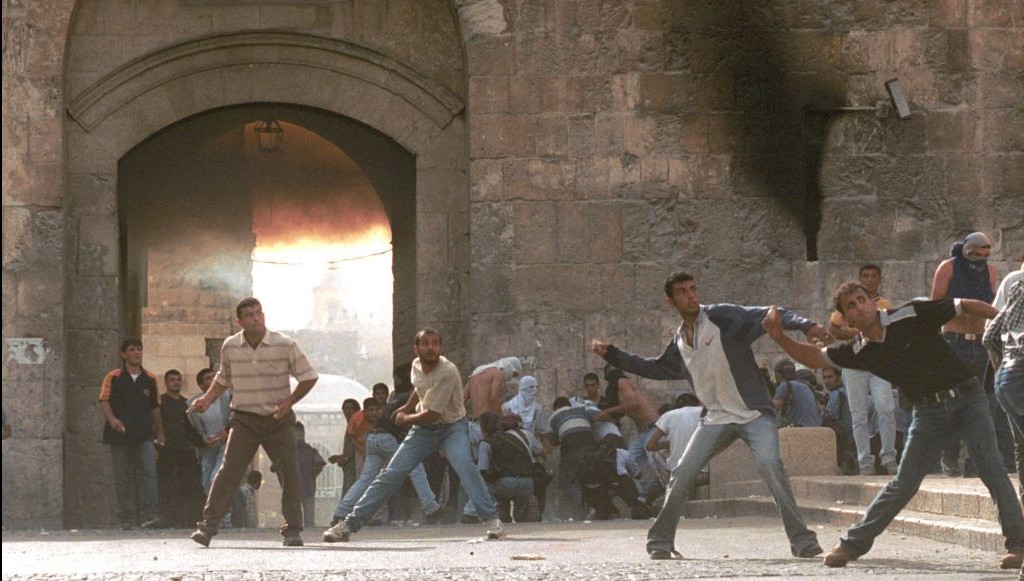
Arab residents of Jerusalem throw rocks at Israeli police near the Lions Gate in Jerusalem’s Old City on October 6, 2000, at the outset of the second Palestinian intifada, or uprising. (Nati Shohat/Flash90)
While Palestinians still carried out stonings and firebomb attacks, the Second Intifada was also far deadlier and more militarized than the previous iteration, marked by suicide bombings, shootings, and IDF operations that killed thousands of Palestinians and more than 1,000 Israelis over the span of more than four years.
The last major wave of Palestinian attacks came in 2015 and 2016 as Palestinians, most without formal ties to terror organizations, carried out hundreds of stabbings, shootings and car-rammings, killing dozens and wounding hundreds. Both the trigger for the outburst of violence and the reason for its eventual end remain under dispute.
Violence emanating from the West Bank had already been falling when Hamas carried out the October 7, 2023, assault on southern Israel. In shock and fearing a similar attack from West Bank Palestinians, Israel swiftly tightened security measures, including checkpoints and restrictions on movement. At the same time, settlers, often backed by the IDF, began expanding their footprint, often claiming security needs.
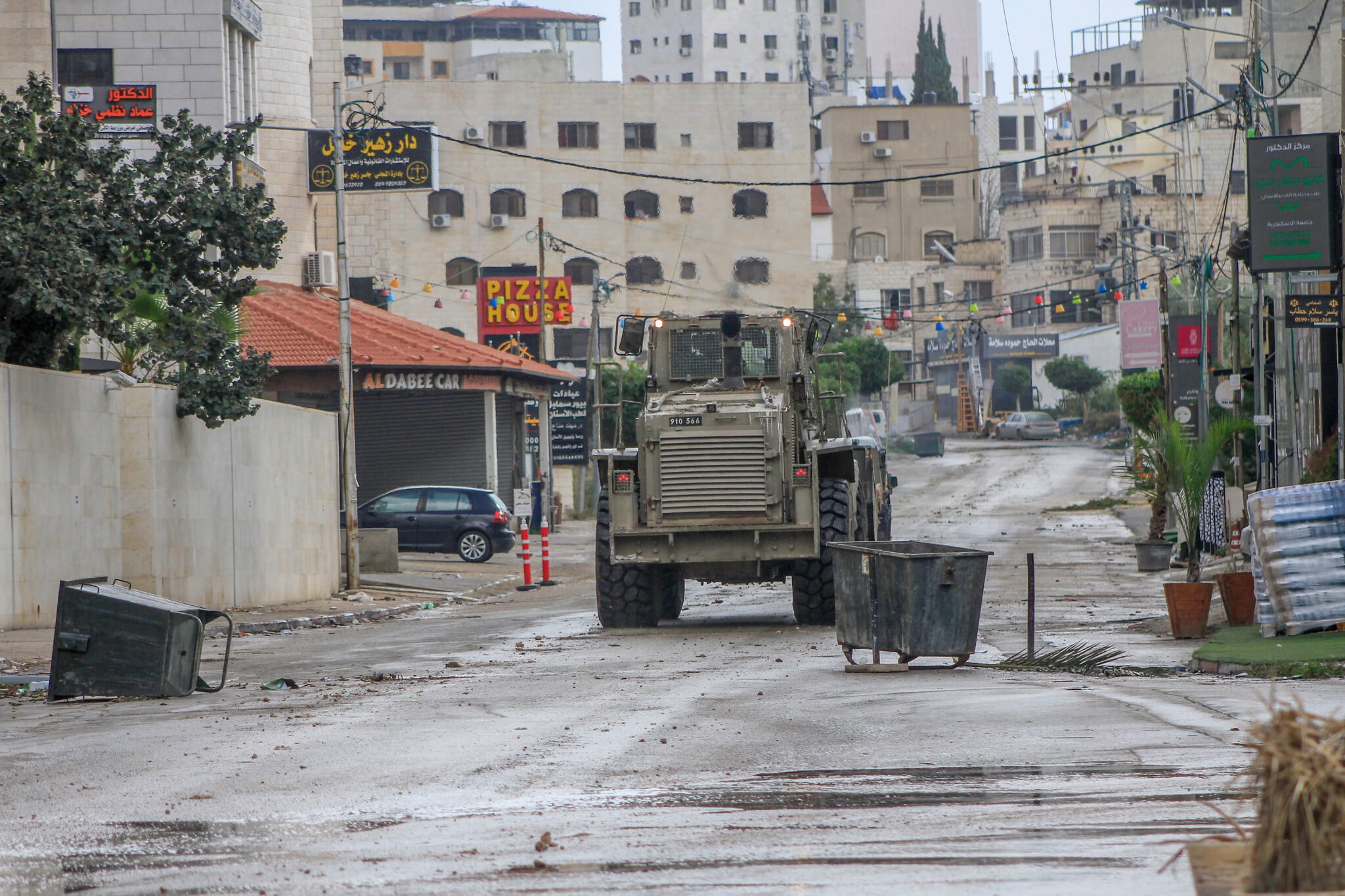
Illustrative: Israeli security forces seen during a raid in the West Bank city of Tulkarm, November 14, 2023. (Nasser Ishtayeh/Flash900
Today, according to Palestinians and Israeli and international activists, there is a concerted campaign aimed at pushing Palestinians off their land, using harassment and violence.
Tensions on the ground seem palpable.
Sinijlawi described the impact of the heightened Israeli security measures — including roadblocks that have transformed typically short journeys of a few kilometers into hours-long journeys — as a daily source of anger.
“Whenever I travel in the West Bank, and I cross these checkpoints… I get very angry,” he said.
Byman agreed that military enforcement does little to curb radical ideologies and sentiment. “The anger is there, the willingness to support violence is there,” he said.
Security measures are “about decreasing capability, not changing intentions.”
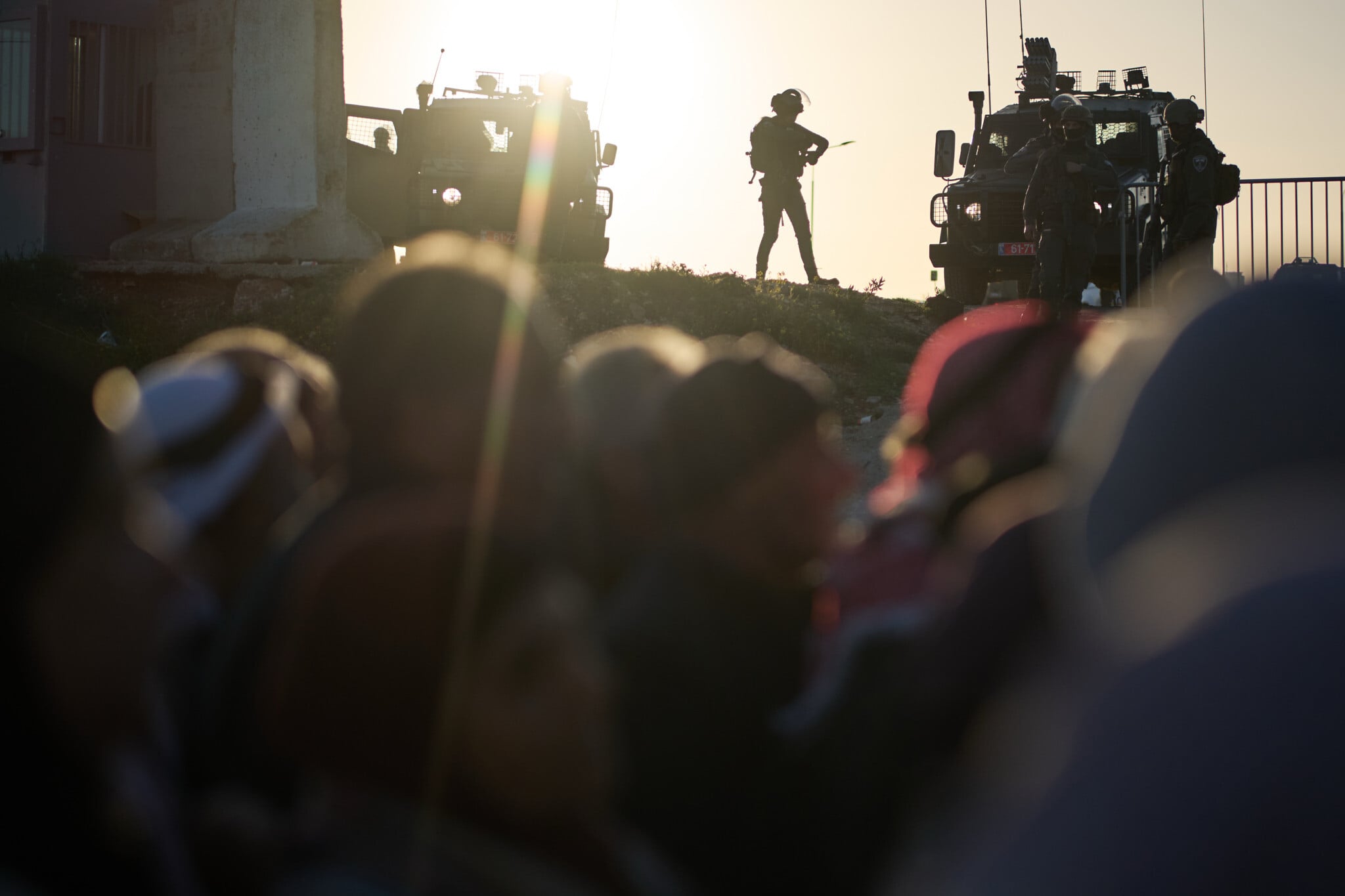
Israeli soldiers stand guard as Palestinian worshippers line up to pass through the Israeli military Qalandiya checkpoint between the West Bank city of Ramallah and Jerusalem on their way to attend Friday prayers at Al-Aqsa Mosque during the Muslim holy month of Ramadan, February 20, 2026. (AP Photo/Leo Correa)
Both Byman and Sinjilawi said without measures aimed at making life better for Palestinians, they would be less willing to follow a more moderate path.
“It is best for Israel to have some sort of negotiated settlement with Palestinians who are against violence,” Byman said. “But the day-to-day undermining of more moderate Palestinian voices, of angering Palestinians… all decreases the chance of a settlement.”
Sinijlawi described the current reality as “a ticking bomb.”
“It’s very important now to try to end the wave of violence… because this is challenging the moderate, nonviolent tendency,” he said. “The Palestinians should be encouraged to go more moderate and not to prove to them every day that their moderation does not pay well.”
Asked what a future uprising might look like if tensions continue to escalate, Sinijlawi declined to speculate.
“I don’t want to imagine this,” he said.