
When the Clal Center opened in the heart of Jerusalem in the 1970s, it was supposed to be a gleaming and innovative shopping mall that would become the city’s commercial hub.
Today, it has become a grimy labyrinth of empty storefronts, shady businesses, abandoned office machines, and indecipherable navigation signs. Widely considered one of the city’s biggest architectural failures, many believe an urban legend that says the building is cursed, even as a beautiful rooftop garden seeks to lure shoppers back into the building.
“There were many wrong decisions made here, and different opinions about what went wrong,” said Shimshon Sam Leshinsky, a social media influencer who gave a tour of the building recently. “It’s a disaster of a building, but for the purpose of sharing its stories, it’s a lot of fun.”
Leshinsky, a resident of the city who has achieved local fame for reviewing restaurants on Facebook, works in the Clal Center for his day job. He gave the tour as part of the Jane’s Walk Festival, an international movement of free walks and talks that invites residents to teach others about their neighborhoods.
Founded in Toronto in 2006 in honor of writer and activist Jane Jacobs, the festival is now held in more than 500 cities around the globe, organizers say.
Sign up for ToI’s free
Real Estate Israel newsletter
By signing up, you agree to the terms
“Shimshon has been giving tours in Jerusalem for several years, and is one of our most eclectic and colorful guides,” said Itamar Farhi, the movement’s organizer in Jerusalem, introducing Leshinsky to about 20 people who joined the tour.

Shimshon Sam Leshinsky gives a tour of the Clal Center in Jerusalem, May 7, 2026 (Zev Stub/Times of Israel)
An ambitious plan
There were high hopes for the Clal Center when the project was conceived for the 17-dunam plot of land between Jaffa Road and Agrippas Street, Leshinsky noted.
For nearly a century, the space was home to the Alliance Israélite Universelle vocational school (known in Hebrew as Ki’ach), founded in 1882 to teach trades to poor children from Jewish, Christian, and Muslim societies.
But after the Six Day War in 1967, Jerusalem underwent a massive real estate boom, and the old, low-rise Ottoman and British-era cityscape suddenly felt outdated to developers who dreamed of a modern, towering metropolis.
In 1970, before the strict historic preservation laws that today protect Jerusalem’s heritage were established, the Alliance school was demolished, with only its decorative iron gate remaining outside.
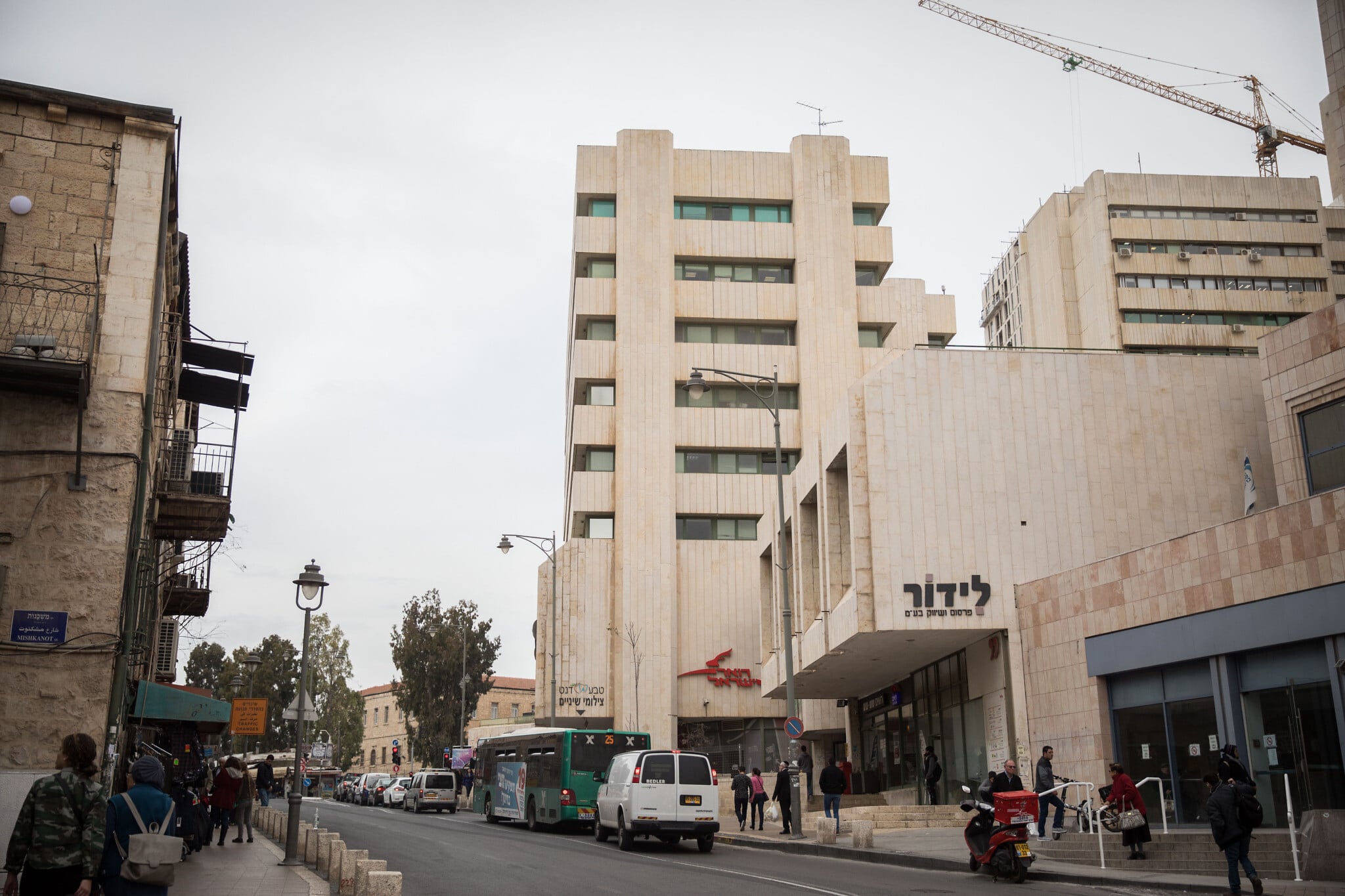
View of the Klal Building in central Jerusalem, on December 28, 2017 (Hadas Parush/Flash90)
The Clal Group, a development company led by Azorim Investments, hired Dan Eitan, one of Israel’s most celebrated modernist architects, to create an ambitious plan for an upscale, indoor shopping mall, something Jerusalem didn’t have at the time.
The Clal Center was to be a futuristic wonderland, with a 15-story office tower rising above a massive, multi-tiered commercial center. Architecturally, the idea was for multiple entrances from the surrounding streets to feed into an intricate, spiraling system of half-floors and galleries wrapping around a grand, open-air central atrium. These would connect the historic Nachlaot neighborhood and the Mahane Yehuda open-air market to the new city center.
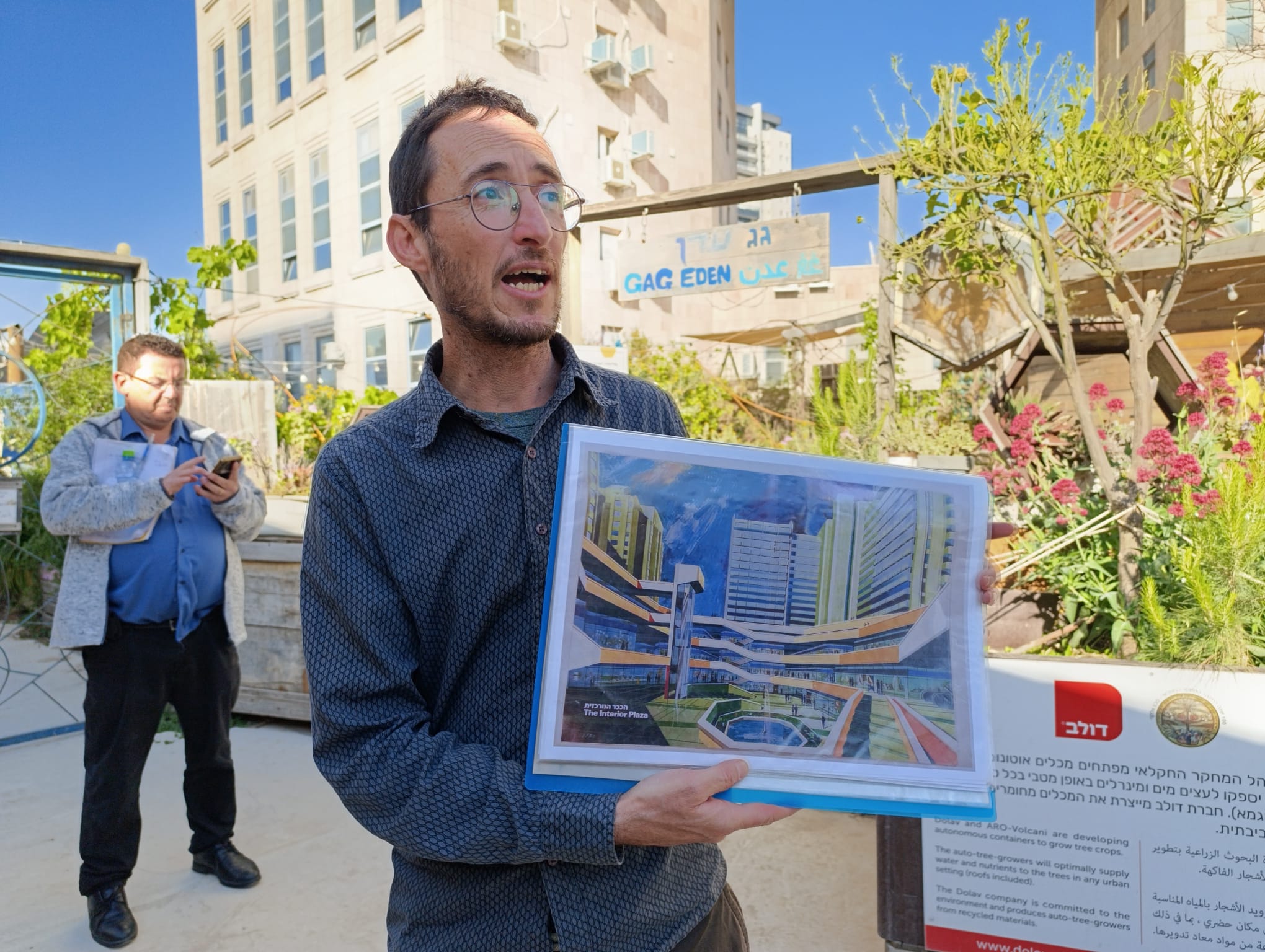
Matan Israeli, founder of Muslala, shows an early drawing of plans for the Clal Center in Jerusalem, May 7, 2026 (Zev Stub/Times of Israel)
Construction began in 1972, and the building opened for business in 1978 with commercial success. The center included some 130 stores, banks, government ministry offices and a cinema that was controversial for operating on Shabbat. Israel’s largest furniture company, Rim, opened its flagship store in the center, employing as its marketing manager a young Benjamin Netanyahu before he launched his political career.
“During the early 1980s, the mall was pretty successful,” Leshinsky said on his tour. “People would fight over seats in the movie theater so they could eat sunflower seeds and throw them on the floor while they watched. It was like the wild west here.”
A ‘cursed’ building
Almost from the beginning, however, the building was plagued by failures.
Eitan’s architectural concept of half-floors quickly proved to be a navigational nightmare, making it impossible for shoppers to tell which floor they were on. Floor numbers were out of order, and elevators skipped levels completely in some places. Locals would joke that a group of shoppers who entered in 1980 was still trying to find their way out.

People walk in the Clal Building, December 28, 2017 (Hadas Parush/Flash90)
In addition, the original open-air concept was unfit for Jerusalem’s wet, windy winters, and planners were forced to quickly cover the open roof with a semi-transparent, yellowed plastic dome that accumulated dirt and grime. Instead of being illuminated by the bright Mediterranean sunlight, the interior soon had a depressing, jaundiced pall. That got even gloomier when the building started attracting suicide jumpers, forcing the management to install ugly, industrial rescue nets.
Things would continue to get worse as the building gained a reputation for being cursed. In the 1980s, a popular urban legend had it that mafia members had murdered a rival and buried his body deep within the wet concrete foundations of the Clal building during construction. Police dismissed the story, and a recent investigation on the Kan public broadcaster convincingly debunked the legend, but the damage was done.
When the Malha Mall opened in Jerusalem in 1993, offering ample free parking and more straightforward layouts, retailers and shoppers abandoned downtown Jerusalem in droves. A final blow came on June 11, 2003, during the Second Intifada, when a Palestinian suicide bomber detonated on Bus 14 directly outside the Clal Center, killing 17 people and sinking the area deeper into neglect and decay.
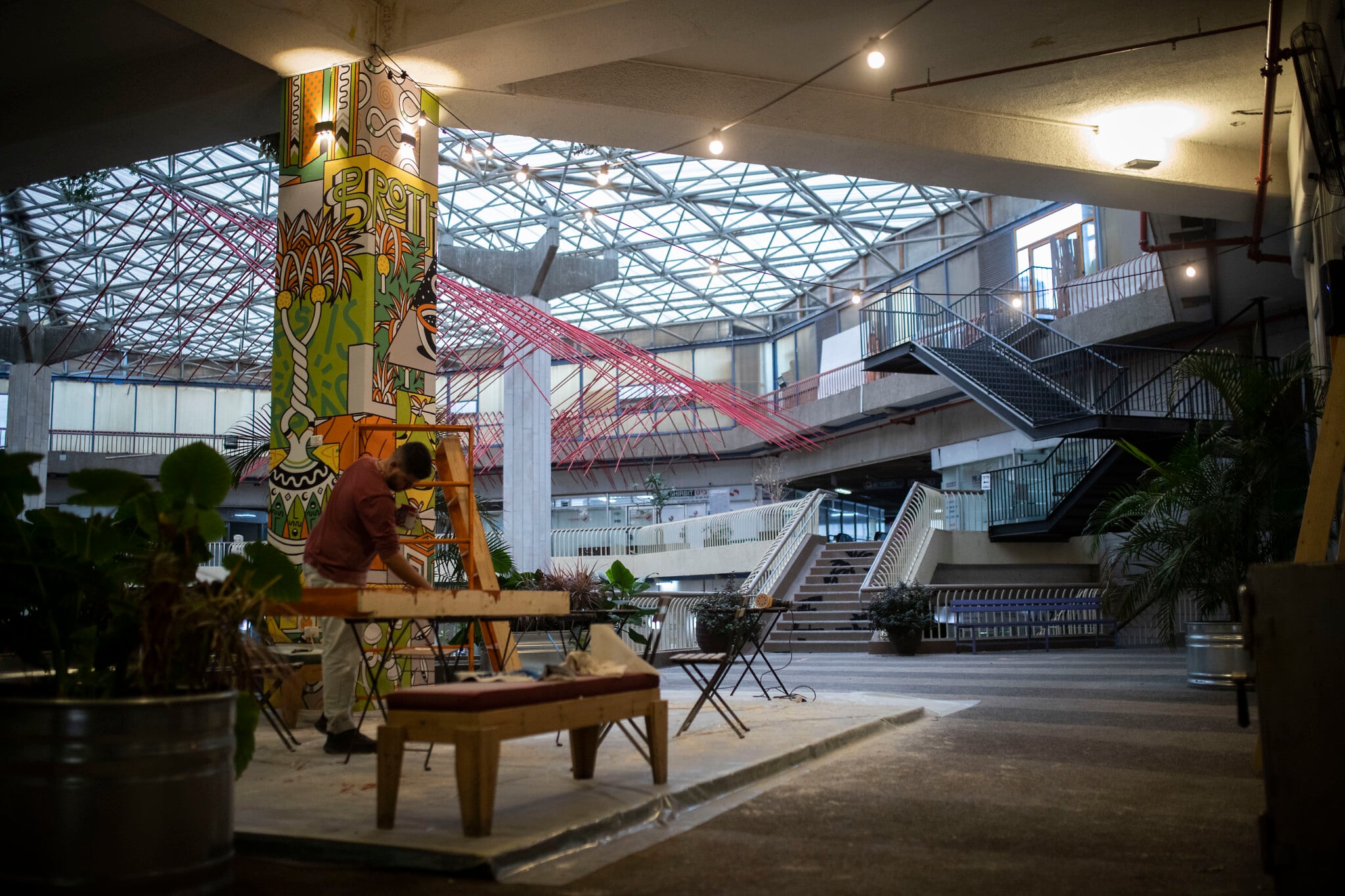
A young man paints wooden shelves outside a pub opening inside the Clal building in Jerusalem, on November 5, 2019 (Hadas Parush/Flash90)
In 2013, a lawyer and his daughter were murdered outside the lawyer’s office in the center. The shooter, a client who was going through a messy divorce, eventually killed himself as well, Leshinsky recalled.
“Since then, they haven’t succeeded in renting out the office to someone else,” Leshinsky added. “I’m not sure why.”
The wrong ownership strategy
One of the most fatal blows to the center’s development was an interesting flaw in its ownership structure, Leshinsky noted.
When the Clal Group was developing the center in the 1970s, it decided to sell storefronts permanently to merchants using a Bayit Meshutaf (joint house) model that provides for collective ownership of all shared spaces. This plan was intended to help it recoup some of its construction costs quickly, but it had some unintended consequences.
“What this model means is that to make any decisions for the building, you need to get a few hundred owners to come together and agree,” Leshinsky said. “You can’t get anything done like that.”
Over the years, building managers would have to chase down owners for money whenever escalators broke or lightbulbs burned out, and many would refuse to pay, leading to decades of neglect and decay.
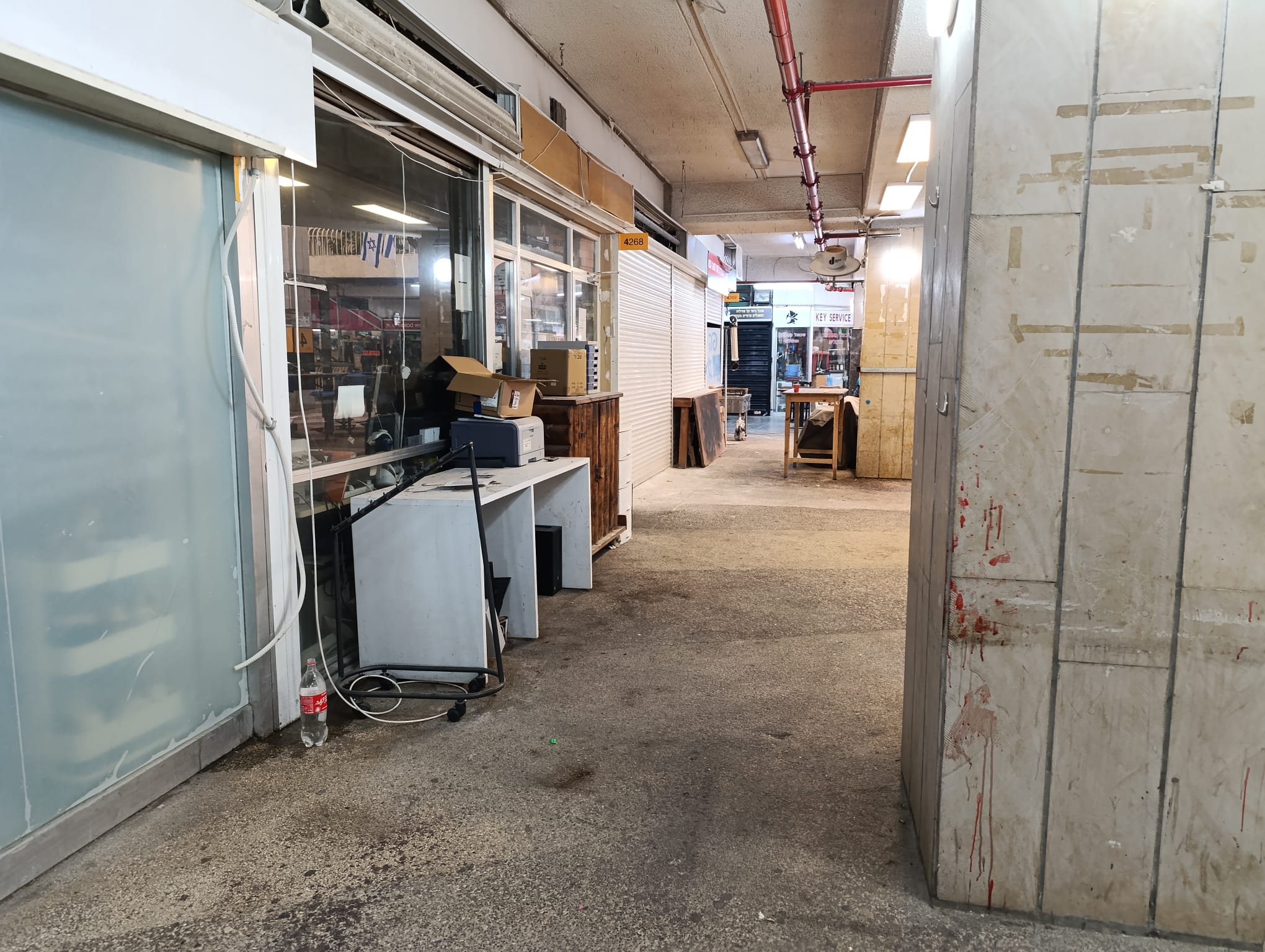
Inside the Clal Center in Jerusalem, May 7, 2026 (Zev Stub/Times of Israel)
Meanwhile, the mall’s owners had no power to choose what businesses were in the center. Unlike most malls, where storefronts are leased and managers try to curate a proper balance of stores, here, owners could sell or rent to whoever they wanted, for whatever purpose. That means that, as Clal’s fortunes declined, the center was increasingly occupied by a patchwork of sex shops, small law and accounting offices, niche specialty stores, and unprofitable businesses that have operated there for 40 years.
Today, Leshinsky estimates, 50-70% of the shops and offices in the building are unoccupied.
Life in the labyrinth
But there is still plenty of life inside the decrepit building, and valiant efforts to rejuvenate it — even as some owners hope to tear it down.
“I could only share a small portion of the crazy stories here due to time constraints,” Leshinsky said about his guided tour. “But there are so many more.”
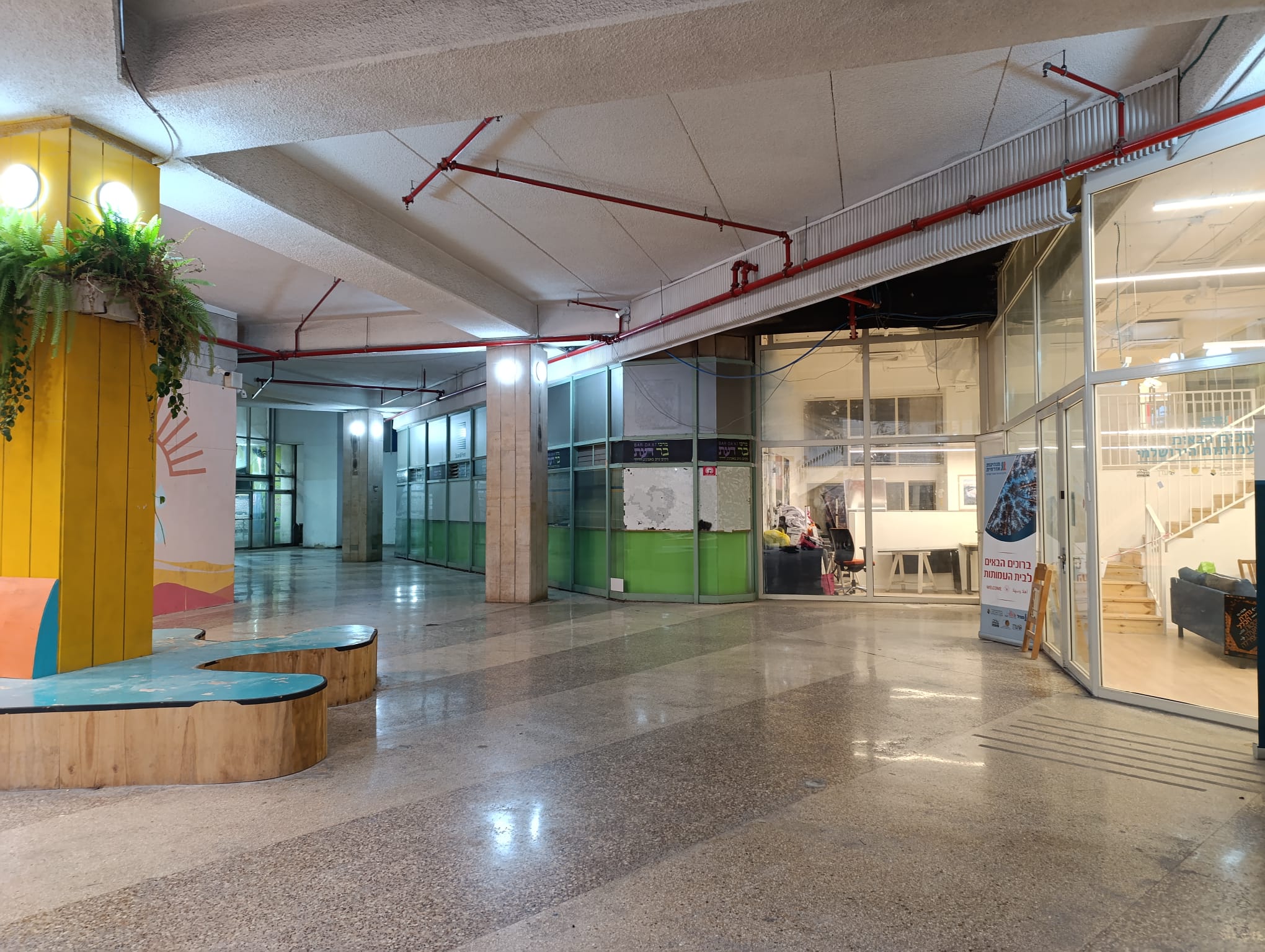
Empty storefronts at the Clal Center in Jerusalem, May 7, 2026 (Zev Stub/Times of Israel)
During Leshinsky’s tour, participants watched Ethiopian stylists braid customers’ hair, sat with a Breslov Hassid for a spiritual jam session in his office, observed a dingy corner mysteriously filled with abandoned copy machines, and met with the proprietor of a new sushi restaurant recently opened in the building.
“We mainly do delivery orders online, because almost nobody actually comes here to eat,” the owner said.
Another entrepreneur recently opened a hotel inside the center, the Davidka Guesthouse, with 13 clean, modern guest rooms that felt clearly out of place in the building.
“You can bring groups to stay here for Shabbat,” Leshinsky said. “It sounds like it could be a very unique experience.”
The brightest spot in the building, though, is on the rooftop, where a community collective known as Muslala has created a lush urban garden that feels like a completely different world from what appears below. It’s a calm and beautiful environment where visitors can drink tea and wander terraces housing an urban camping area, a meditation room, agriculture, and even beehives.
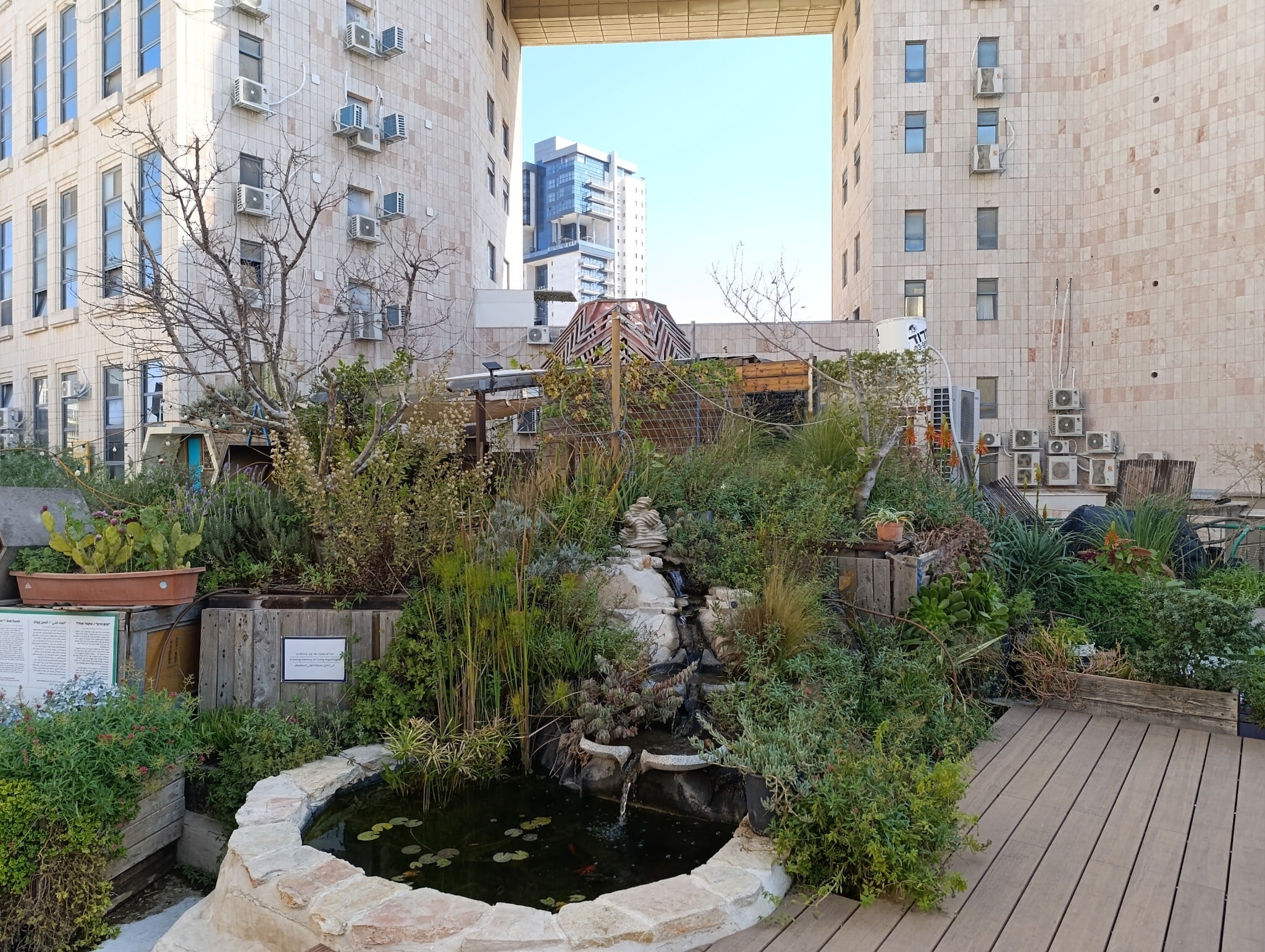
Muslala’s rooftop garden in the center of Jerusalem, November 18, 2025 (Zev Stub/Times of Israel)
“Ten years ago, we realized that there are two dunams (0.5 acres) of space on this rooftop that are completely unused and inaccessible to the public,” the project’s founder, Matan Israeli, explained to the group. “Do you have any idea what the monetary value of two dunams is in central Jerusalem?”
Over the past decade, Muslala has commandeered the rooftop as a “laboratory of different models of urban sustainability,” Israeli previously told The Times of Israel, developing 2,000 square meters of indoor and outdoor space that he says gets about 50,000 visitors per year. In addition to managing the garden, the non-profit assists other buildings in creating their own rooftop gardens, and offers workshops and classes, hosts events, and provides urban camping under the stars.
“People live with a consciousness that our cities have to be crowded, and that we don’t have space to fulfill our dreams,” Israeli said. “We’re looking to change that.”
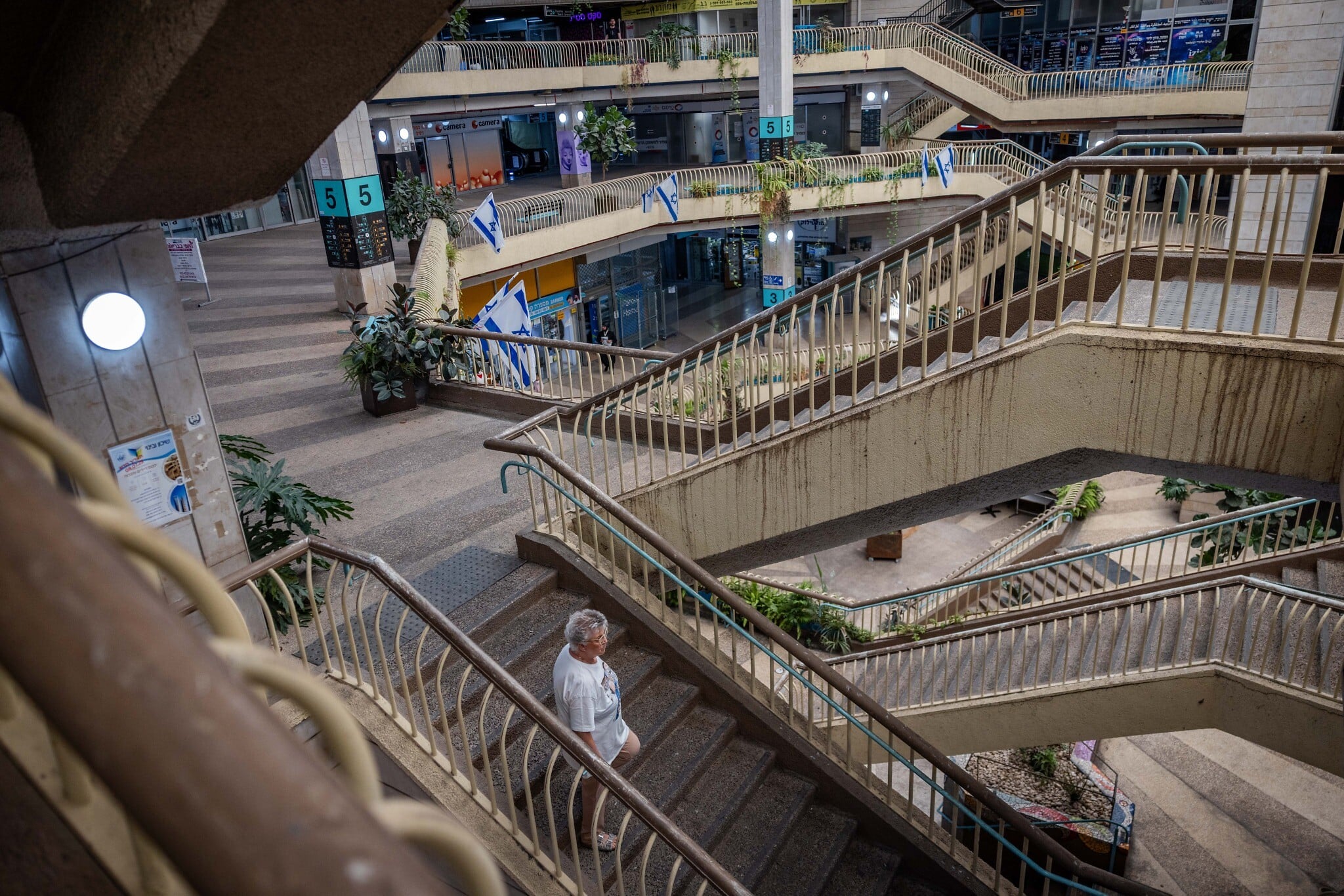
People walking inside the Clal building in central Jerusalem, on July 8, 2025 (Yonatan Sindel/Flash90)
For the Clal Center, however, it’s unlikely that the dream of becoming the commercial hub of Jerusalem will ever come true. Fed up with the current situation, store owners are working behind the scenes to try to knock the building down to build a more modern structure, Leshinsky said.
“There are a few different groups trying to get the owners to sign on to destroy the building, and they’ll probably be successful at some point,” Leshinsky said. “I imagine that 20 years from now, this will be a new building with a commercial center and apartments, just like other buildings around here.”
To Leshinsky and others, that kind of news would be a bittersweet triumph for the city.
“That might be better for everyone, in the big picture,” Leshinsky said, “but it wouldn’t be as much fun.”