
The Bank of Israel on Monday decided to lower interest rates by 0.25 percentage points, citing a strong shekel and stable inflation environment, but warned that geopolitical uncertainty over the war with Iran remained “significant.”
As was widely anticipated, the central bank, led by Governor Amir Yaron, trimmed borrowing costs from 4% to 3.75%, marking the second rate cut this year. In its previous two rate decisions in March and February, the Bank of Israel left borrowing costs on hold, after two cuts in November and January.
“With the outbreak of the US-Israel war with Iran in February, the central bank paused rate cuts because of the uncertainty around defense spending and the impact of hostilities on the economy and inflationary pressure,” IBI investment house chief economist Rafi Gozlan told The Times of Israel. “With the talks over an agreement to end the war indicating a decline in geopolitical risk, and a strong shekel curbing price increases, keeping inflation stable, the central bank felt comfortable adjusting interest rates downwards.”
US President Donald Trump declared over the weekend that the US and Iran were on the cusp of finalizing a deal to end the war launched jointly by the US and Israel against the Islamic Republic on February 28. However, Iran and the US on Monday played down hopes for an imminent signing of an agreement to end the war, which has been in a fragile ceasefire since early April.
“There is still significant geopolitical uncertainty, both domestically and globally,” the central bank said in a statement. “Operation Roaring Lion had an impact on real economic activity, and the most recent data show a recovery.”
Sign up for the Tech Israel Daily
and never miss Israel’s top tech stories
By signing up, you agree to the terms
The central bank noted that “inflation in Israel remains around the midpoint of the target,” while the shekel appreciated by 8.3% against the dollar since the previous interest rate decision. The most recent data showed the annual inflation in April was steady at 1.9%, and remained well within the government’s target range of between 1% and 3%.

Illustrative: Shoppers evacuate Jerusalem’s Mahane Yehuda market and seek shelter as an air raid siren goes off on March 13, 2026. (Chaim Goldberg/FLASH90)
The overly strong shekel has a deflationary force, as it makes imports cheaper, restrains price increases and credit costs for consumers, and enables the Bank of Israel, which is concerned about price stability, to lower interest rates. Meanwhile, the shekel’s 20% appreciation against the dollar over the past year has been hurting exporters’ competitiveness and profitability as they earn in dollars but pay expenses in shekels. Exports make up as much as 40% of Israeli economic activity.
Local manufacturers and exporters accused Yaron for doing too little too late to help moderate gains in the shekel, which has been trading at a 33-year high against the US dollar. Exporters have been warning that the local currency’s strength poses a risk to growth prospects in the economy, and are calling for a bigger interest rate cut and intervention in the foreign exchange market.
“The Bank of Israel is losing credibility by ignoring the inflation situation, the decline in the risk premium, and exchange rate movements,” the Israel Manufacturers’ Association said. “Israel has become an island of high interest rates in a global reality of falling interest rates, and the real interest rate differentials attract a heavy flow of foreign capital, which injects more dollars into the local market and fuels the destructive appreciation of the Israeli currency.”
In recent months, Yaron has come under fierce criticism from politicians and manufacturers for hesitating to take immediate action to lower high borrowing costs more aggressively and ease the plight for exporters, households, and businesses.
“A 3.75% interest rate still reflects a relatively high real interest rate,” Leader Capital Markets macroeconomist Jonathan Katz said. “At this stage, it does not appear that the Bank of Israel will combine a rate cut with intervention in the foreign exchange market, although that remains a possibility.”
“If the ceasefire is implemented, we expect another cut in July,” Katz said.
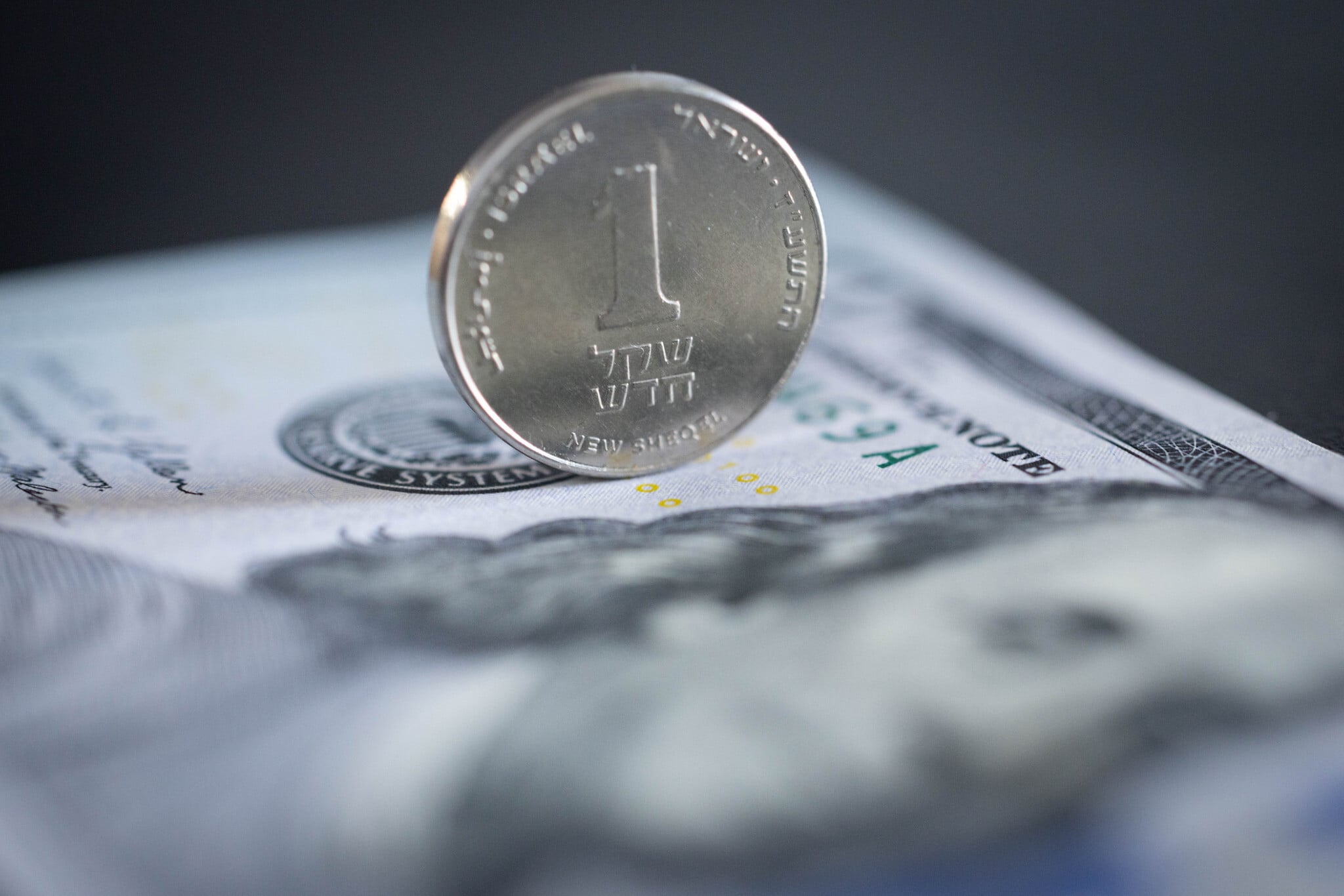
Illustrative. A shekel coin and a US hundred-dollar bill, April 13, 2026. (Nati Shohat/Flash90)
Gozlan noted that while lower interest rates make the currency less attractive to investors seeking high returns, the central bank “understands that by lowering interest rates, it will not be able to change the shekel trend.”
“The strength of the shekel is driven mainly by a globally weak dollar, the strong correlation between global equity prices and the exchange rate, and an influx of large foreign investments into Israel,” he said. “As US stock markets have been rising in the past year, the value of assets of Israeli institutional investors in major Wall Street stocks increases, which in turn means that they are required to balance the increase by selling dollars and increasing their exposure to the shekel, which strengthens the local currency.”
“Without a change in this trend, the shekel will continue to strengthen,” said Gozlan.
Which gorgeous bird do you prefer?

THIS MONTH ONLY: Join our reader support group for as little as $6/month and receive an exclusive tote bag featuring one of Israel’s native birds.
Choose between the Duchifat (orange), Israel’s national bird, or the Shaldag (blue), a beloved symbol of the Israeli landscape.
As a member of the Times of Israel Community, you’ll also enjoy:
An ad-free experience of our site and podcasts.
Exclusive access to award-winning films via DocuNation.
Weekly letters from founding editor David Horovitz.
Join ToI Community & claim my bag
Already a member? Sign in to stop seeing this
You’re a dedicated reader

That’s why we started the Times of Israel – to provide discerning readers like you with must-read coverage of Israel and the Jewish world.
So now we have a request. Unlike other news outlets, we haven’t put up a paywall. But as the journalism we do is costly, we invite readers for whom The Times of Israel has become important to help support our work by joining The Times of Israel Community.
For as little as $6 a month you can help support our quality journalism while enjoying The Times of Israel AD-FREE, as well as accessing exclusive content available only to Times of Israel Community members.
Thank you,
David Horovitz, Founding Editor of The Times of Israel