
WASHINGTON — The US military stopped a merchant vessel trying to break through its blockade of Iranian ports by firing a missile into its engine room, the US Central Command said on Saturday.
The Gambia-flagged cargo ship Lian Star ignored more than 20 warnings from US forces overnight as it tried to enter an Iranian port, the military said. The ship remained adrift in the Gulf of Oman, and US forces have not boarded it, said a US official with knowledge of the situation, speaking on condition of anonymity to discuss military operations.
With the latest action, the US military has stopped six ships trying to breach the blockade. One was allowed to proceed. Another 116 ships have been redirected, the military said.
The US launched the blockade on April 17 in response to Iran effectively closing the strait after the war in the Middle East began with US and Israeli strikes on February 28. A fragile ceasefire has held since April 7. Now the region awaits word on whether a deal can be reached to extend it by 60 days, while talks would be held on Iran’s disputed nuclear program.
While Iran, whose leaders are sworn to Israel’s destruction, denies seeking nuclear arms, it has amassed uranium enriched to levels with no civilian application.
Get The Times of Israel’s Daily Edition
by email and never miss our top stories
By signing up, you agree to the terms
The stockpile of highly enriched material is believed to be buried underground since the US struck three key Iranian nuclear sites in the 12-day Israel-Iran war in June 2025.
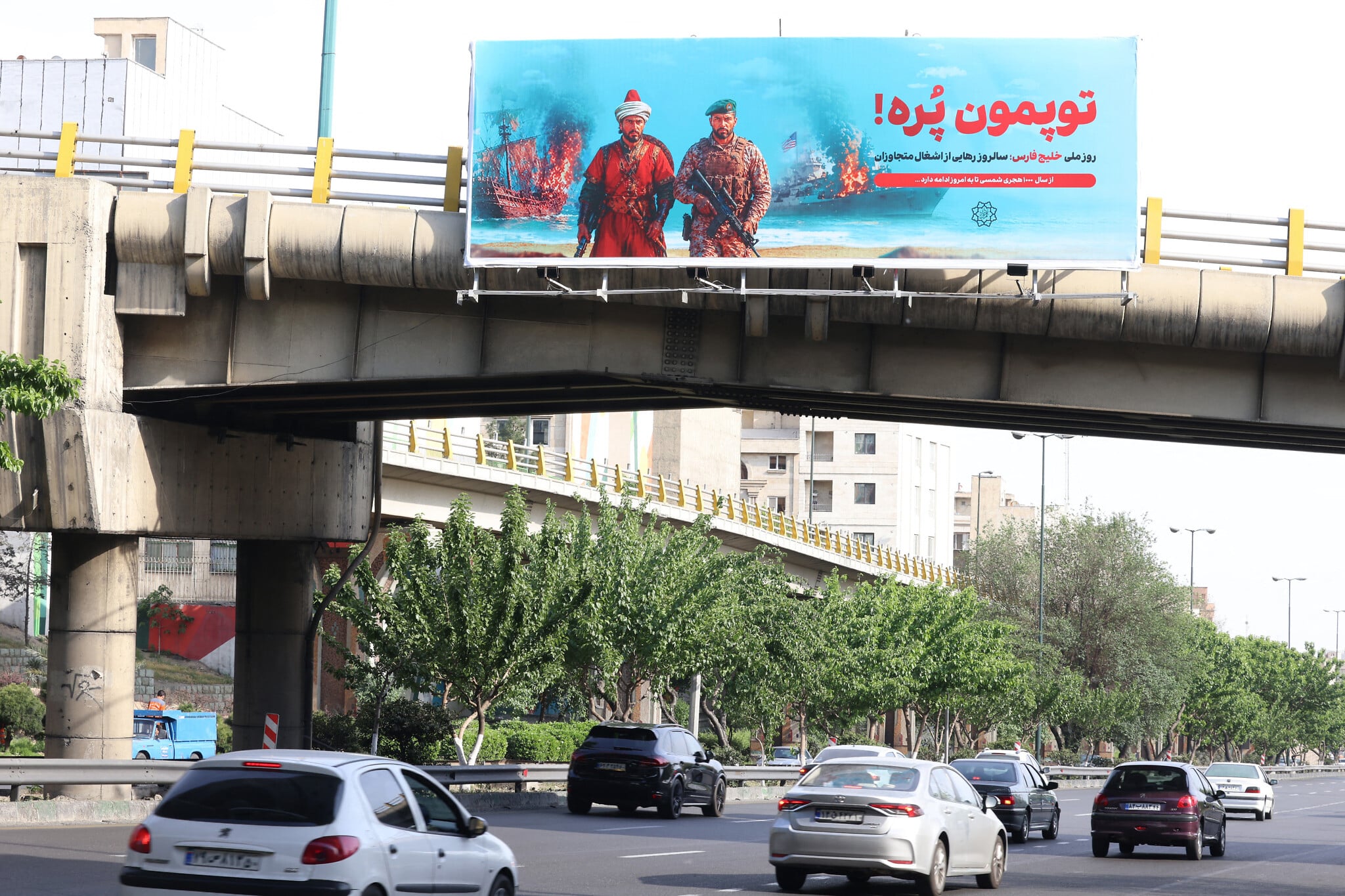
A large anti-American banner that reads in Persian, “Our cannons are full,” referring to the Strait of Hormuz, is placed across a bridge that spans a highway in Tehran on May 12, 2026. (ATTA KENARE / AFP)
The ceasefire declared by Trump in April came with core declared goals of the war unfulfilled, including ensuring that Iran does not attain nuclear weapons, destroying its missile program, and creating the conditions for the Iranian public to overthrow the regime.
Events in the Strait of Hormuz, a key waterway between Iran and Oman, have shaken the global economy. Shipments of significant amounts of oil, natural gas and related supplies like fertilizer are largely stranded, increasing the strain on consumers and food producers.
The US blockade seeks to limit Iran’s own shipments and further weaken its access to cash, creating more pain for its long-weakened economy.
US President Donald Trump met with advisers on Friday but has yet to decide on whether to move ahead with a deal to extend the ceasefire and reopen the strait. Iran has said the deal had not been finalized.
Commercial traffic has quietly continued to flow through the strait, despite Iran’s assertions that it must approve any transits, though at a much lower volume than before the war.
Iran has even charged tolls for transit as high as $2 million, which experts have called a violation of a principle of international maritime trade: freedom of peaceful navigation.
Qatar’s Deputy Prime Minister, Sheikh Saoud bin Abdulrahman bin Hassan bin Ali Al Thani, said on Saturday said that the Gulf nation opposes charging fees to transit, “but for certain times when they say they are going to use it for mine clearing or some usage of the fees for a temporary time, this is something that is negotiable, and it could be something that will help the transit of the Strait of Hormuz to be back to normal stage.”
The US official previously told The Associated Press that the US has not found or destroyed any mines in the strait.
Which gorgeous bird do you prefer?

THIS MONTH ONLY: Join our reader support group for as little as $6/month and receive an exclusive tote bag featuring one of Israel’s native birds.
Choose between the Duchifat (orange), Israel’s national bird, or the Shaldag (blue), a beloved symbol of the Israeli landscape.
As a member of the Times of Israel Community, you’ll also enjoy:
An ad-free experience of our site and podcasts.
Exclusive access to award-winning films via DocuNation.
Weekly letters from founding editor David Horovitz.
Join ToI Community & claim my bag
Already a member? Sign in to stop seeing this
You’re a dedicated reader

That’s why we started the Times of Israel – to provide discerning readers like you with must-read coverage of Israel and the Jewish world.
So now we have a request. Unlike other news outlets, we haven’t put up a paywall. But as the journalism we do is costly, we invite readers for whom The Times of Israel has become important to help support our work by joining The Times of Israel Community.
For as little as $6 a month you can help support our quality journalism while enjoying The Times of Israel AD-FREE, as well as accessing exclusive content available only to Times of Israel Community members.
Thank you,
David Horovitz, Founding Editor of The Times of Israel