
Imagine celebrating one of your proudest professional milestones, only to discover that an algorithm told your friends and colleagues you had been publicly humiliated.


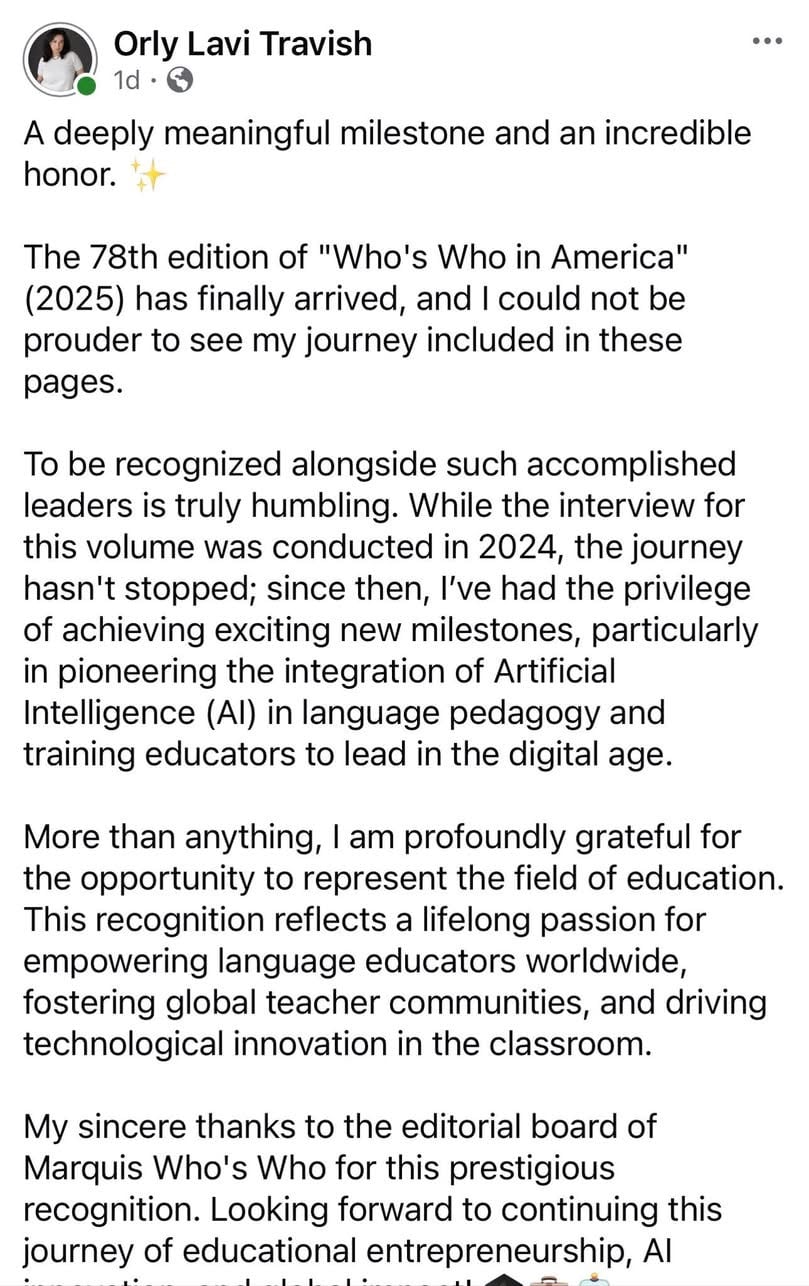
That is exactly what happened to me recently. I was thrilled to share on social media that I had been included in the prestigious 78th edition of Who’s Who in America for my work in language education and AI pedagogy. In my original English post, I wrote that being recognized alongside such accomplished leaders was “truly humbling,” by which I meant it filled me with deep modesty, gratitude, and respect.
However, Facebook’s automated translation tool had other plans. Lacking any cultural nuance or context, the algorithm translated “humbling” into the Hebrew word for “humiliating” (Mashpil משפיל).
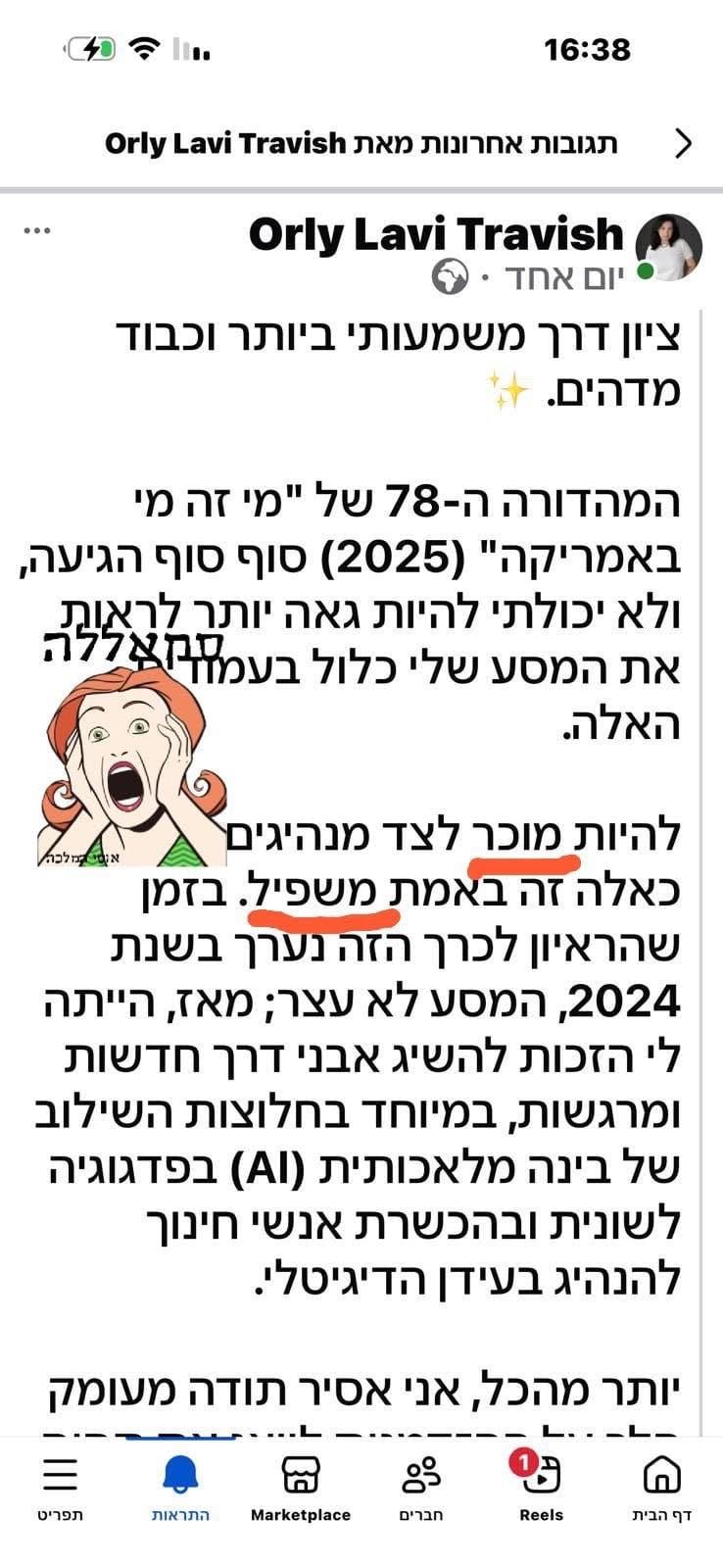
Within minutes, my phone was buzzing with concerned messages from friends in Israel, all asking who had insulted me and what had gone wrong.
Once the laughter cleared, I realized this mix-up was actually the perfect lesson. I am a big believer in technology, and I actively train educators on how to embrace Artificial Intelligence in the classroom. Yet, this funny mistake highlights exactly why the language teaching profession is safe from extinction, and why the human teacher is more crucial today than ever before.
Teaching a language is never just about vocabulary or grammar rules; if it were, textbooks and Google Translate would have replaced us decades ago. True language education is an act of cultural diplomacy and deep human connection. As teachers, we do not just teach words; we teach the history, mindset, humor, and soul of a culture. A computer can tell you what a word means in a dictionary, but it cannot teach you how that word feels to a native speaker or how its meaning shifts depending on the tone of voice and context.
When technology tries to navigate culture without human guidance, the results can be much worse than a simple misunderstanding. In 2017, a Palestinian construction worker posted a photo of himself smiling next to a bulldozer with the Arabic caption “Yasa’ad Sabahkum,” which simply means “good morning.” According to reports by the BBC and The New York Times, Facebook’s automated translation engine translated the phrase as “attack them” in English and “hurt them” in Hebrew. This algorithmic failure led to the innocent man being arrested by Israeli police before the error was finally rectified. https://www.neowin.net/news/facebook-apologizes-for-translation-that-resulted-in-arrest/
A similar international embarrassment occurred during a state visit by the Chinese President to Myanmar. As reported by major news outlets, an error in Facebook’s Burmese-to-English translation system caused President Xi Jinping’s name to appear as an offensive slur in official statements. The company had to issue a formal public apology for the diplomatic nightmare caused by an algorithm that was simply guessing missing data. https://www.jpost.com/omg/facebook-apologizes-after-vulgar-translation-of-chinese-leaders-name-614551
These examples show us that while AI is an incredible tool for practicing skills and generating ideas, it completely lacks empathy and cultural intuition. The classroom needs a human teacher to create a safe space for students to make mistakes, to build their confidence, and to guide them through the beautiful complexities of human communication. To navigate the vast emotional distance between humility and humiliation, or between a warm morning greeting and a threat, we need more than just advanced code.
The future of education is not about replacing teachers with machines. Instead, it is about empowering teachers with technology, while keeping the human heart, the cultural empathy, and the pedagogical wisdom exactly where they belong, at the center of the classroom.
As for me, I am still smiling, feeling deeply honored, and highly amused by the machine that reminded us all why human teachers are completely irreplaceable.
Educational Entrepreneur. Hebrew language and Israeli culture specialist Orly Lavi Travish is the founder and owner of 972 Education Inc. With over 30 years of experience and degrees in Hebrew and Arabic language and literature, she trains students and educators worldwide in innovative teaching methods that integrate AI. Her additional certification in teaching diverse learners informs her pioneering work, which includes the creation of multiple educational initiatives, including IVRITECH conferences, “Language on the Sofa,” (״שפה על “הספה, Language on the Sofa) the first international teacher’s forum of its kind for language teachers in general, and Hebrew language teachers in particular, “In One Language on a Second Language” (״בשפה אחת על שפה שניה״) the first Hebrew podcast on teaching a second language, education, and culture, and “Zikaron BaMuzeon” (״זיכרון במוזיאון״ “Remembrance in the Museum” ) a FREE educational virtual tour with the Holocaust Museum LA for students around the world.