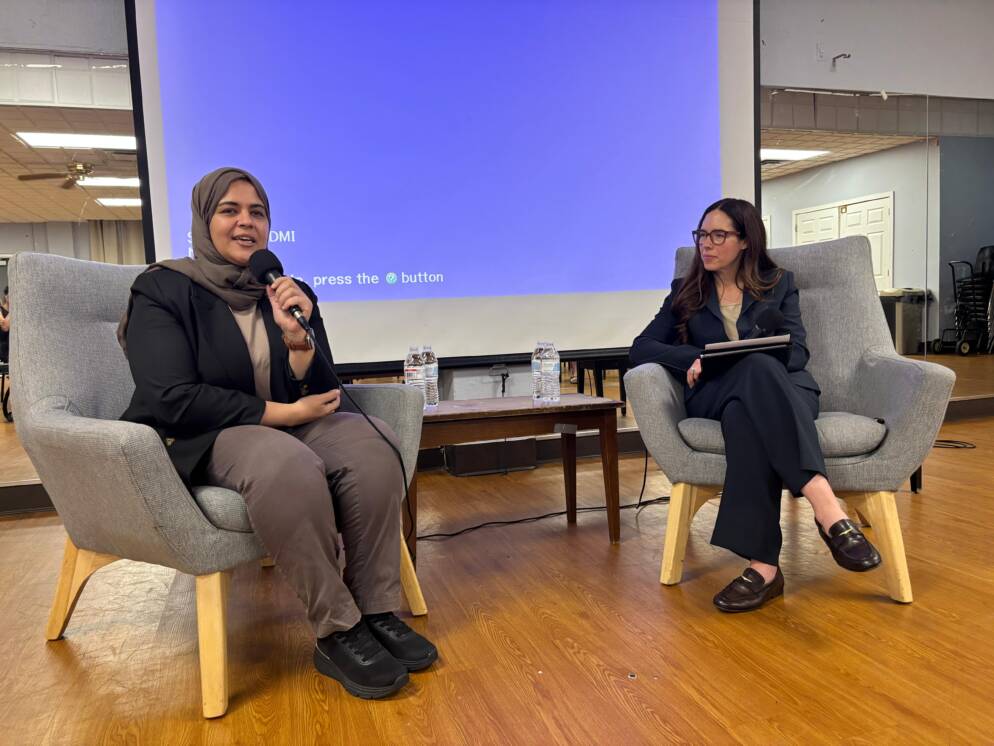
 Dalia Ziada, left, an Egyptian-born pro-Israel activist, and Liz Berger in conversation at the Kaiserman JCC. (Photo credit: StandWithUs)
By Dinah Bucholz
From where do slogans like “Zionism is racism” and accusations of apartheid and genocide originate? A recent program at the Kaiserman JCC in Wynnewood answered this question.
Holly Saltzburg, community outreach manager at StandWithUs, a Jewish advocacy group, partnered with NoVaChai, a Jewish educational organization, to screen a documentary film titled “A Special Russian Truth” and host a discussion between Egyptian-born pro-Israel activist Dalia Ziada and Liz Berger, a Jewish advocate and doctoral candidate in antisemitism studies.
The Documentary
The film featured Soviet-born historian Izabella Tabarovsky and Vlad Khaykin from the Anti-Defamation League, as well as Ziada and other scholars.
The speakers showed that anti-Israel propaganda emerged from the Soviet Union in the 1960s when the Communist regime recognized that Israel served as an outpost of Western civilization in the Middle East.
The documentary explained how the Soviets planted the seeds of propaganda in Africa and wielded enormous influence over Arab countries, leading up to the 1975 United Nations resolution declaring that Zionism is racism. They cleverly repackaged as virtuous the Jew hatred that had already predisposed entire populations to view Jews unfavorably.
“You already had centuries of antisemitic propaganda that had taken hold in Russia and subsequently in the Soviet Union that portrayed Jews as manipulative, conniving, conspiring,” one of the speakers in the film said. “What the Soviets did is they took old antisemitic ideas, and they gave them a kind of polish.”
James Rose, the film’s producer, said the idea was born of necessity: “The project started with high school students who shared concerns and frustrations about anti-Israel rhetoric,” he said. “Frankly, I didn’t have a good answer for them.”
As he researched material he could use to help them, he discovered the work of Tabarovsky and was inspired to produce the film.
The Discussion
What emerged from the discussion between Ziada and Berger was their life stories, antisemitism on college campuses and around the world, and how to combat it.
Ziada was born in Egypt, where she said every home prominently displays either the Quran or the Bible, alongside “Mein Kampf.”
“Imagine for a kid growing up, this is the first book they see with the photo of Hitler on it, and you think it’s a good man,” she said, explaining the level of indoctrination. As a young adult, observing the destructive behavior of the Muslim Brotherhood, she began to question everything. It was one thing to burn the Israeli and American flags, for example, but why also the Egyptian flag?
After Oct. 7, Ziada took her life in her hands when she spoke out to defend Israel and condemn Hamas. She fled to the United States, where she has continued to serve as an outspoken advocate for Israel and the Jewish people.
Berger, born to a Catholic family, did not encounter Jews during her childhood. Jews and Judaism were simply not mentioned.
“It was sort of as if Jesus was born, and then that’s what happened, and nothing came before it,” she said.
But a dedicated teacher put a book in her hands that changed her life. “The Abandonment of the Jews” by David S. Wyman opened her eyes to a new perspective and led her down a path toward Judaism and to a deep study of the history of antisemitism.
During the question-and-answer period, an audience member asked Ziada if she gets any love from the Arab and Muslim communities. The activist expressed gratitude to the individuals who reach out to her to thank her for her work, and she also thanked the Jews who rescued her and have continued to support her.
She said that when she was desperate to leave Egypt, she reached out to strangers for help, terrified because she didn’t know where she would live and how she would survive. She was rescued by three Jewish men who didn’t even know her.
“They came to my door, and they said, ‘We’re here for you. We are your family. We are going to take care of you until you can stand on your feet again,’” she said. “People I was raised to hate … saved my life and made sure that I can stand on my feet again and keep fighting the fight.”
A Disturbance
Toward the end of the event, a protester disrupted the program, shouting that a Muslim should not dare show her face among Jews. After the protester was escorted out by security, Ziada appeared unfazed, explaining that some people can’t seem to reconcile the notion that a Muslim can support the Jewish people, “which is crazy, because this should be normal,” she explained.
A Message of Hope
Berger said that she sees reasons to be hopeful despite the current surge of antisemitism.
“Sometimes it is in the creative scholarly work of the antisemitism studies cohort at Gratz College, sometimes it is in conversations in my professional life with educators who are open to learning more about how antisemitism manifests in schools, but it is always in the friends we have,” she said.
“I was always a friend and ally to Jewish people, before I even realized I was, many years before I converted to Judaism,” she added. The world is mostly made up of “people who don’t yet know they care about the lives of Jewish people, and whose access point we have yet to discover.”
Rose said he’s heartened by the grassroots Jewish organizations that have stepped up to the plate and by moderate voices speaking up amid extreme rhetoric.
Asked if he has a final message, he said he was surprised to learn how little is known about Soviet-era propaganda, a crucially important story.
“Have a discussion about this,” he urged. “Host a screening at your synagogue, community center, host a parlor discussion.”
Rose noted that “the design and 24-minute length is perfect for discussions, classrooms, conferences … I want this to be a resource at that level, so I offer to screen no charge for any social educational organization that wants to use it.”
Saltzburg, who organized the event, said that it was “incredibly meaningful” to hear “people from different backgrounds come together in honest dialogue.”
“I’m proud that this event gave us the opportunity to be part of the process of educating, asking hard questions, and helping ensure that truth, understanding and dialogue are louder than hate,” she added.
Dinah Bucholz is a freelance writer.