
JTA — Nearly three decades after Hella Eskenazi’s first trip from her home in Cuba to the Maccabiah Games in Israel, the journey hasn’t gotten much easier.
This time, she was joined by dozens of athletes who had to travel through five countries over more than four days to reach Israel — a consequence of both the turmoil affecting travel to Israel generally and the unique complexities of getting anywhere from their communist island nation in the Caribbean.
The first time Eskenazi made the trip was in 1997, when she was a member of Cuba’s national karate team, and her country’s sole representative at the sports competition known as the “Jewish Olympics.” That was the year the Games were marred by the collapse of a pedestrian bridge over the Yarkon River in Tel Aviv that killed four members of the Australian delegation and injured 60 others.
This time around, Eskenazi, now 56, is both an athlete and the vice president of Patronato de la Casa de la Comunidad Hebrea de Cuba, her nation’s Jewish community and main synagogue. She’s a former Hebrew school director and has been involved in Cuba’s Maccabi programs since 2013, Cuba’s first year with a full delegation.
For this summer’s Games, Cuba sent 52 athletes to participate, many of whom already live in Israel after making aliyah. But for the 29 members who made the journey from Havana, the trip was anything but easy.
Get The Times of Israel’s Daily Edition
by email and never miss our top stories
By signing up, you agree to the terms
And that would have been the case even if Air France hadn’t canceled their flights — due to the conflict in Iran — halfway through their travel.
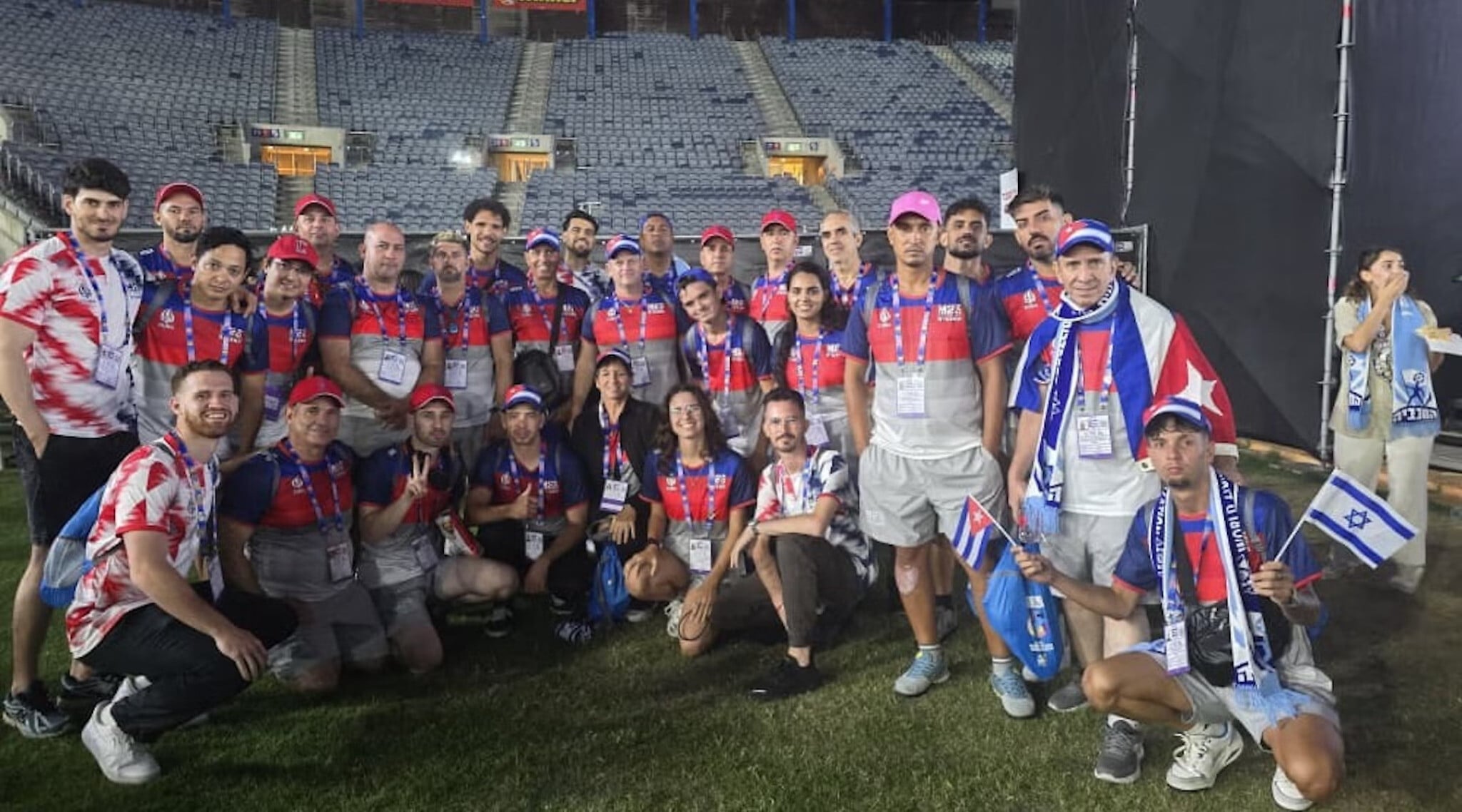
The Cuban delegation poses during the Maccabiah Games in Israel. (Courtesy Hella Eskenazi)
As Eskenazi explained, due to a variety of political and economic factors, it’s not easy to get out of Cuba. Her athletes needed various visas that would allow them to travel through Europe to get to Israel, and Cuba does not have a national airline with the same international capabilities as travel giants like Air France or Turkish Airlines.
And because Cuba’s oil supply lags behind much of the world, Air France does not offer flights from Cuba. So they had to travel to Panama first, just to get to Paris.
The original plan, Eskenazi said, was for a portion of the delegation to fly from Havana to Panama to Paris to Tel Aviv. But when Air France canceled all its flights to Tel Aviv, they had to pivot — which wasn’t easy given their restrictive travel visas.

Hella Eskenazi (fifth from left) poses with members of the Cuban delegation for the Maccabiah Games in Israel. (Courtesy Hella Eskenazi)
Part of the delegation flew from Paris to Austria, while others went through Abu Dhabi, where Eskenazi said Cubans don’t need visas. And each group had layovers of 12 or 15 hours, making the total journey from Cuba to Israel take four or five days.
Eskenazi’s journey was different because she had a visa that allowed her to travel through the United States. She flew from Havana to Miami to New York to Tel Aviv. Even then, she still had an 18-hour layover in New York.
Eskenazi said her group would not have made it to Israel without the help of the Maccabi World Union, the global organization that puts on the Games and supports local delegations.
“We are here thanks to the Maccabi World Union,” she said in a phone interview from Israel. “Maccabi World Union, they did many things for Cuba, for the Cuban Jewish community to participate in this Maccabiah.”
So once the Cuban cohort finally made it to Tel Aviv, it was understandably a meaningful arrival.
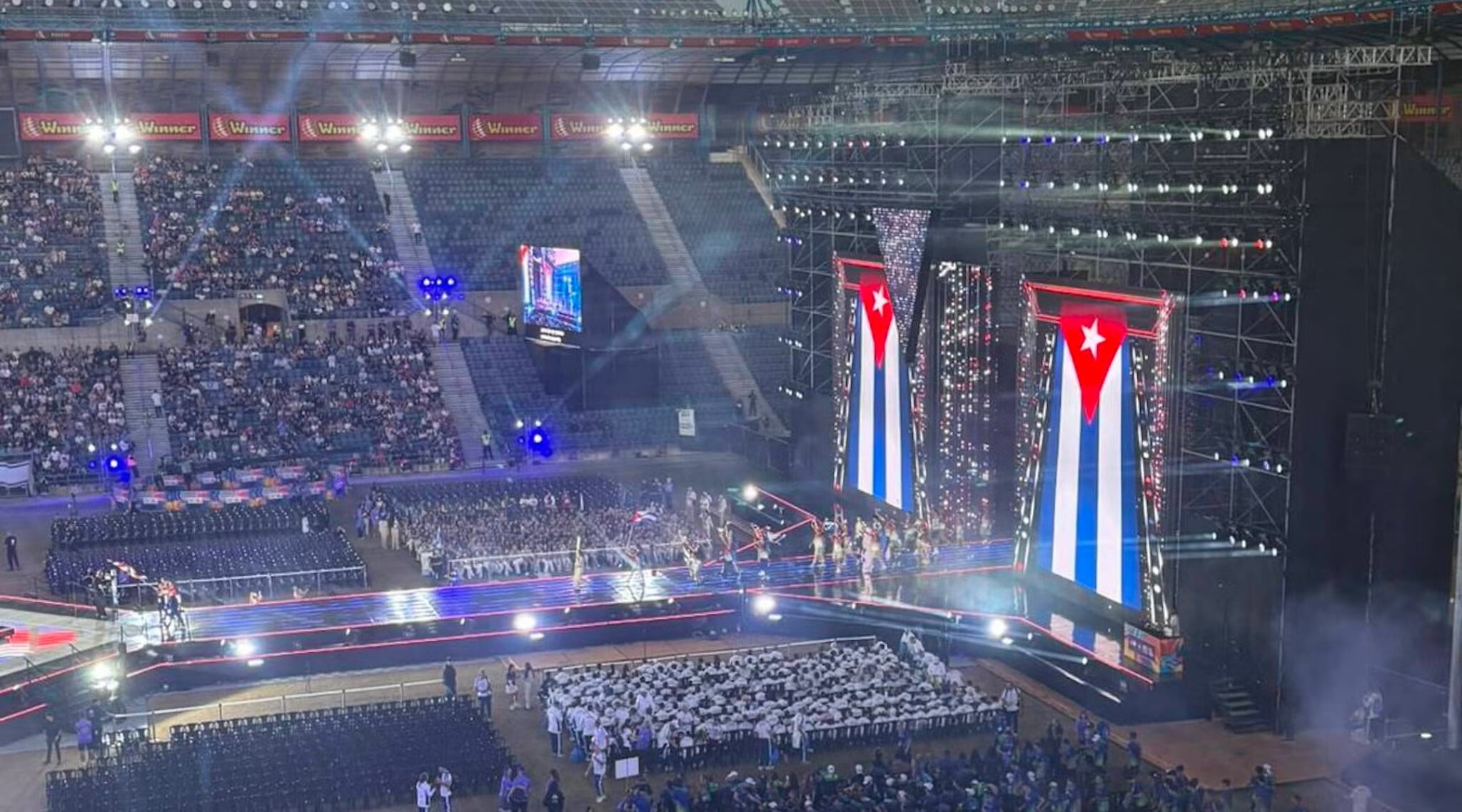
The Maccabiah Games are held at Teddy Stadium in Jerusalem, Israel. (Courtesy Hella Eskenazi)
“It has been very, very emotional for us because in Cuba we have many difficulties right now,” Eskenazi said. “And to arrive here, to have electricity, to have food, to be safe, to have our friends, to make sport, to share with all of the people from all over the world, has been very emotional, very emotional for us.”
It’s also been a successful trip, competitively speaking.
Cuba has won several medals, competing in sports including softball, futsal and basketball. Eskenazi herself has won two: a silver medal in the one-mile run and a bronze in the five-kilometer competition for the 55-59 age bracket.
But beyond sports, Eskenazi said it’s been a special experience for her athletes — who hail from a country with a relatively affluent but small Jewish community — to be surrounded by Jews from around the world.
“It’s very important because imagine that you can share with people from Holland, from France, from the United States,” she said. “We met people from Ukraine, from Argentina, from Mexico, from different parts of the world. It’s been very, very emotional.

The opening ceremony of the 22nd Maccabiah Games at Teddy Stadium in Jerusalem, July 1, 2026 (Danny Maron/Flash90)
“We are happy to be here because we love to share here with the Israeli way of life,” Eskenazi added. “For us, it’s very interesting, and we love Israel. Remember that we are Jewish people, and the Israeli people, they are friendly. This is a very special country. If you can see people, for example, with kippah on the street, with tefillin or tallit, it’s like to be inside of the synagogue, a big synagogue. It’s amazing to be here.”
And after the Games end, it’s right back on the plane home. Hopefully, with fewer stops this time.
Eskenazi said her delegation is again splitting up into smaller groups, with some flying back through Paris and Panama, and others going through Madrid straight to Havana.
Regardless of the logistics and the travel delays, Eskenazi said Israel is a special place.
“When I visit Israel, I feel like Cuba, like my country,” she said. “I feel that this is my home, also.”
We can’t do this work alone.

The war with Iran has been draining for all of us in Israel. But when I heard about a high casualty incident – ballistic missile impacts in Arad and Dimona that left nearly 200 people wounded – I drank a cup of coffee, packed a bag, and headed south.
There, I spoke with Shilgit, the head of an after-school program for underprivileged youth. Standing outside her destroyed center, Shilgit said it was a miracle that no children were hurt and spoke about the community coming together in the hours since.
As a Times of Israel reporter, I’m committed to telling stories of resilience like Shilgit’s. But my colleagues and I can’t do this alone. If you value work like this, please consider joining our reader support group, The Times of Israel Community. Your financial support is essential to keep real human reporting like this going.
— Stav Levaton, military reporter
Already a member? Sign in to stop seeing this
You’re a dedicated reader

That’s why we started the Times of Israel – to provide discerning readers like you with must-read coverage of Israel and the Jewish world.
So now we have a request. Unlike other news outlets, we haven’t put up a paywall. But as the journalism we do is costly, we invite readers for whom The Times of Israel has become important to help support our work by joining The Times of Israel Community.
For as little as $6 a month you can help support our quality journalism while enjoying The Times of Israel AD-FREE, as well as accessing exclusive content available only to Times of Israel Community members.
Thank you,
David Horovitz, Founding Editor of The Times of Israel