
The Israel Innovation Authority plans to invest NIS 100 million ($33 million) to establish national infrastructure for research and development that will help local companies and universities test, evaluate, and adopt advanced quantum computing technologies.
To that end, the authority on Monday announced a request for proposals to launch and operate a national quantum computing R&D infrastructure center. The call for proposals is intended for industrial corporations that will establish and provide R&D services to Israeli companies and research institutions active in quantum computing.
The center will allow local companies and researchers to experiment, compare platforms, assess performance, and develop new applications across a range of quantum computing architectures. The infrastructure will integrate at least three different quantum processing technologies.
“Quantum computing is expected to fundamentally transform the way industries address highly complex computational challenges,” said Israel Innovation Authority CEO Dror Bin.
“We aim to provide Israeli industry and academia with a state-of-the-art R&D infrastructure that will enable them to evaluate, integrate, and adopt quantum computing technologies, transforming scientific and technological knowledge into a competitive advantage for Israeli high-tech while strengthening Israel’s position as a global leader in this field,” he said.
Sign up for the Tech Israel Daily
and never miss Israel’s top tech stories
By signing up, you agree to the terms
Quantum processors promise computational horsepower to solve the most complex problems where regular computers fail. The tech could lead to breakthroughs in the areas of economics, technology, security, engineering, and science, in fields such as drug discovery, cryptography, financial modeling, and in streamlining supply-chain logistics.
Israel’s program comes as the global race to develop practical and useful software to make quantum computing more workable and accessible heats up. Major global economies have launched national quantum initiatives, led by China and the US, with multi-billion-dollar investments in research, infrastructure, and talent development.
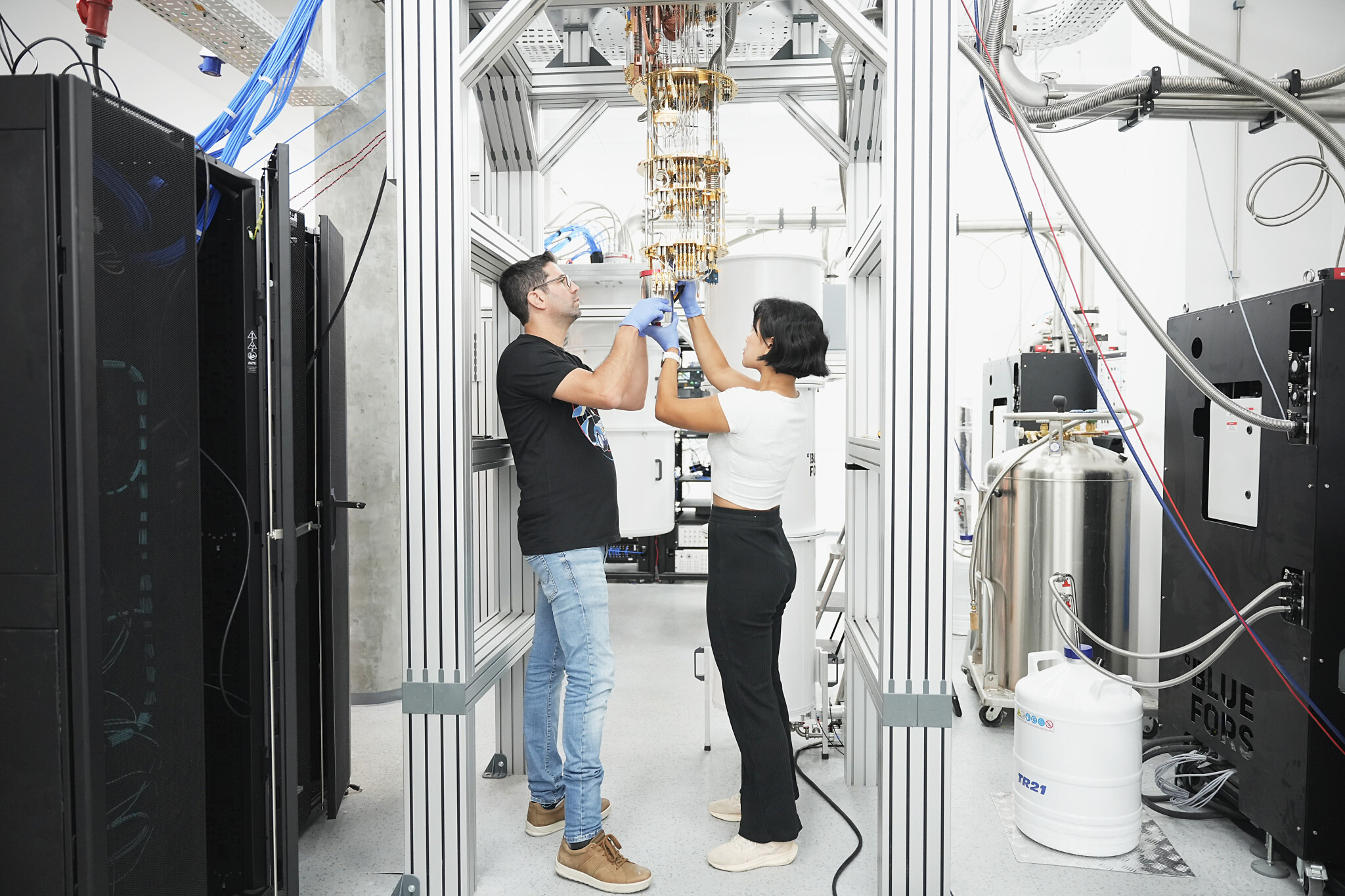
Illustrative: Employees at Quantum Machines, which was selected to establish the Israeli Quantum Computing Center at Tel Aviv University. (Dima Karminsky)
Israel lacks both the strategy and the massive investments that allow countries like the US, the UAE and Saudi Arabia to make huge leaps forward in the realm of quantum computing.
Israel has the talent and a track record of innovation, but is falling short of the much-needed investment in infrastructure, including computing power and chips. That could put the country at a disadvantage as other countries, including its neighbors, are pushing ahead in the global technological arms race.
“Establishing a national R&D infrastructure is expected to enable Israeli companies to evaluate different technologies, shorten development cycles, build practical expertise, and develop the capabilities needed to compete in the rapidly evolving global quantum ecosystem,” the Israel Innovation Authority said in a statement.
Following the deadline for proposals on October 8, and the completion of the selection process, the Israel Innovation Authority expects a national quantum computing R&D infrastructure to be established within a year. R&D services include access to hardware testing, cloud-based software development, and algorithm evaluation across multiple quantum technologies.
The infrastructure is part of the Israel National Quantum Initiative, launched in 2018 to facilitate relevant quantum research, develop human capital in the field, encourage industrial projects, and invite international cooperation on R&D.
In June 2024, Israel opened the Israeli Quantum Computing Center (IQCC), which provides access to advanced research facilities for local startups and academia.
“It was launched at a time when Israeli quantum processors were not yet available and therefore relied on foreign processors,” the Israel Innovation Authority said. “The current call for proposals is intended to establish an Israeli quantum computing technology and, on that basis, provide R&D services to Israeli academia and industry.”
Israel is home to about 20 quantum computing startups, developing everything from software systems to full quantum processors and accounts for 9 percent of global private investment in the field, according to the Israel Innovation Authority. Among the startups are Classiq and Quantum Machines.
We can’t do this work alone.

The war with Iran has been draining for all of us in Israel. But when I heard about a high casualty incident – ballistic missile impacts in Arad and Dimona that left nearly 200 people wounded – I drank a cup of coffee, packed a bag, and headed south.
There, I spoke with Shilgit, the head of an after-school program for underprivileged youth. Standing outside her destroyed center, Shilgit said it was a miracle that no children were hurt and spoke about the community coming together in the hours since.
As a Times of Israel reporter, I’m committed to telling stories of resilience like Shilgit’s. But my colleagues and I can’t do this alone. If you value work like this, please consider joining our reader support group, The Times of Israel Community. Your financial support is essential to keep real human reporting like this going.
— Stav Levaton, military reporter
Already a member? Sign in to stop seeing this
You’re a dedicated reader

That’s why we started the Times of Israel – to provide discerning readers like you with must-read coverage of Israel and the Jewish world.
So now we have a request. Unlike other news outlets, we haven’t put up a paywall. But as the journalism we do is costly, we invite readers for whom The Times of Israel has become important to help support our work by joining The Times of Israel Community.
For as little as $6 a month you can help support our quality journalism while enjoying The Times of Israel AD-FREE, as well as accessing exclusive content available only to Times of Israel Community members.
Thank you,
David Horovitz, Founding Editor of The Times of Israel