
Israeli-founded data security unicorn Cyera announced on Tuesday that it has agreed to buy local cybersecurity startup Oasis Security in a deal valued at $1 billion.
Cyera said the acquisition will bolster its data security platform by integrating data protection with Oasis’s technology for managing and securing non-human identities, as companies rapidly integrate artificial intelligence agents and autonomous tools into existing software systems and workflows, which increases data leakage and other risks.
Founded in 2022 by Danny Brickman, CEO, and Amit Zimerman, CPO, both veterans of Unit 81 — the Israel Defense Force Intelligence Corps’ Technological Unit that supplies cutting-edge technologies to the security establishment — Oasis was created to build a software platform for managing and securing machine identities.
The platform helps companies discover, manage and control access to their systems from non-human accounts, such as AI agents, as non-human identities will soon outnumber human users, the startup said.
Backed by large venture capital funds Accel, Cyberstarts, Sequoia Capital and Craft Ventures, Oasis has raised more than $195 million in funds to date.
Sign up for the Tech Israel Daily
and never miss Israel’s top tech stories
By signing up, you agree to the terms
“From day one, we recognized that non-human identities would become one of the key security challenges of the AI era,” said Brickman. “While Cyera redefined data security, we redefined identity governance for the AI age.”
Businesses adopt agentic AI or virtual AI agents into their work processes that act similarly to smart assistants, using reasoning to make real-time decisions and complete complex tasks, such as collating and analyzing vast amounts of data, but with minimal human input.
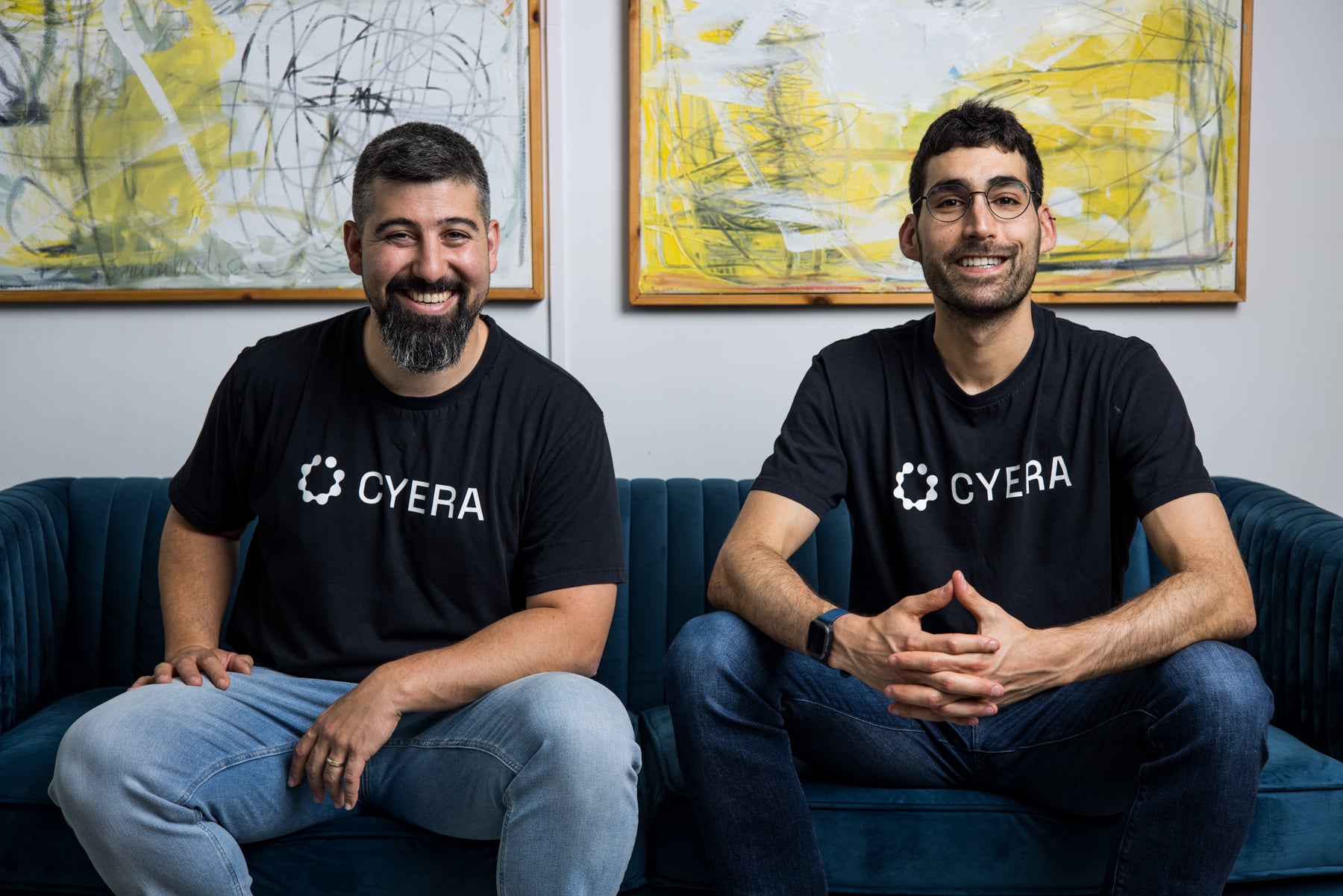
Cyera cybersecurity startup founders Yotam Segev (left) and Tamar Bar-Ilan. (Courtesy of Cyera)
As part of day-to-day workflows, autonomous AI agents execute commands, modify files and access sensitive company data often without governance, oversight, or identity management. The number of non-human identities among Fortune 500 companies has surged by 480 percent in the last six months alone, Cyera said.
“The old security model was built for humans, not machines, and AI agents are breaking whatever access controls are left,” said Cyera founder Yotam Segev. “The AI era is transforming how organizations protect their data as AI agents are arriving faster than teams can govern them.”
Cyera was founded in 2021 by Segev, CEO, and Tamar Bar-Ilan, CTO, who met during their Israeli army service, during which they built and ran the cloud security division for the IDF’s unit 8200.
Exposed to the challenges of securing data in the cloud, Segev and Bar-Ilan decided after their military service to develop and build a unified data security platform to provide businesses and organizations with a complete view of where their data “lives, how it’s used and how to keep it safe.”
“Every security decision begins with understanding two things: what data needs protection and who, or what, is seeking to access it,” said Segev. “Oasis enables us to unite these two worlds on a single platform, giving organizations the level of control they need to adopt AI securely.”
Cyera, which was last valued at $12 billion, has been on an acquisition spree over the past two years. In May, Cyera announced a deal to buy Israeli AI startup Genie Security after purchasing Israeli startup Ryft in April, and snapping up local startups Otterize and Shape AI in June, and Trail Security in 2024.

Illustrative: Hand holding AI agents’ virtual interface with data analytics, automation, and machine learning icons. (iStock by Getty Images/Suchat longthara)
Cyera’s data and AI platform is deployed by more than 20% of Fortune 500 companies operating in the areas of financial services, retail, media and entertainment, healthcare, technology and global telecom, the firm said.
We can’t do this work alone.

The war with Iran has been draining for all of us in Israel. But when I heard about a high casualty incident – ballistic missile impacts in Arad and Dimona that left nearly 200 people wounded – I drank a cup of coffee, packed a bag, and headed south.
There, I spoke with Shilgit, the head of an after-school program for underprivileged youth. Standing outside her destroyed center, Shilgit said it was a miracle that no children were hurt and spoke about the community coming together in the hours since.
As a Times of Israel reporter, I’m committed to telling stories of resilience like Shilgit’s. But my colleagues and I can’t do this alone. If you value work like this, please consider joining our reader support group, The Times of Israel Community. Your financial support is essential to keep real human reporting like this going.
— Stav Levaton, military reporter
Already a member? Sign in to stop seeing this
You’re a dedicated reader

That’s why we started the Times of Israel – to provide discerning readers like you with must-read coverage of Israel and the Jewish world.
So now we have a request. Unlike other news outlets, we haven’t put up a paywall. But as the journalism we do is costly, we invite readers for whom The Times of Israel has become important to help support our work by joining The Times of Israel Community.
For as little as $6 a month you can help support our quality journalism while enjoying The Times of Israel AD-FREE, as well as accessing exclusive content available only to Times of Israel Community members.
Thank you,
David Horovitz, Founding Editor of The Times of Israel