
Mediator Pakistan insisted Thursday that negotiations between Iran and the United States were ongoing, even as Washington carried out a “heavy wave of strikes” on its foe in retaliation for fresh attacks targeting Jordan.
The last two days have seen Saudi Arabia join the US in striking militant groups in Iraq, and Egypt come under fire for the first time with a drone attack at a Mediterranean port. On Thursday morning, Jordan reported intercepting incoming Iranian missiles for a second day running, while Kuwait said an Iranian strike that hit a building belonging to a Chinese company killed one person.
The return to direct hostilities followed a brief pause in fighting meant to give talks a boost.
“Negotiations between parties are ongoing, particularly on [the] Strait of Hormuz and to de-escalate,” Pakistani Foreign Ministry spokesman Tahir Andrabi told reporters in Islamabad.
Pakistan had helped to broker a deal between the warring sides, laying the groundwork for negotiations on a permanent resolution, and Andrabi said it was doing its “utmost to bring all parties back” to technical talks under the agreement.
Get The Times of Israel’s Daily Edition
by email and never miss our top stories
By signing up, you agree to the terms
Previous talks between the two parties following an April truce stalled, with the ceasefire collapsing earlier this month and Iran again slamming shut the Strait of Hormuz, a vital conduit for Middle Eastern oil and gas.
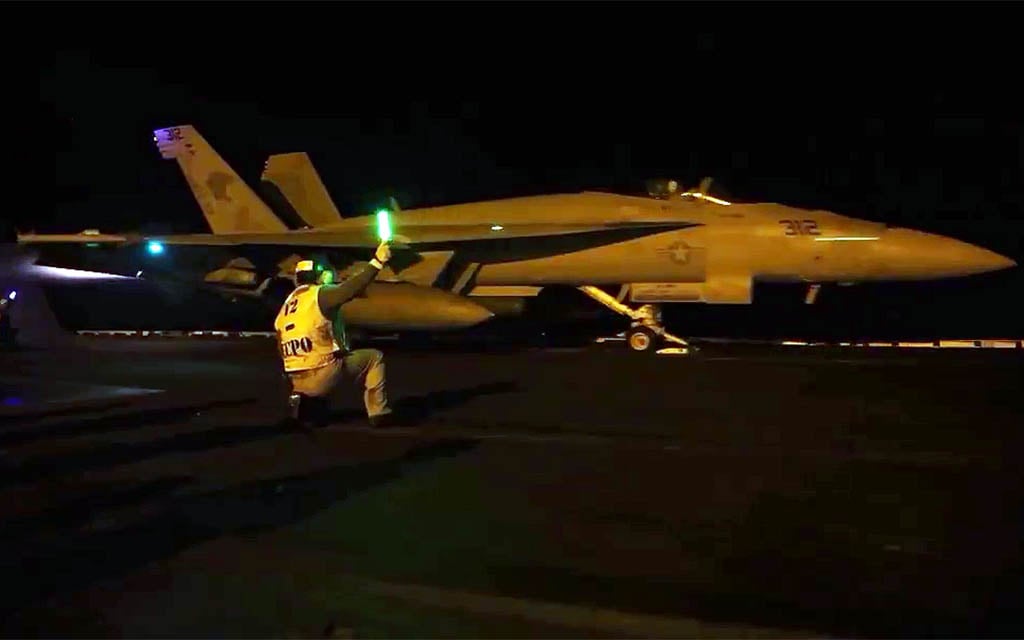
Footage released July 30, 2026, by US Central Command shows American aircraft launched against Iranian military targets. (Screenshot/CENTCOM via X)
Iran’s Revolutionary Guards said Thursday that two oil tankers attempting to transit the Strait of Hormuz with US support turned back after one of them caught fire.
Earlier, the US military said it had “successfully completed a heavy wave of strikes against Iran,” hitting dozens of Revolutionary Guard targets including military command centers.
US President Donald Trump had vowed to hit Iran “hard” after Tehran’s previous attack on Jordan, its first in the region in days.
Iran’s state news agency IRNA reported hits on several cities in the southwestern Khuzestan province, as well as on Qeshm island in the Gulf. Areas around the cities of Abadan, Shadegan, Arvandkenar and Ahvaz — all in Khuzestan — were struck, the agency said, citing provincial authorities.
Iran’s Revolutionary Guards said Thursday that three of its members were killed in an attack by the United States on the northwestern province of Zanjan.
“In the brutal attack carried out by the terrorist regime of the criminal United States on 30 July 2026, three brave and devoted members of the Ansar al-Mahdi IRGC in Zanjan province… attained martyrdom,” the Guards’ provincial branch said in a statement, according to Tasnim news agency.
— U.S. Central Command (@CENTCOM) July 30, 2026
The Jordanian army reported a new volley of Iranian missiles on Thursday morning, saying five had been shot down, causing no casualties.
The military’s official spokesperson said “air defenses engaged five missiles launched from Iran targeting the Kingdom’s territory early this morning, Thursday. The missiles were detected, intercepted, and shot down according to established defense plans,” the military’s statement said.
The Islamic Revolutionary Guard Corps said it struck the US-run Azraq base in Jordan in response to the US strikes.
“With the help of God, the aggressor will be punished today,” it said earlier in a statement carried by state media. Iran’s Guards said the US “used the occupied bases in your country [Jordan] to launch an air strike with bunker-buster bombs on two residential houses, targeting two modest homes belonging to local residents on Qeshm Island.”
The US attack had killed a father, mother and a child, and wounded two other children, according to the Guards.
Kuwait’s defense ministry, meanwhile, denounced a “heinous” Iranian attack that “targeted a building belonging to a Chinese company in the north of the country, resulting in the death of one worker and causing severe material damage.”
U.S. Sailors monitor F/A-18E Super Hornet fighter jets launching from the USS George H.W. Bush (CVN 77) while sailing in the Arabian Sea. pic.twitter.com/l5XFbEf5v7
— U.S. Central Command (@CENTCOM) July 30, 2026
And while energy facilities across the region have been repeatedly targeted by drones and missiles, Egypt had been spared until Wednesday, when an attack at a gas import hub sparked a fire that damaged two ships.
The government confirmed Thursday that a drone was responsible for the blaze, noting that no one had claimed responsibility. It added that an inquiry was ongoing “to determine the circumstances of the incident and to take the necessary measures to preserve Egypt’s interests and national security.”
Maritime trade tracking firm Kpler identified the damaged ships as the Energos Winter storage and regasification vessel and the GasLog Salem tanker, saying they had been moved offshore after the incident. A private security monitor, UK-based Ambrey, reported that the US-owned-and-operated floating storage vessel had been hit by at least one drone.
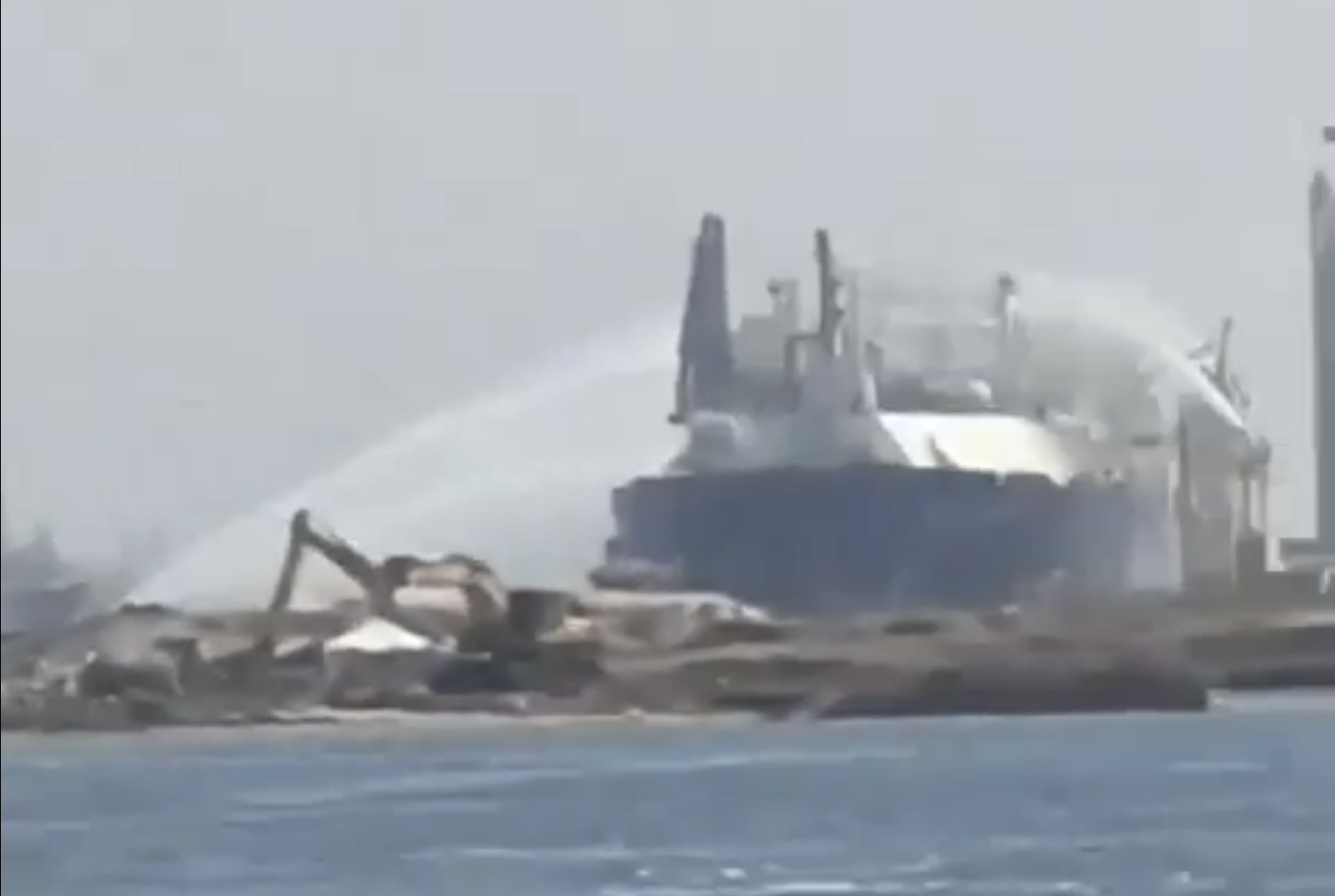
Firefighters work to put out a blaze on a gas tanker in Egypt’s Damietta port after it was reportedly hit by an Iranian drone strike, July 29, 2026. (Screenshot/ X used in accordance with clause 27a of the copyright law)
The authority that manages the port said it remained fully operational “with all terminals and berths experiencing regular vessel arrivals and departures, along with ongoing loading, unloading, and cargo handling of all types.”
Two unnamed Iranian sources, however, were quoted by The New York Times heavily implying that Tehran was behind the drone attack on Egypt.
The attack was “designed to show that global shipping and energy supplies could be more deeply disrupted if Iran chose to escalate,” the report quoted the Iranians as saying, without explicitly stating if Iran or its terror proxies launched the attack.
We can’t do this work alone.

The war with Iran has been draining for all of us in Israel. But when I heard about a high casualty incident – ballistic missile impacts in Arad and Dimona that left nearly 200 people wounded – I drank a cup of coffee, packed a bag, and headed south.
There, I spoke with Shilgit, the head of an after-school program for underprivileged youth. Standing outside her destroyed center, Shilgit said it was a miracle that no children were hurt and spoke about the community coming together in the hours since.
As a Times of Israel reporter, I’m committed to telling stories of resilience like Shilgit’s. But my colleagues and I can’t do this alone. If you value work like this, please consider joining our reader support group, The Times of Israel Community. Your financial support is essential to keep real human reporting like this going.
— Stav Levaton, military reporter
Already a member? Sign in to stop seeing this
You’re a dedicated reader

That’s why we started the Times of Israel – to provide discerning readers like you with must-read coverage of Israel and the Jewish world.
So now we have a request. Unlike other news outlets, we haven’t put up a paywall. But as the journalism we do is costly, we invite readers for whom The Times of Israel has become important to help support our work by joining The Times of Israel Community.
For as little as $6 a month you can help support our quality journalism while enjoying The Times of Israel AD-FREE, as well as accessing exclusive content available only to Times of Israel Community members.
Thank you,
David Horovitz, Founding Editor of The Times of Israel