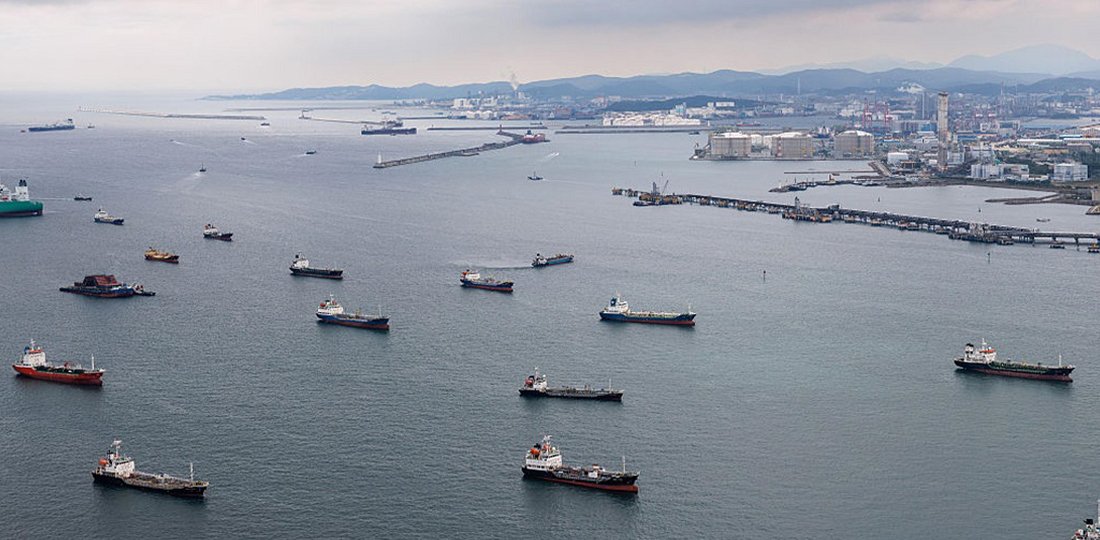
Washington DC. Although efforts to end the US-Iran war continue, the future of peace talks remains unclear. In this situation, data has been released showing that ship traffic in the Strait of Hormuz and Bab el-Mandeb Strait, two of the world’s most important maritime trade routes in the Middle East, remained almost stable on Tuesday compared to the previous day.
According to the ship monitoring organization Klepper, a total of eight ships transited the Strait of Hormuz on Tuesday. Of these, five were oil tankers and three were dry cargo ships. This number has not changed compared to Monday. Six of the eight ships entered the strait, while one liquefied natural gas tanker and one oil tanker exited.
Before the war began, the Strait of Hormuz was one of the busiest sea lanes in the world. An average of 130 to 140 ships used to transit this route daily. However, after the US and Israel jointly launched military operations against Iran on February 28, Iran announced the closure of the strait. Since then, the number of ships has decreased drastically, affecting global energy supply.
The Strait of Hormuz is a major maritime route for the transport of about 20 percent of the world’s consumed crude oil and a large amount of liquefied natural gas, making its security situation extremely important for the global energy market. For this reason, every activity in this region is closely monitored by the international market.
Meanwhile, the liquefied natural gas tanker Mubarez, operated by the Abu Dhabi National Oil Company of the United Arab Emirates, has again passed through the Strait of Hormuz and reached India. According to data from the London Stock Exchange Group and Klepper, the ship loaded gas from Das Island in the United Arab Emirates on July 14. The ship was last seen inside the Strait of Hormuz on July 16. The Mubarez is currently near the western coast of India. According to available data, the ship is expected to reach the port of Dahej in Gujarat, India on August 5. This is Mubarez’s third journey carrying gas from Das Island and passing through the Strait of Hormuz since the war began.
Previously, it had successfully completed two gas shipments to China and India. However, Abu Dhabi National Oil Company stated that, according to its policy, it does not comment publicly on the location, movement, or route of the company’s ships. Meanwhile, ship traffic also appeared stable on Tuesday in another important maritime route, the Bab el-Mandeb Strait. According to Klepper, 20 ships transited this strait. Of these, 10 ships entered the strait and 10 exited. This number is also the same as the previous day. Among the ships entering via Bab el-Mandeb were six oil tankers, three dry cargo ships, and one gas tanker. Similarly, among the exiting ships were seven oil tankers and three dry cargo ships.
According to analysts, the actual number of ships may be slightly higher than what appears in the data. It is said that some ships travel with their transponders turned off for security reasons, so such ships are not included in the official count. Meanwhile, Qatar has announced positive progress in the mediation efforts to end the US-Iran war. According to Qatari officials, efforts to advance the talks are ongoing, and there are indications that significant progress has been made on some important issues. This hope has also led to a decrease in the price of crude oil in the international market.
However, Iran has denied the claim by US President Donald Trump that peace talks have already begun. Tehran has clarified that formal talks have not started and no final agreement has been reached. This indicates that there is still uncertainty about the peace process. Hormuz and Bab el-Mandeb are the most sensitive maritime routes for world trade. Since most of the crude oil, natural gas, and other goods exported from West Asia to Asia, Europe, and other regions are transported through this route, the security situation here and ship traffic directly impact the global economy, energy supply, and international trade.