
The Knesset dissolved on July 17 ahead of the October 27 election, ushering in a period during which, broadly speaking, new legislation and business is frozen unless there is coalition-opposition consensus.
Defying that norm, however, Benjamin Netanyahu’s government last week convened the Knesset Finance Committee and attempted to allocate almost $100 million to the ultra-Orthodox education system — including millions to build more Haredi schools, millions for yeshivas, and millions aimed at preventing yeshiva students from dropping out. There was, to put it mildly, no coalition-opposition consensus on this package of additional pre-election finance for the Haredim, and opposition politicians managed to thwart it — staging an 11-hour filibuster to prevent a vote.
It had naively been expected that this would be the end of the matter — since opposition consent was believed to be required even to convene another committee session on the same matter. But the coalition scheduled a second session nonetheless, ignoring opposition objections and a failed petition to the High Court, and on Tuesday it bulldozed through a similar package of extra Haredi “educational” funding that also included money for a so-called Yeshiva Committee that has encouraged ultra-Orthodox draft evasion.
Israel’s education system is in crisis. It ranks 31st among 36 participating OECD countries in the latest PISA tests (the Program for International Student Assessment, which assesses 15-year-old students’ reading, mathematics, and science abilities).
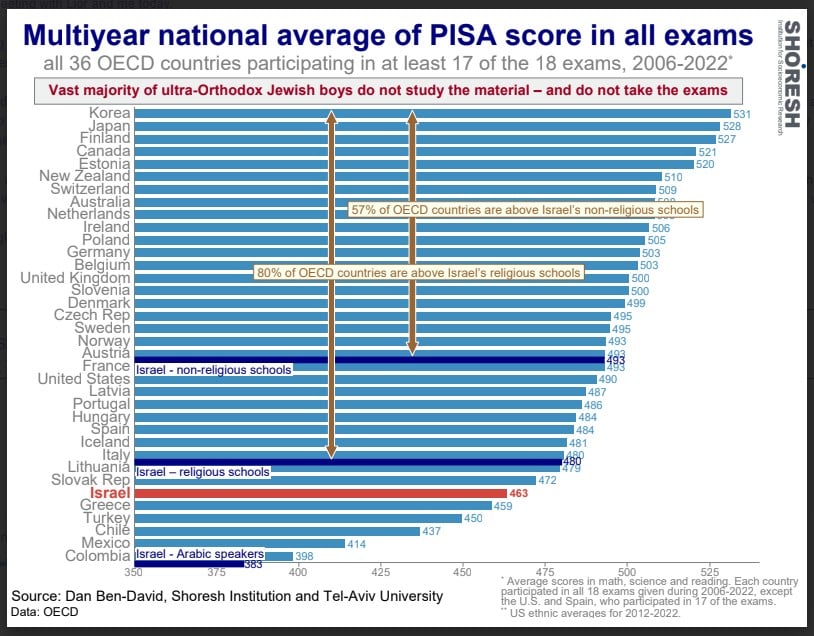
Israel’s educational ranking — bad, and not even the full story. (Courtesy: Shoresh Institution)
And that appalling standing does not fully reflect Israel’s dismal reality.
Get The Times of Israel’s Daily Edition
by email and never miss our top stories
By signing up, you agree to the terms
The vast majority of ultra-Orthodox boys, from their early teens onward, do not study a core curriculum — indeed study no secular subjects at all. Naturally, they do not take the PISA tests. Were they to do so, the true status of Israeli education would be revealed in all its gravity.
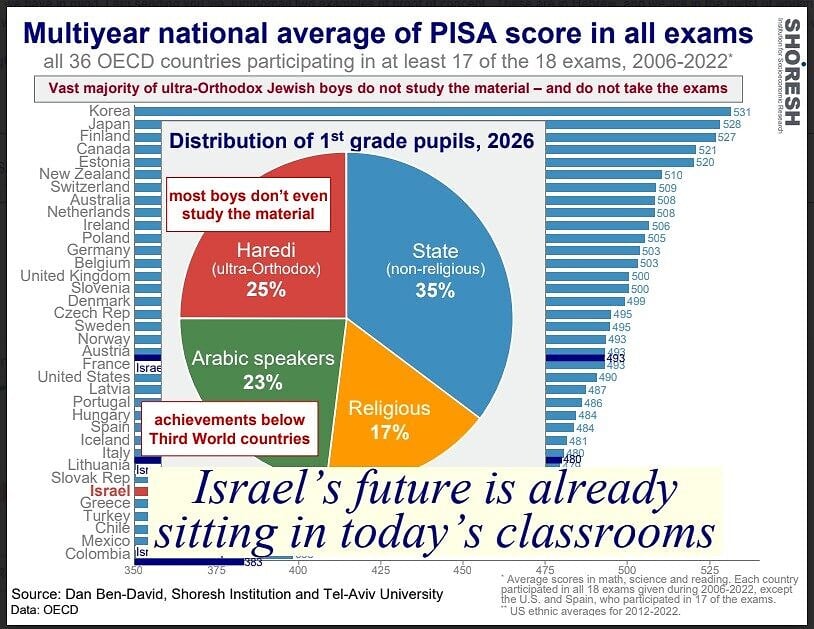
The same chart, overlaid with distribution of 1st grade Israeli students. (Courtesy: Shoresh Institution)
Not all young ultra-Orthodox men insistently reject worldly education. But those who apply for higher education programs, get accepted and begin such studies drop out at disproportionately high rates, according to data prepared by academic economist Prof. Dan Ben-David, because they have been deprived during their earlier miseducation of the basic tools to give them a realistic chance of success.
All of this renders the men of the fastest-growing community in Israel either unwilling to enter Israel’s hitherto first-class workforce (choosing to stay in yeshiva) or incapable of doing so (because of miseducation) — exacerbating the decline in the prowess of the Israeli labor pool, with genuinely existential consequences. “There won’t be a third-world Israel,” warns Ben-David. In the “spiral of collapse” that Israel has already entered, he says, an increasingly inadequate education system will inevitably be unable to maintain a first-class economy, a first-class health system, or a first-class army. And a weakened army won’t be capable of protecting the state.
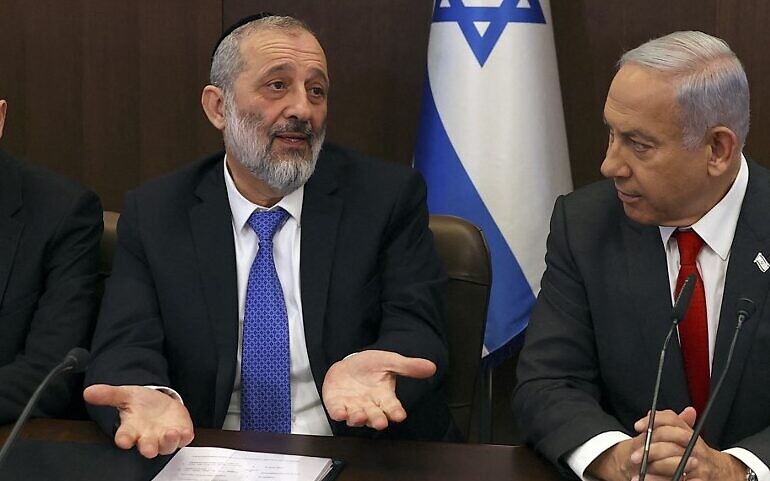
Interior and Health Minister Aryeh Deri with Prime Minister Benjamin Netanyahu at a cabinet meeting at the Prime Minister’s office in Jerusalem, on January 8, 2023. (Ronen Zvulu/Pool/AFP)
Netanyahu knows this, knows it deep down. He recognizes the dangers to Israel’s current and future capacity to survive and thrive posed by the exponential growth of an ultra-Orthodox community that is being deprived of an adequate education, refuses to serve in the army, and lacks the tools to productively enter the workforce even if it wanted to.
As finance minister back in 2003-5, with Israel facing recession and needing to cut public spending and revitalize the economy after the suicide-bomber battering of the Second Intifada, Netanyahu slashed child allowances — abandoning a system that offered increasing subsidies to large families (triggering an immediate fall in the ultra-Orthodox birthrate) — and stopped an array of other welfare payments and income supplements, to compel wider participation in the workforce.

Israeli fertility rates. (Shoresh Institution)
But as prime minister for most of Israel’s recent lifespan, dependent on ultra-Orthodox political support, he reversed course.
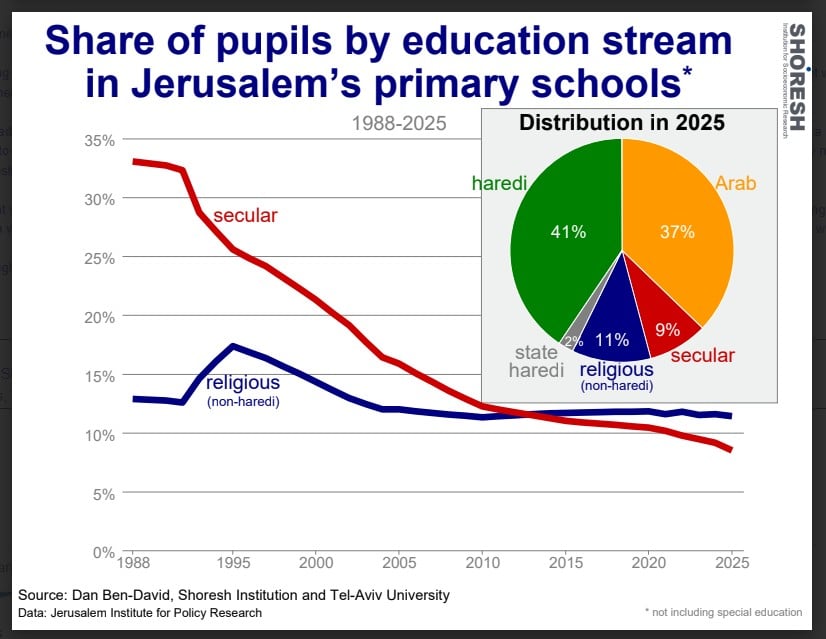
Elementary school students in Jerusalem (Courtesy: Shoresh Institution)
The ultra-Orthodox were less than 9% of the Israeli populace 20 years ago. Today, they’re over 14%. By 2040, they are projected by the Central Bureau of Statistics to be 20%, and 32% in 2065.
They’re not being properly educated. And as Tuesday’s additional, probably illegal bonus for their “schools” underlined, the outgoing coalition is doing everything in its power to exacerbate the crisis. (Unsurprisingly, the High Court on Wednesday froze what might reasonably be described as these attempted pre-election bribes, as the coalition surely knew would happen — bolstering solidarity in the far-right/right/ultra-Orthodox coalition bloc against the loathed High Court.)
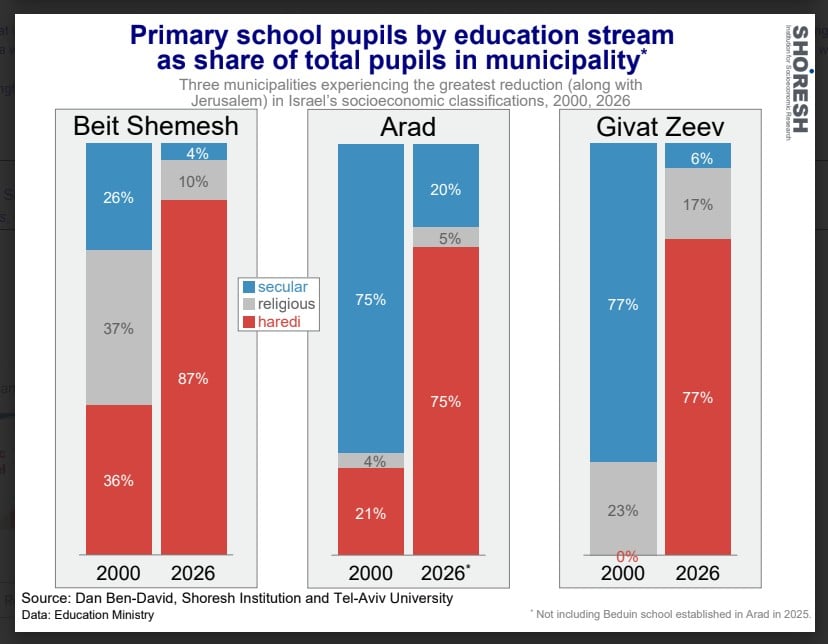
The soaring proportion of ultra-Orthodox students in Beit Shemesh, Arad, and Givat Zeev, from 2000 to 2026. (Shoresh Institution)
Two years ago, 130 of Israel’s leading economists published an open letter warning that “the combination of the policies of Israel’s governments over time and the high growth rate of the Haredi population is leading the country towards an abyss, one that poses a very real and very grave threat to Israel’s economy and society, including to the Haredi community itself.”
Today, these experts noted, “22% of all children under working age (0-14 years old) are Haredim. By 2065, this share is expected to be roughly 50%, more than doubling the Haredi share in just four decades. Without sweeping, profound, and rapid changes in government policy, the State of Israel will face existential danger.”
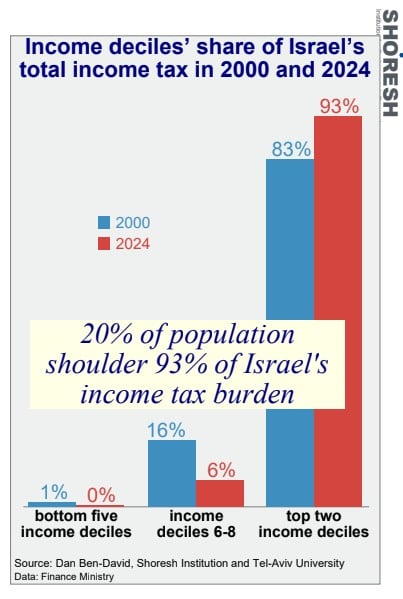
Who pays how much income tax (Shoresh Institution)
“Without a change in the current trajectory,” they continued, “many of those who bear the [economic and security] burden will prefer to emigrate from Israel. The first to leave will be those with opportunities abroad: physicians, engineers, high-tech workers, and scientists. Israel’s remaining population will be less educated and less productive, thus increasing the burden on the remaining productive population. This, in turn, will encourage further emigration from Israel. This process of a ‘spiral of collapse’ in which increasingly larger groups decide to emigrate, will further deteriorate the conditions of those who remain…”
The warning went unheeded and, Ben-David notes, the stream of emigration, notably among the 300,000 or so Israelis who are central to Israel’s economy and well-being, notably in the vaunted, vital tech sector, is in danger of becoming a flood.
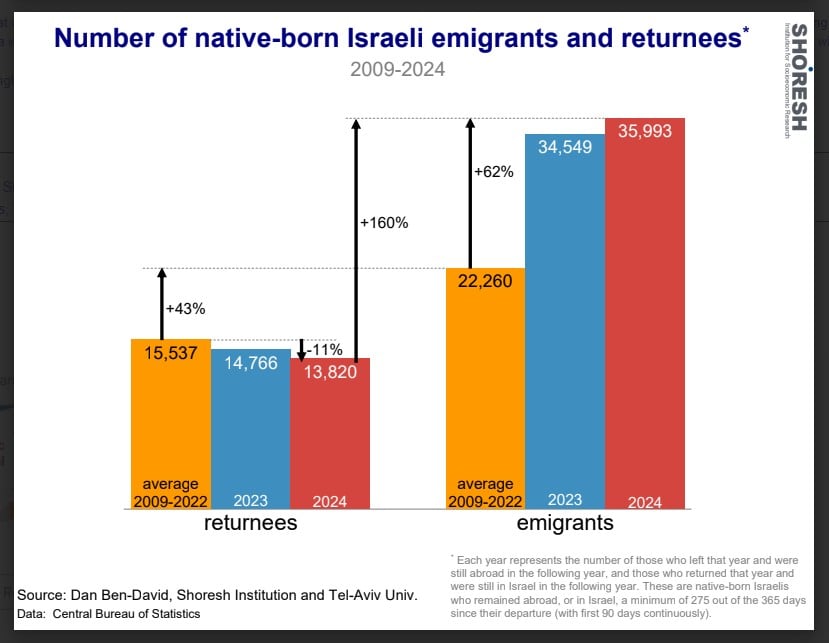
Israelis coming and going (Courtesy: Shoresh Institution)
Ben-David believes the situation is still salvageable. He has done the rounds of innumerable Israeli political leaders and key officials — Gadi Eisenkot, Naftali Bennett, Gideon Sa’ar and many more — walking them through a presentation that ran to 73 largely horrifying charts when he showed it to me this week. (I’ve peppered this article with several of them.) And he’s met in the past with Netanyahu, with Shas leader Aryeh Deri and multiple other ultra-Orthodox leaders.
Bennett, in particular, gives every sign of being persuaded of the crisis, and has lately advocated that Haredi schools that do not teach a core curriculum, and other essential subjects such as civics besides, simply not be allowed any state funding, and that Haredim unwilling to perform national service or enter the workforce get no government allowances or subsidies.
“We will not fund an independent [Haredi] state,” Bennett told The Times of Israel in June. “We, I will not fund a school that does not teach all of the core curriculum — not only math and English, which I used to think is the main thing, but it’s not only that. Math, English, civics, democracy, Zionism. You want to teach your kids, ‘We’ll die and we won’t enlist.’ Fine, go find a plot of land, buy it, build a school, hire teachers, do it at your own cost. Build a private school; we will not fund it.”
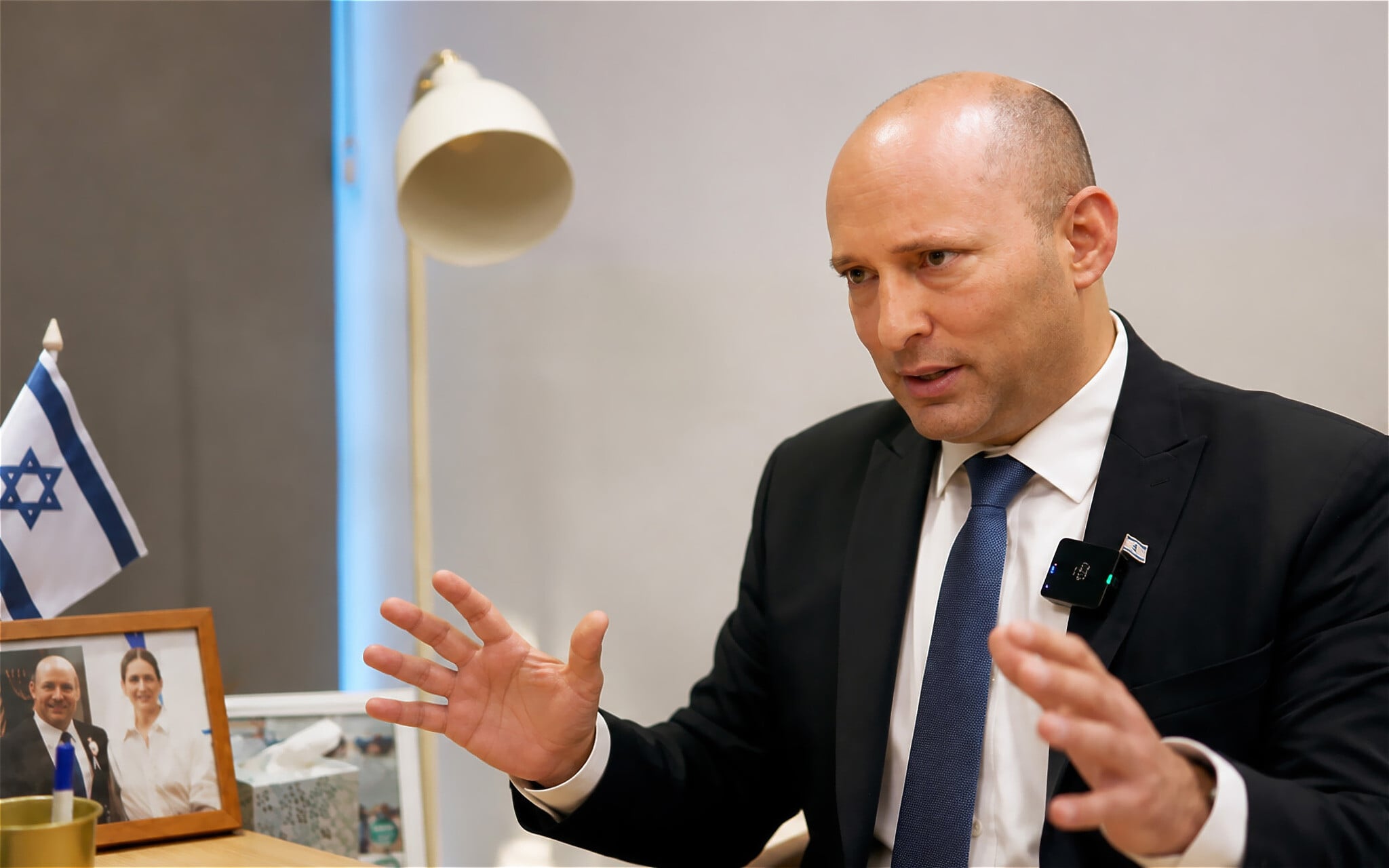
B’Yachad (Together) party leader and former prime minister Naftali Bennett in an interview for The Times of Israel at his Together party HQ on June 11, 2026 (Yitzhak Ledee/Times of Israel)
Warming to his theme, Bennett went on, “You want to not go to work your whole life. Fine, I can’t force you to work. I will not give you a shekel in allowances, in reduced municipal taxes, in reduced mortgages, in daycare subsidies. Not one shekel. You don’t go to the army, fine. I will not fund a shekel… We have developed something so distorted, so crazy, but it’s been normalized, because we live in it, and we never woke up to say, What the heck have we done here? So now’s the moment.”
“In each of those three paths, which are education, employment, and the service, we will [instead] have a beautiful and compelling on-ramp,” promised the former and would-be-again prime minister. “We’re not fighting the Haredim; we’re saving the Haredim. The on-ramp will be amazing: State Haredi schools where 60% of their curriculum is what I said, and 40% is Talmud study. Every school in Israel will have a 40% [range of specialty subjects such as] cyber, music, nature studies, but every kid will learn English, math, Bible studies, civics, and Zionism. By the way, Jews and Arabs alike. Everyone will learn that basis. You don’t want to? You can build your private school.
“Same with work,” Bennett said. “What we’re going to have are job-training programs for these people… I’m dati, I’m a man of faith. I believe,” he stressed. “I learn Torah. I love the Torah. This is not against the Torah. This is for the Torah.”
Interviewed on Channel 12 TV last week, Bennett tried multiple times to convey this message. His interviewer was insistently focusing on the battle for opposition primacy between him and Eisenkot, and Bennett had trouble getting a word in. But he tried.

Prof. Dan Ben-David (left) meets with Yashar! leader Gadi Eisenkot (Shoresh Institution)
At his Shoresh Institute, Ben-David has drawn up a four-point road map for “ensuring Israel’s future.”
Its mission: “Returning Israel to a sustainable long-run trajectory — ensuring faster economic growth, lower poverty, and Israel’s ability to defend itself.” (He discusses it further in the podcast below.)
One clause mandates budgetary reform — with a “shift from sectoral to national priorities” and the “termination of benefits incentivizing lifestyles of non-work.”
Another demands electoral reform, with the creation of effective checks and balances between the three branches of government, and the installation of cabinet ministers “with understanding and expertise in their ministry’s realm, within an executive branch able to implement its decisions and enforce the law.”
Ben-David also urges the ratification of a constitution to “set in stone national foundations that will protect the country and the basic rights of its citizens, making it difficult for anyone to erode these foundations in the future.”
But his first essential remedy is to shut down Israel’s current, four-stream education system entirely, and establish one education system for all, with a transformation in operation, management and oversight. He calls for a “complete prohibition on the involvement of political parties in educational content” and an overhaul of the process by which teachers are “chosen, taught and compensated.” And he seeks a “significant upgrade of compulsory, identical core curriculum, with state funding only for fully compliant schools.”

Finance Committee chair MK Hanoch Milwidsky, right, speaks with MKs Moshe Gafni, center, and Yitzhak Pindrus during a Knesset Finance Committee meeting in Jerusalem, August 4, 2026, at which additional funding was approved for Haredi education. (Chaim Goldberg/Flash90)
The outgoing coalition has no intention of doing any of this — as underlined by the antics at the Knesset Finance Committee on Tuesday.
It has spent its four-year-term championing an ultra-Orthodox leadership that is ever-more determined to maintain its community’s broad exemption from the responsibilities of national defense, multifront war notwithstanding, and it is massively funding an ultra-Orthodox non-education system knowing full well that this godless apparatus deliberately denies its students the opportunity to effectively participate in a first-class workforce.

Ultra-Orthodox protesters demonstrate against an IDF recruitment conference for the Haredi community in Jerusalem, August 4, 2026. (Chaim Goldberg/Flash90)
“Our country did not reach this point, nor this government, by chance,” Ben-David said. “We’ve been heading steadily in this direction for decades.”
“When a country starts to collapse economically, the first to leave are the most educated, the most skilled, the people with options — which means there is a greater burden on those who remain,” he said in the podcast he did with ToI’s Amanda Borschel Dan this week, echoing that 2024 economists’ open letter. “And then those who can, of those who remain, leave — and then you’re in a situation, basically, like Venezuela was, or like Lebanon. Beirut was once called the Paris of the Middle East. These are countries that destroyed themselves.
“But the difference between them and us is that they can still be around. Nobody’s threatening their very existence. That’s not the case with Israel. If we screw this up, there will be no country for our people or for our children.”
And yet, Ben-David is adamant, “there is still time to make a difference.”
If it’s not already too late, then October’s election will be the last chance.
—
This Editor’s Note was sent out earlier Wednesday in ToI’s weekly update email to members of the Times of Israel Community. To receive these Editor’s Notes as they’re released, join the ToI Community here.