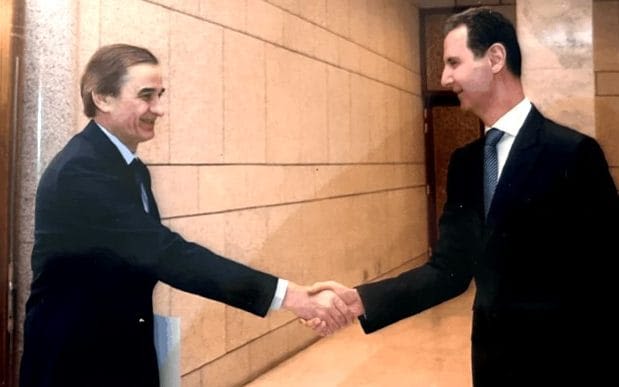

Hussam Luka held a powerful position under Assad, who is pictured shaking hands with him in a photo found in Luka’s abandoned home – BBC
A former senior Syrian intelligence official accused of orchestrating torture and massacres has been found living in Moscow.
Hussam Luka, who headed Syria’s general security directorate under Bashar al-Assad, the deposed dictator, fled when Damascus fell in December 2024.
And it has emerged that, like Assad, Luka has taken refuge in Russia.
Known as “The Spider” for his extensive network of informants, Luka was one of the most feared men in Syria, and had control over the country’s most brutal detention centres.
When Assad fled as opposition forces closed in on him, Luka also vanished, leaving even his closest allies behind without warning.

Assad with Vladimir Putin in July 2024. He was helped by Russian security services to flee Syria – Valeriy Sharifulin
He was traced in suburban Moscow through a phone book discovered in his abandoned Damascus residence by rebel fighters.
The notebook contained 155 handwritten contacts that included shopkeepers, doctors, military officials and family members, according to the BBC, which said one of the contacts finally yielded a Russian phone number for the fugitive spy chief.
Like Assad, he is shielded from international law enforcement by the Russian authorities.
As a local commander in Homs during the early Syrian civil war, Luka’s phone number was spray-painted on walls as residents were told they could call him for safe passage from the besieged city.
Witnesses say some were granted transit, while others who called the number were never seen again.
Luka’s most shocking alleged crime came during the 2015 Eid al-Adha holiday, when air strikes killed 28 people, including 17 children in the al-Waer neighbourhood of Homs.
According to Syrian activists, Luka personally selected the bombing targets that day.

Luka is said to have personally selected the targets for a 2015 air strike in the Al-Waer district of Homs which is known locally as the ‘Children’s Massacre’
This brutality earned him promotion. By Assad’s fall, Luka controlled Syria’s notorious Sednaya prison in Damascus, known as the “human slaughterhouse”, where tens of thousands disappeared.
As head of the general security directorate, he had control over Syria’s detention policies, and monitored communications from the prison.
Those arrested included opposition fighters, journalists, doctors and rights activists – anyone deemed a threat to Assad’s rule.
Assad now lives in Moscow’s Rublyovka, a gated community for Russia’s elite. Other officials, including Yassar Ibrahim, his former economic adviser, also escaped to Russia.
Clashes in Syria
The contrast between the exiles’ comfortable Russian existence and Syria’s deteriorating security is striking.
On Thursday, a bomb planted on a minibus in Jaramana, south-east of Damascus, wounded at least 14 people during peak hours.
Jaramana, a mixed Druze-Christian community, has become a security flashpoint.
Clashes broke out between Druze gunmen and government forces in early 2025, and government forces, and sectarian violence in April and May killed dozens before disarmament agreements were brokered.
Tensions remain high after residents protested, demanding accountability for violations in nearby Suwayda.
Authorities blame recent Damascus bombings on the Islamic State, which has exploited the security vacuum to reconstitute cells.
On Saturday, Lebanese authorities detained a former Syrian army officer on an arrest warrant from Damascus accusing him of “killing and crimes against humanity”, a judicial official told AFP.
Adel Issa, a 67-year-old former officer in the Syrian army’s 17th brigade under Assad, headed to his country’s embassy in Beirut for paperwork on Friday, the official said on condition of anonymity.
When staff learned of an arrest warrant from Damascus filed in absentia for the “crimes of killing and crimes against humanity during his time with the Syrian army”, they called on Lebanese authorities to detain him, the official added.
He is still in their custody, and Lebanon’s public prosecutor has asked his Syrian counterpart to send the suspect’s extradition file before Beirut decides whether to hand him over.
Since Assad’s fall, Syrian authorities have arrested dozens of people they say committed crimes during the country’s 13-year civil war, and trials began in April.
Syria’s attorney general has launched lawsuits against officials for crimes including “premeditated murder, torture, and death resulting from torture”.
Yet Russia – which militarily sustained Assad’s 14-year war that killed hundreds of thousands of people – is unlikely to extradite him, leaving Syrian justice prospects dim as the nation struggles with terrorism and sectarian conflict.