
Prime Minister Benjamin Netanyahu’s Likud party announced early Tuesday that Foreign Minister Gideon Sa’ar, Defense Minister Israel Katz, and Likud Central Committee chair Haim Katz will be granted guaranteed spots on the party’s electoral list ahead of the primary later this month.
The three men will be given reserved placements separate from the eight slots set aside for candidates of Prime Minister Benjamin Netanyahu’s choosing, the Likud announcement said, meaning that in total, 11 of the first 29 spaces on the ruling party’s slate will go to hand-picked candidates rather than to those elected by the party’s roughly 140,000 members at the upcoming August 17 primary.
The decision, announced just after 1 a.m., will be brought to the Likud secretariat for approval on Tuesday.
Justifying the decision, Likud said that the party’s internal court had ruled that Israel Katz could be given a reserved spot on the list “in order to allow him to deal with security needs and not engage in politics at this time.”
It added that the court had made the ruling because the defense minister “was expected to place high on the list anyway,” and thus guaranteeing his position would not make much of a difference.
Get The Times of Israel’s Daily Edition
by email and never miss our top stories
By signing up, you agree to the terms
It furthermore noted that Sa’ar had been guaranteed a reserved slot on the list under the terms of last year’s merger between his New Hope party and Likud, and that Haim Katz deserved a reserved spot by dint of his position as the central committee chair.
The 1 a.m. missive, which failed to explain why the three men were not simply allocated three of the eight reserved spots already granted to Netanyahu, was likely to incur anger within Likud, as the motion to increase the premier’s reserved slots to eight had already sparked dissent when it was approved last month.
Indeed, Likud MK Tally Gotliv on Tuesday slammed the decision to guarantee Israel Katz a spot, calling it “a disgraceful move that mocks Likud voters,” and alleging Katz was “deeply afraid of the primary results and rightly so.”

Likud MK Tally Gotliv speaks to the media outside the Jerusalem District Court, August 6, 2026. (Chaim Goldberg/Flash90)
If the party secretariat approves the three reserved slots, Netanyahu will in practice be granted control over 11 of the top 29 spots on the Likud list — and unprecedented influence over more than a third of the party’s realistic slate.
A realistic slate refers to the number of candidates from that party expected to win a Knesset seat. Public opinion polls have consistently shown Likud getting around 22-24 seats in the October 27 election, significantly down from its current 32, meaning that the 11 reserved slots would leave 11-13 positions to be filled through the party primary. More than twice as many incumbent lawmakers and ministers are expected to compete for those slots.
Likud uses a complex primary system to determine much, though not all, of its candidate list, and has long prided itself on its internal democratic processes. It is one of only a handful of Israeli parties that hold primaries to select both its leader and Knesset slate, alongside the left-wing The Democrats and the Arab-majority Hadash.
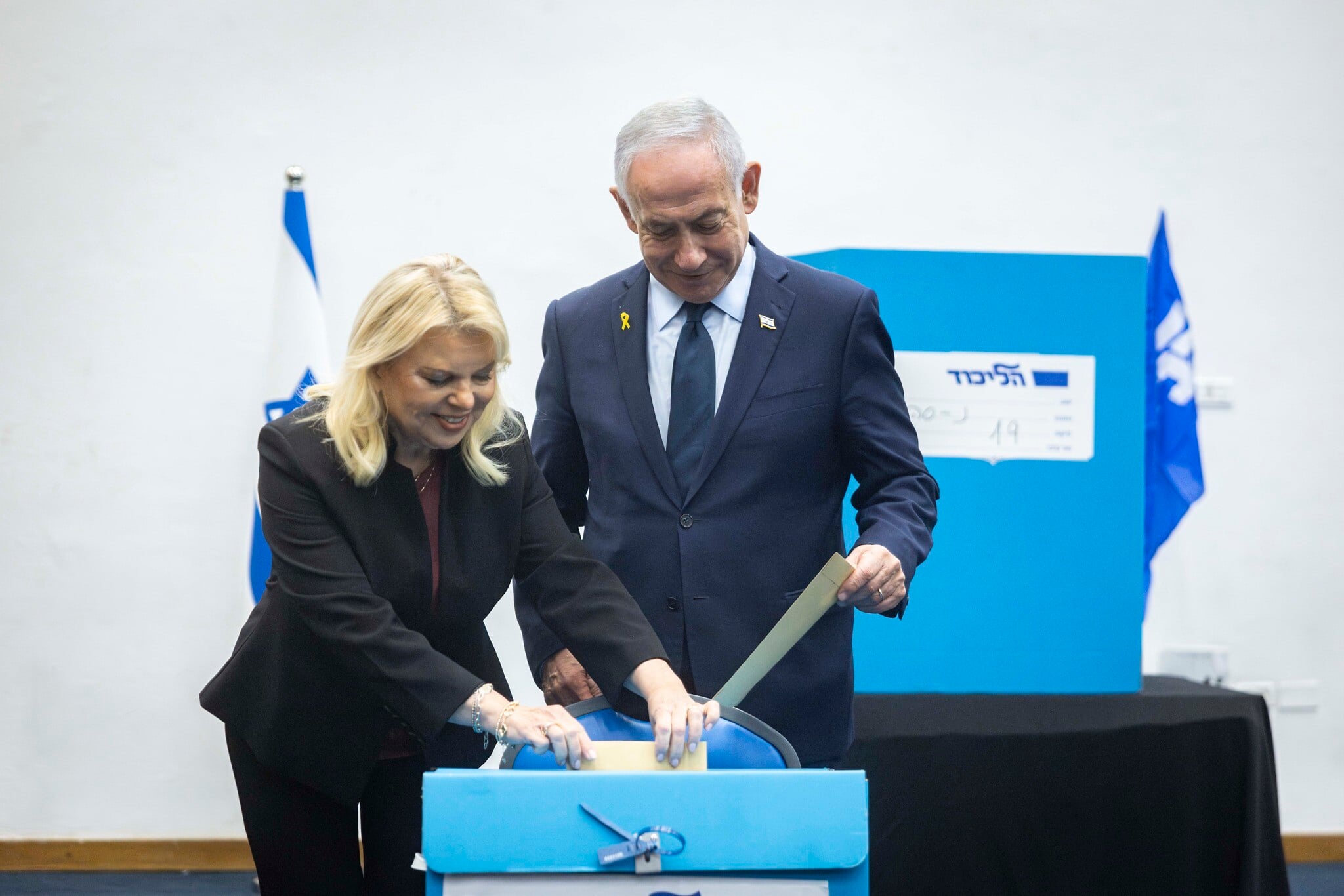
Prime Minister Benjamin Netanyahu and his wife Sara cast their vote during the elections for the Likud Central Committee, at the International Convention Center in Jerusalem, November 25, 2025. (Chaim Goldberg/Flash90)
The move was the latest controversial choice from the party, which hours earlier caused an uproar after it was discovered that Netanyahu’s first pick for his eight reserved slots, entrepreneur Oren Dobronsky, had recently called US President Donald Trump a “morally corrupt piece of shit.”
The announcement did not specify where on the list the three men would be placed. Netanyahu’s eight preferred candidates, including Dobronsky, will be placed in the 3rd, 5th, 9th, 11th, 15th, 18th, 26th and 29th spots on the list.
The primary race will be tighter still after the Likud internal tribunal overturned a Central Committee vote to allow sitting and former lawmakers to compete for slots reserved for regional districts.
The district spots have for decades been open only to new candidates, acting as a diversifying tool that gives new figures a chance to make it into the Knesset.
The Likud Central Committee vote, had it not been overturned, would have taken some of the pressure off veteran lawmakers and ministers by allowing them to compete for more slots.
Ariela Karmel and Sam Sokol contributed to this report.
Help us report truthfully on social media

As a multimedia journalist, my job is to take the quality, fact-based journalism produced by The Times of Israel newsroom and make it accessible across every platform — from Instagram posts to podcasts to short-form videos.
This is how many, especially young people, consume news these days. But misinformation is rampant on social media. Our team at ToI produces accurate, responsible short-form reporting on Israel and the Jewish world.
If you believe in the importance of factual social media journalism, please consider joining our reader support group, The Times of Israel Community. Your financial support is essential to sustain responsible multimedia reporting.
— Gabriella Jacobs, multimedia journalist
Already a member? Sign in to stop seeing this
You’re a dedicated reader

That’s why we started the Times of Israel – to provide discerning readers like you with must-read coverage of Israel and the Jewish world.
So now we have a request. Unlike other news outlets, we haven’t put up a paywall. But as the journalism we do is costly, we invite readers for whom The Times of Israel has become important to help support our work by joining The Times of Israel Community.
For as little as $6 a month you can help support our quality journalism while enjoying The Times of Israel AD-FREE, as well as accessing exclusive content available only to Times of Israel Community members.
Thank you,
David Horovitz, Founding Editor of The Times of Israel