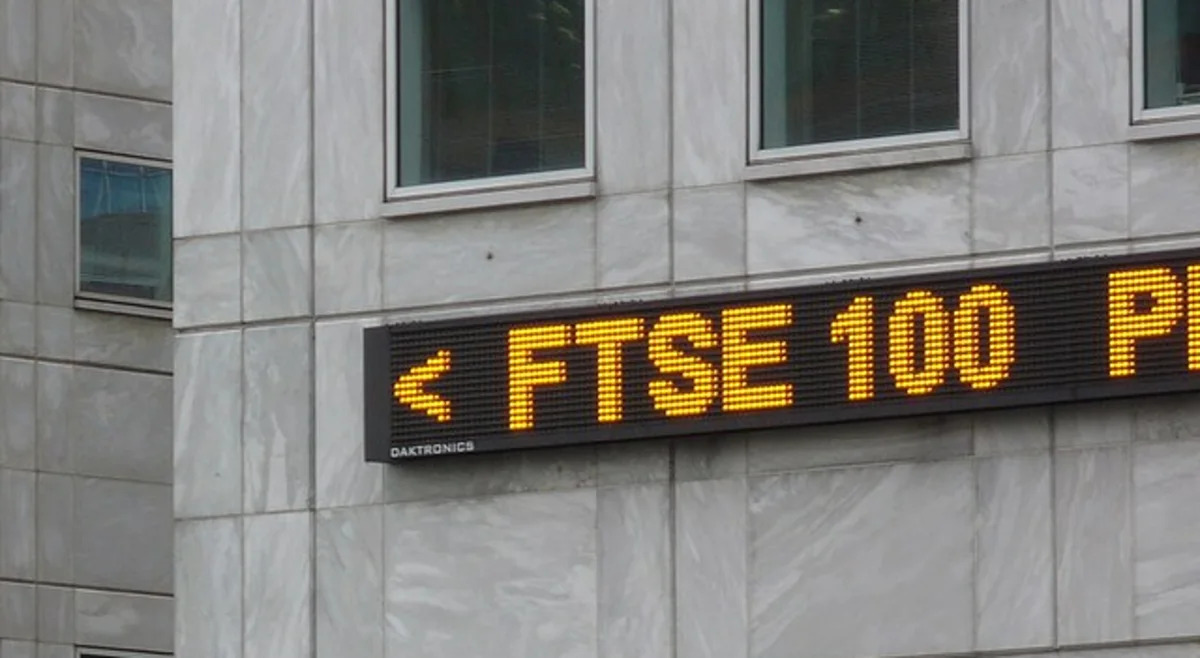
 FYSE 100 sign ©Metro Centric
UK equities moved modestly lower on Tuesday as renewed tensions between the United States and Iran combined with disappointing British retail sales data to dampen investor sentiment.
As of 03:23 ET (07:23 GMT), the FTSE 100 was down 0.08%. Germany’s DAX declined 0.06%, while France’s CAC 40 fell 0.07%. Sterling was unchanged against the dollar at $1.3501.
Geopolitical risk remained firmly in focus after the Washington Post reported that U.S. President Donald Trump used a decoy operation when leaving Turkiye following the NATO summit on July 8 because of a potential Iranian threat.
According to the report, Trump was covertly transferred by catering truck to a smaller C-32A aircraft, while the traditional Air Force One continued its journey carrying journalists and some White House personnel.
A U.S. official described the situation as involving a “credible threat” from Iran.
A White House spokesperson defended the security measures, saying “there are many enemies of America who have their sights on him, and we use every tool at our disposal to address those threats.”
Tensions surrounding the Strait of Hormuz also remained elevated. Trump told reporters on Monday that the U.S. Navy has “100 per cent control” of the strategically important waterway, describing the blockade as “infallible” and a “steel wall.”
Iran’s Revolutionary Guard Corps, meanwhile, maintained that the Strait would remain a “theatre of war” until Washington meets Tehran’s conditions, including financial restitution.
Trump also reiterated his demand for reparations in a Truth Social post, saying Iran should provide compensation for the “last five month Military Conflict.”
In a separate post, he said Iran “should be responsible for the damages and death caused to the people of Lebanon, Syria, Yemen, and Gaza.”
Weak retail data adds pressure on UK stocks
Domestic economic data provided another headwind after UK retail sales growth slowed considerably in July.
Total sales increased 1.3% year on year, according to BRC-KPMG data, compared with growth of 2.5% a year earlier and below the 12-month average of 1.8%.
Food sales increased 3.8%, helped by the closing stages of the World Cup, but non-food sales declined 0.7%.
“Consumer demand has struggled in the heat, leaving retailers facing a challenging start to the second half of the year,” said Helen Dickinson, chief executive of the British Retail Consortium.
Dickinson added that “household budgets remain stretched” and called on the government to reduce business rates and regulatory costs.
IGD chief executive Sarah Bradbury also warned that “pressures are building across the food supply chain” because of the Middle East conflict and hot weather, creating a risk of “higher food costs” heading into autumn.
Oil prices climb as Middle East risks remain in focus
Energy markets reflected the continued geopolitical uncertainty, with Brent crude rising 2.15% to $89.62 a barrel and U.S. WTI gaining 2.24% to $83.95.
Gold prices were softer. Gold futures slipped 0.02% to $4,418.82, while spot gold declined 0.65% to $4,360.46.
UK stocks in focus
Bellway (LSE:BWY) highlighted uncertainty around near-term housing demand as higher construction costs and moderating consumer demand weighed on the outlook. The housebuilder indicated that operating profit was likely to come in at the lower end of its guidance range.
IHG (LSE:IHG) reported higher second-quarter RevPAR, supported by demand from affluent travellers and activity associated with the 2026 Soccer World Cup.
With geopolitical uncertainty pushing oil prices higher and domestic retail data pointing to softer consumer demand, investors are balancing external risks against company-specific developments as the FTSE 100 trades close to flat.