
The Israeli military on Tuesday denounced the “illegal, reprehensible and unacceptable” establishment of settler outposts inside Palestinian villages in the West Bank in recent days, but did not explain why it had not dismantled them or why, in a recent example, troops prayed with civilians rather than removing them from the area.
On the outskirts of Qusra, south of Nablus, a Palestinian family has been prevented from entering or leaving since Sunday due to the settlers outside. Soldiers were filmed on Sunday arriving at the structure erected by the settlers and praying with them.
On Tuesday evening, a Palestinian Red Crescent ambulance arrived, evacuated a girl whose family wanted her to receive medical treatment, and brought some food to the two besieged families there.
Last month, settlers surrounded a home in the nearby village of Jalud for more than two weeks, after which the family living there fled, and settlers took over the property. Settlers remain in the Jalud home to this day, and its owners have been unable to return.
“In recent weeks, several reports have been received of Israeli civilians entering and taking control of Palestinian homes and land in the areas of Qusra and Jalud. This is illegal, reprehensible and unacceptable activity that harms the residents of the areas and disrupts their daily lives,” the IDF said in a statement.
Get The Times of Israel’s Daily Edition
by email and never miss our top stories
By signing up, you agree to the terms
The military said that following these incidents, “and in light of reports of disturbances, a closed military zone order was issued in the area for anyone who is not a resident of the area.”
The army said that it “strongly condemns incidents of this kind” and that “should it be determined that IDF reservists or active-duty soldiers are involved in such incidents, they will face disciplinary action.”
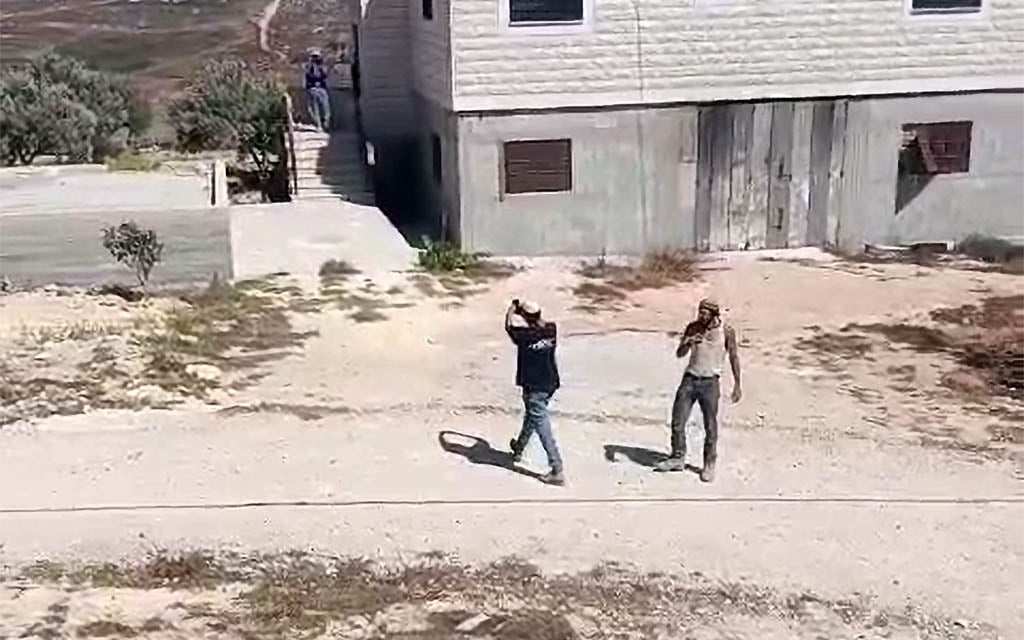
Settlers walk around the yard of a home in Jalud before taking it over, July 2026. (Courtesy)
Regarding an incident Monday in Qusra, where soldiers prevented a Palestinian ambulance carrying a foreign journalist from approaching the family’s home, the army said that the ambulance entering the closed military zone had been coordinated, but “upon the ambulance’s arrival at the checkpoint, IDF soldiers identified Israeli civilians inside who attempted to enter the area subject to the closed military zone order under the ambulance’s cover.”
“As a result, the IDF soldiers operating at the checkpoint conducted an inspection of the ambulance. Subsequently, the ambulance was inspected by the Israel Police,” the military said.
Since a deadly clash in the village of Tell last month, Israeli settlers have established 13 illegal outposts in the area. Two were demolished overnight by Israeli authorities.
A military source said the demolitions of the illegal structures were intended “to curb this serious phenomenon, to protect residents and maintain order.”
However, the IDF did not explain why the outposts were not yet razed nor respond when asked why troops have not removed settlers from the area despite the closed military zone order. Demolishing the outposts would likely require the approval of Finance Minister Bezalel Smotrich, who is also a minister in charge of settlement affairs in the Defense Ministry and has worked aggressively to expand Israel’s footprint in the West Bank.
‘Even someone in prison is given food’
Also Tuesday, a Palestinian who moved into his brother’s home on the outskirts of Qusra four months ago said he too was trapped there with his son by settlers since Sunday.
Qusai Abu Ridi told The Times of Israel that no one has been able to enter or leave the house because of the outpost settlers established near the entrance. He said it was the same outpost that has also left Youssef Hassan’s family trapped in their adjacent home.
Abu Ridi said his brother, who owns the house, lives in the United States. He moved into the property after settler attacks in which security cameras were smashed and further damage was caused, saying he wanted to stay there to protect the house.
He and his 18-year-old son have now been trapped inside since Sunday, he said.
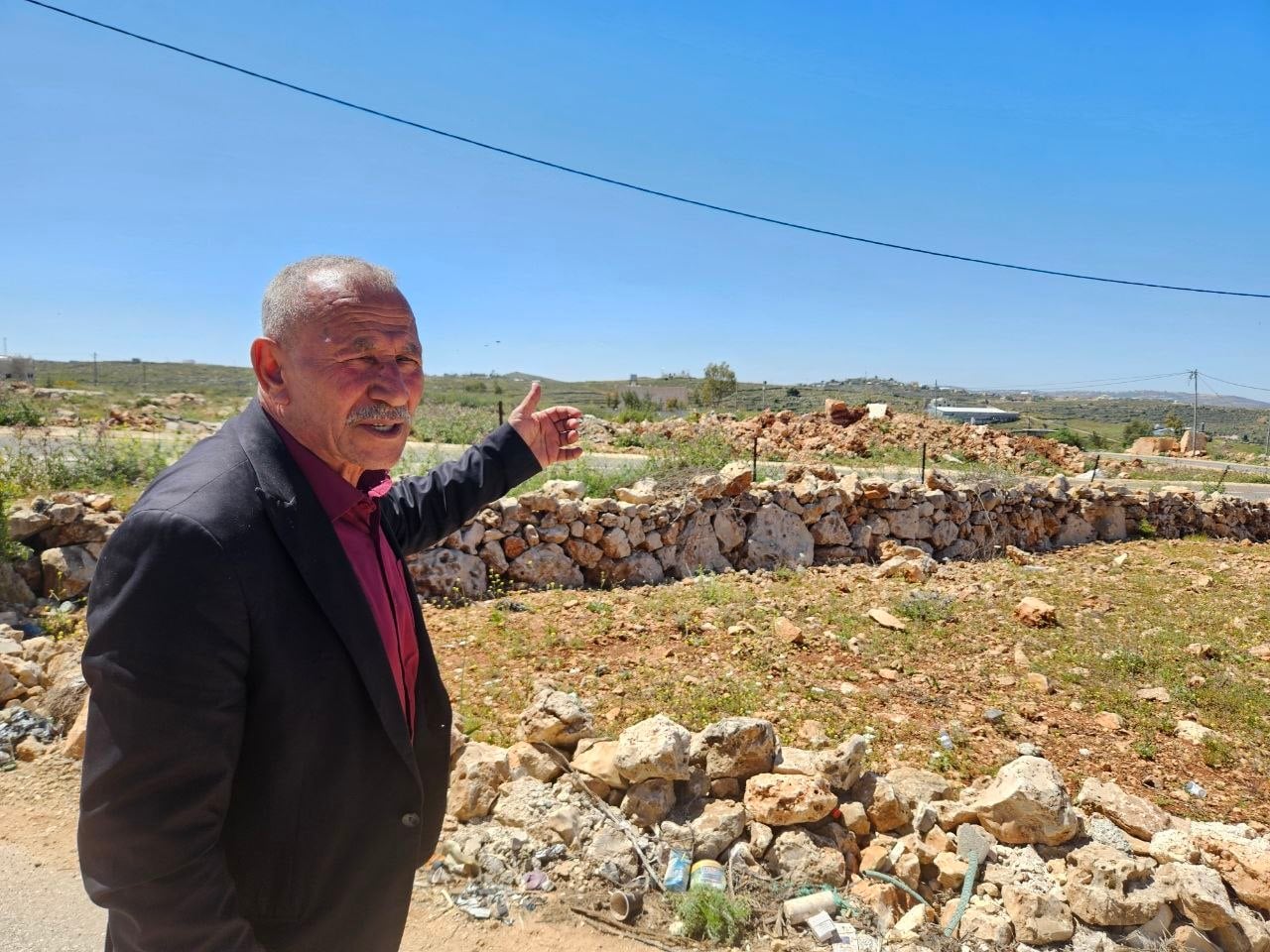
Illustrative: Hani Odeh, former head of the Qusra village council, points to structures abandoned due to settler violence, April 23, 2026. (Nurit Yohanan, The Times of Israel)
Abu Ridi said settlers have cut the home’s water and electricity lines in recent days. He added that from the house, he could see IDF troops coming and going several times a day from the area where the settlers were gathered.
“Even someone in prison is given food. We have no food,” he said. “In the end, if they don’t provide us with food, we’ll leave.”
Meanwhile, the left-wing Yesh Din organization sent an urgent appeal to IDF Central Command chief Maj. Gen. Avi Bluth, demanding that the outpost be evacuated, that its residents be prevented from remaining there, and that the safety of the Palestinians trapped in their homes be ensured.
More than 2,200 Palestinians have been displaced this year due to settler violence or access restrictions, while hundreds more have been displaced due to home demolitions by Israeli authorities, Stephane Dujarric, spokesman for the United Nations secretary-general, citing the UN’s Office for the Coordination of Humanitarian Affairs (OCHA), said in June.
Settler violence has mounted in recent years, with near-daily, sometimes deadly attacks taking place throughout the West Bank, but few suspects arrested and charged. Critics accuse the government of condoning or even encouraging the attacks.
The number of serious incidents of “nationalistic crime” committed by extremist Jewish settlers in the West Bank surged by 63 percent during the first half of this year compared to the same period last year, from 405 attacks to 660 attacks in the corresponding periods, the Kan public broadcaster reported Monday, citing security establishment figures.
Such offenses are classified by Israeli security bodies as terrorism.
Palestinian casualties from settler violence climbed sharply as well, with 140 Palestinians wounded and six killed during the first half of the year, compared with 82 wounded and none killed during the same period last year.
Times of Israel staff contributed to this report.
Help us report truthfully on social media

As a multimedia journalist, my job is to take the quality, fact-based journalism produced by The Times of Israel newsroom and make it accessible across every platform — from Instagram posts to podcasts to short-form videos.
This is how many, especially young people, consume news these days. But misinformation is rampant on social media. Our team at ToI produces accurate, responsible short-form reporting on Israel and the Jewish world.
If you believe in the importance of factual social media journalism, please consider joining our reader support group, The Times of Israel Community. Your financial support is essential to sustain responsible multimedia reporting.
— Gabriella Jacobs, multimedia journalist
Already a member? Sign in to stop seeing this
You’re a dedicated reader

That’s why we started the Times of Israel – to provide discerning readers like you with must-read coverage of Israel and the Jewish world.
So now we have a request. Unlike other news outlets, we haven’t put up a paywall. But as the journalism we do is costly, we invite readers for whom The Times of Israel has become important to help support our work by joining The Times of Israel Community.
For as little as $6 a month you can help support our quality journalism while enjoying The Times of Israel AD-FREE, as well as accessing exclusive content available only to Times of Israel Community members.
Thank you,
David Horovitz, Founding Editor of The Times of Israel
Already a member? Sign in to stop seeing this