
I always thought of him as one of the youngest people who was directly impacted by the Holocaust, despite having been spared its worst atrocities. Baruch Avidar, as he was known in Israel, died at the age of 84 last month and was buried in Rosh HaAyin, his home in recent years; he previously lived in Herzliya, Bat-Yam, and Haifa.
But he began his life in 1942 as Boris Grac (pronounced “Gratz”) in, of all places, Kazakhstan. Baruch was the son of my father’s first cousin Adam (Avram) Grac and his wife Rifka. The couple lived in Lodz, Poland, and for several years, they managed to barely stay ahead of the Nazis by continually moving eastward, eventually reaching the then-Soviet republic of Kazakhstan.

Boris Grac in Kazakhstan
(courtesy North/Avidar family)
The wrenching decision to flee their hometown was a life-saving one; Adam’s parents (my grandfather’s sister and brother-in-law) and four of his five siblings were murdered in the Shoah; Rifka’s parents and five of her six siblings were also killed.
After the end of World War II, Adam, Rifka and Boris made an ill-fated return to Poland, where life for the few surviving Jews was unbearable. My grandfather in New York managed to send them funds to set up a new life in Italy, but that move also failed, as did a brief stint in pre-state Israel.
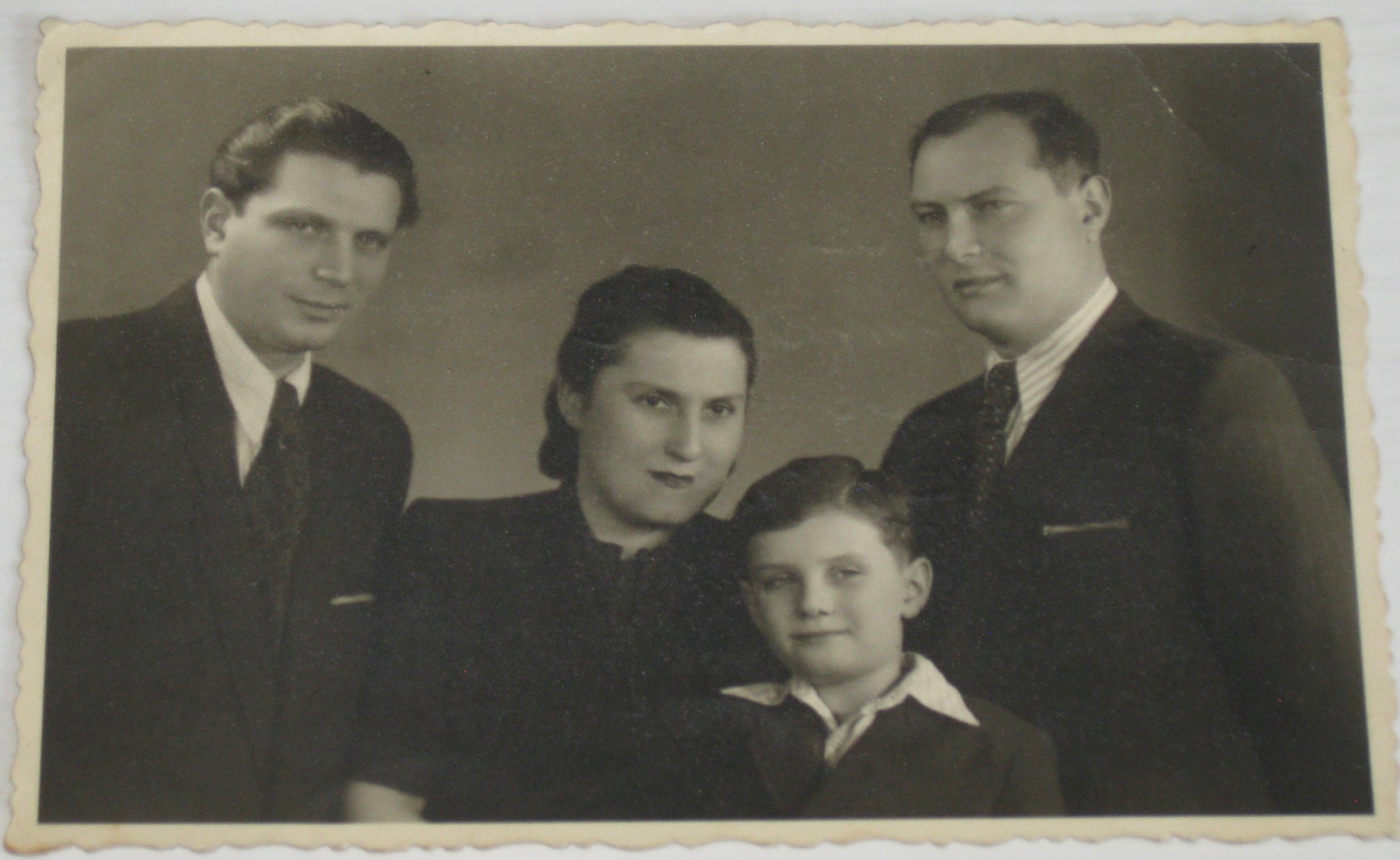
Adam, Rifka and Boris Grac, and Adam’s brother Herschel, in Uruguay after WW II – the sole survivors of 25 close relatives who lived in Lodz and Skierniewice, Poland before the Holocaust
(courtesy of North/Avidar family)
Eventually the family made its way to South America, to where my grandfather’s second sister had earlier emigrated. (His third sister and brother-in-law, their five children and a granddaughter remained in Poland and were also all murdered by the Germans).
The Grac family lived in Montevideo, Uruguay, and in 1959, when Boris was 17, he wrote his first letter in English to my father and his siblings in New York, hoping to begin a correspondence with the relatives he’d always known about but had not yet met. He spoke about studying English and engineering, playing basketball and other sports, and his hobby of enjoying cars and motorcycles.
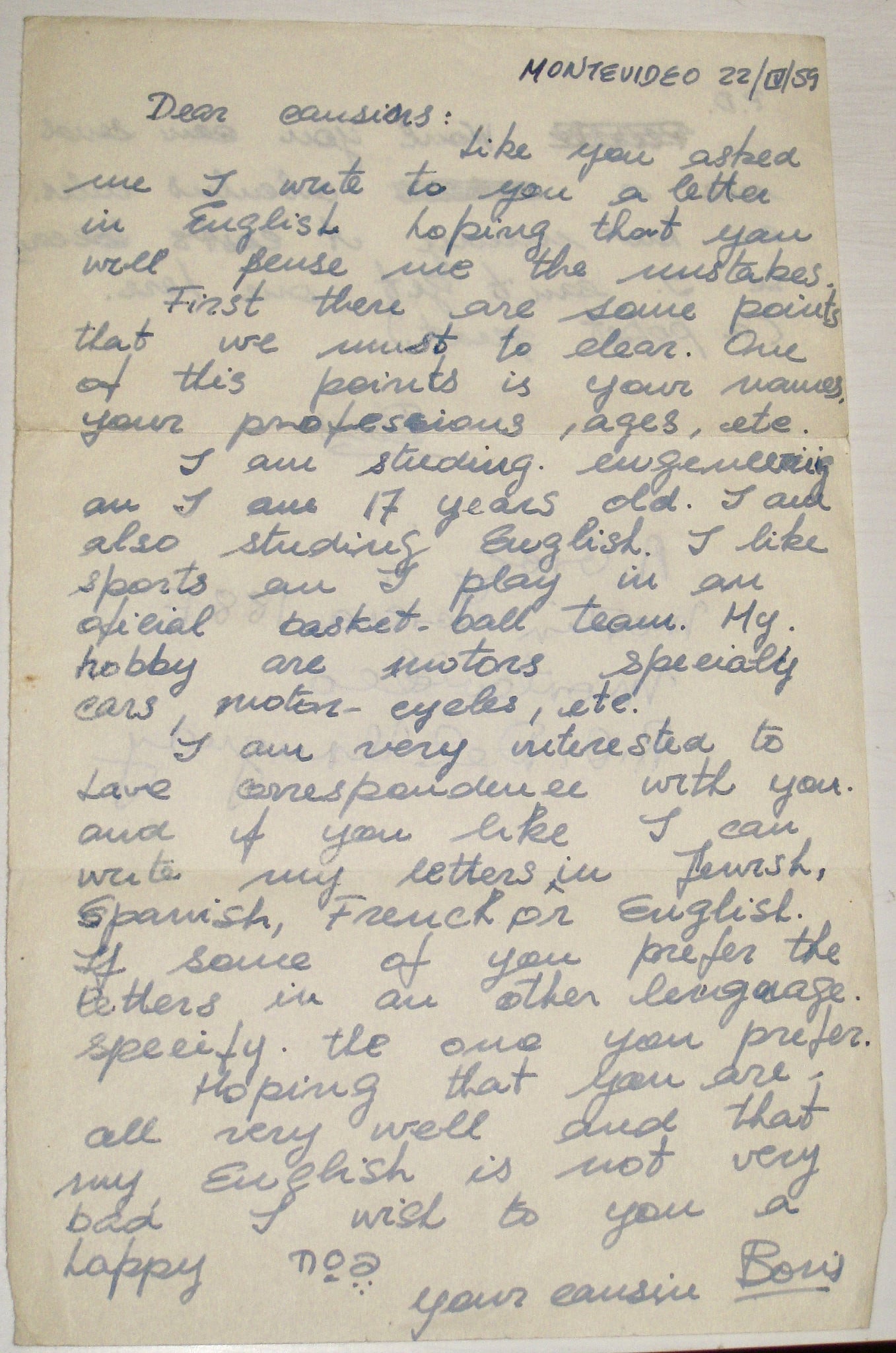
1959 letter from Boris from Montevideo to his family in New York
(courtesy North/Avidar family)
Not long after that, Boris decided to check out an Israeli kibbutz created for Spanish-speaking immigrants; it was there that he met his future wife Dina, a beautiful, intelligent, dark-haired dancer from Argentina. At some point, he told his parents he was going to remain in Israel. They joined their only child there around 1961, and eventually owned a clothing store on Tel Aviv’s Lilienblum Street for many years.
Baruch, meanwhile, continued his education at Tel Aviv University and the Technion, then became a career IDF officer for two decades, rising to the rank of Lieutenant Colonel. He changed his last name to Avidar, as he and Dina raised their children Doron and Nurit and enjoyed an active social life with their many friends. After the military, he worked at the Clal Corporation and Macon International, often translating documents into one of the six languages in which he was fluent – perhaps the only advantage deriving from his peripatetic childhood.
On the surface, it seemed like an ideal existence, despite its rough start. But the reality was somewhat darker; the trauma of his first decade of life, along with his battle experiences in the Six-Day and Yom Kippur wars of 1967 and 1973, left their mark. Although he relegated his original identity as Boris Grac to the past, it informed his life as Baruch Avidar.
He was charming and erudite and fun to be with; he loved spending time with my father, dancing with my mom, and playing tennis with my aunt (my dad’s sister). He took us to a picnic on Mount Meron, and joined me in visiting an elderly relative in Ramat Gan who revealed the horrific fate of our martyred aunts, uncles and cousins. When my sister Susan lived in Israel for a year, Baruch proudly gave her detailed tours of the entire country. However, he also could be stubborn, argumentative, way too right-wing for many of us, and above all, tough.
To me, Baruch’s insistence on Jews being tough in all facets of their lives had a direct link to the shadow of the Shoah, which influenced every aspect of his complex personality. It affected his relationships with his family, and it could seem harsh and hurtful at times.
On the other hand, when Baruch’s parents became old and frail, and when his wife was diagnosed with early-onset Alzheimer’s, the care he provided them was selfless, exemplary and touching. A softer side also emerged when it came to his five beloved grandchildren.
At his funeral, Baruch’s son Doron said he learned to love him not only for his pleasant characteristics, but for the “less pleasing” ones as well, even those that caused pain – adding he applies that ability now to his interactions with many people. “So I thank you, Abba”, Doron concluded, “for that lesson, which was not simple and often not easy, but definitely educational”.
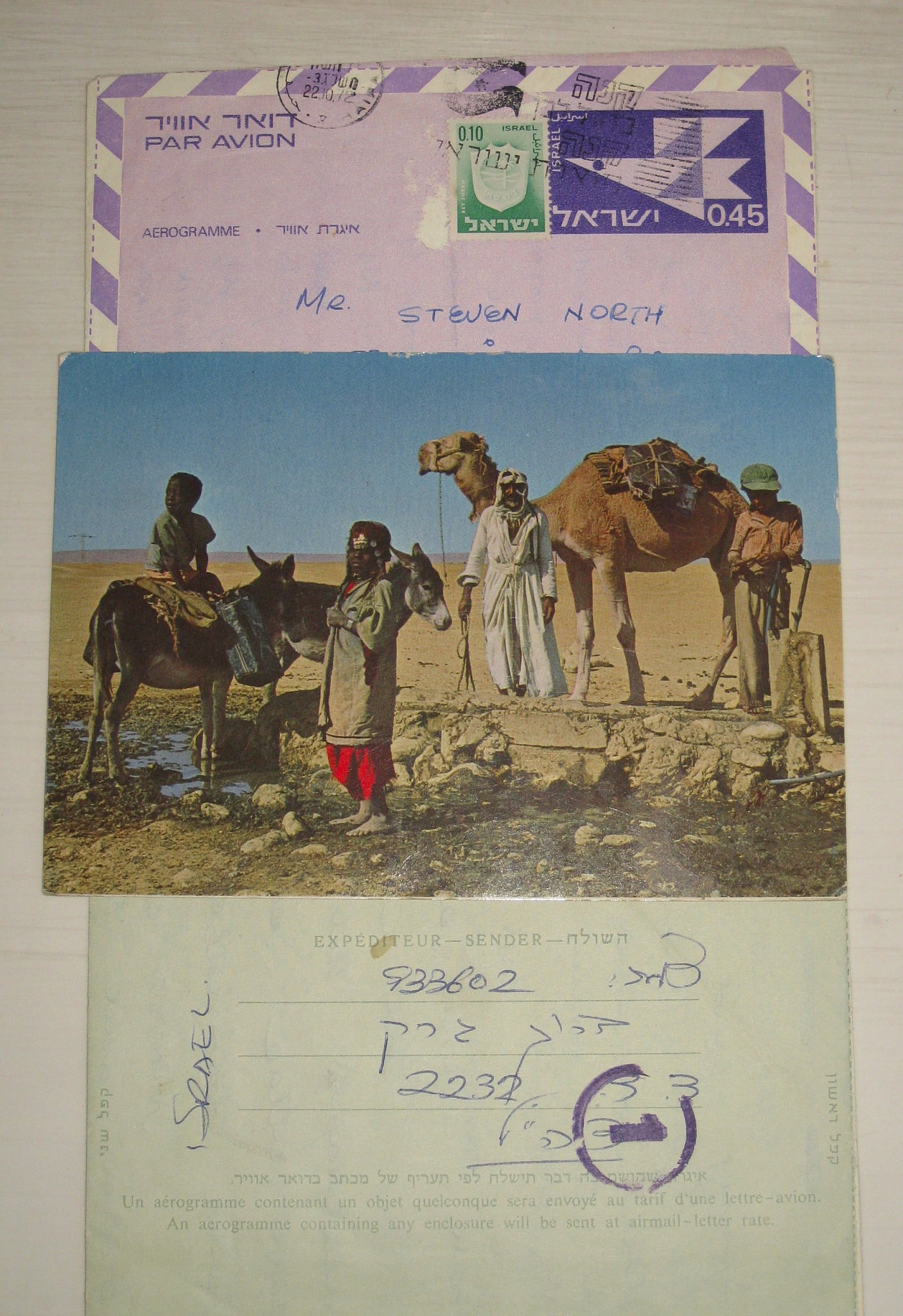
1960s/1970s correspondence from Baruch to Steve North
(courtesy Steve North)
My own relationship with Baruch began in 1961 when I was eight years old and we became “pen pals”; I still have the first postcard he sent me from the army, showing a camel and donkey with their Bedouin owners in the desert – which was my image of Israel until I got there myself in 1970. During my two dozen visits since then, and his periodic trips to the U.S., I enjoyed sparring with him over our political differences, and sharing with him our American Jewish way of life. (The highlight of that might have been the time I brought him and Dina to Rosh Hashana services at my Reconstructionist synagogue, where they saw a female rabbi for the first time; it confused them no end).
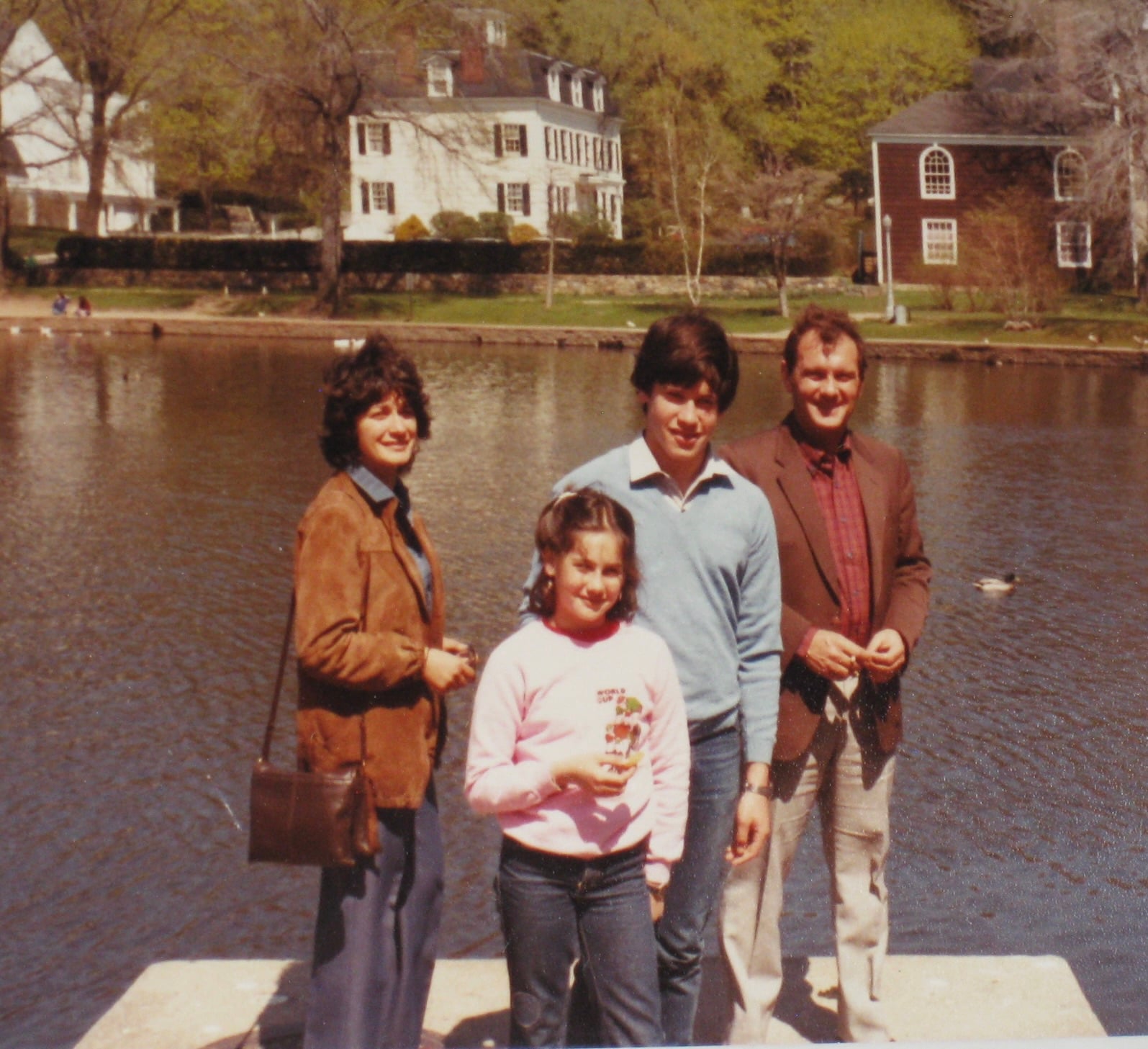
1980s visit of Dina, Nurit, Doron and Baruch Avidar to Steve North in Roslyn, NY
(photo by Steve North)
Although reluctant to discuss the effect of his chaotic childhood on the life he led in Israel, I once asked him during my teenage years why his father Adam gave me packages of tightly-wrapped American dollars to hide in my suitcase and bring back to New York, where my father would deposit them in a secret bank account. “It’s because we had to escape so many times from so many places”, Baruch explained, “and he’s certain it’ll happen again to us here. He wants to know he won’t have to start from scratch if we’re driven out of Israel”.
Then there was the time I showed Baruch a family tree I had made. Next to my grandfather Moshe’s name were the names of his three American children, five grandchildren, and several great-grandchildren. Next to my great-aunt Golda’s name were her six Argentinian children, fifteen grandchildren, and many great-grandchildren.
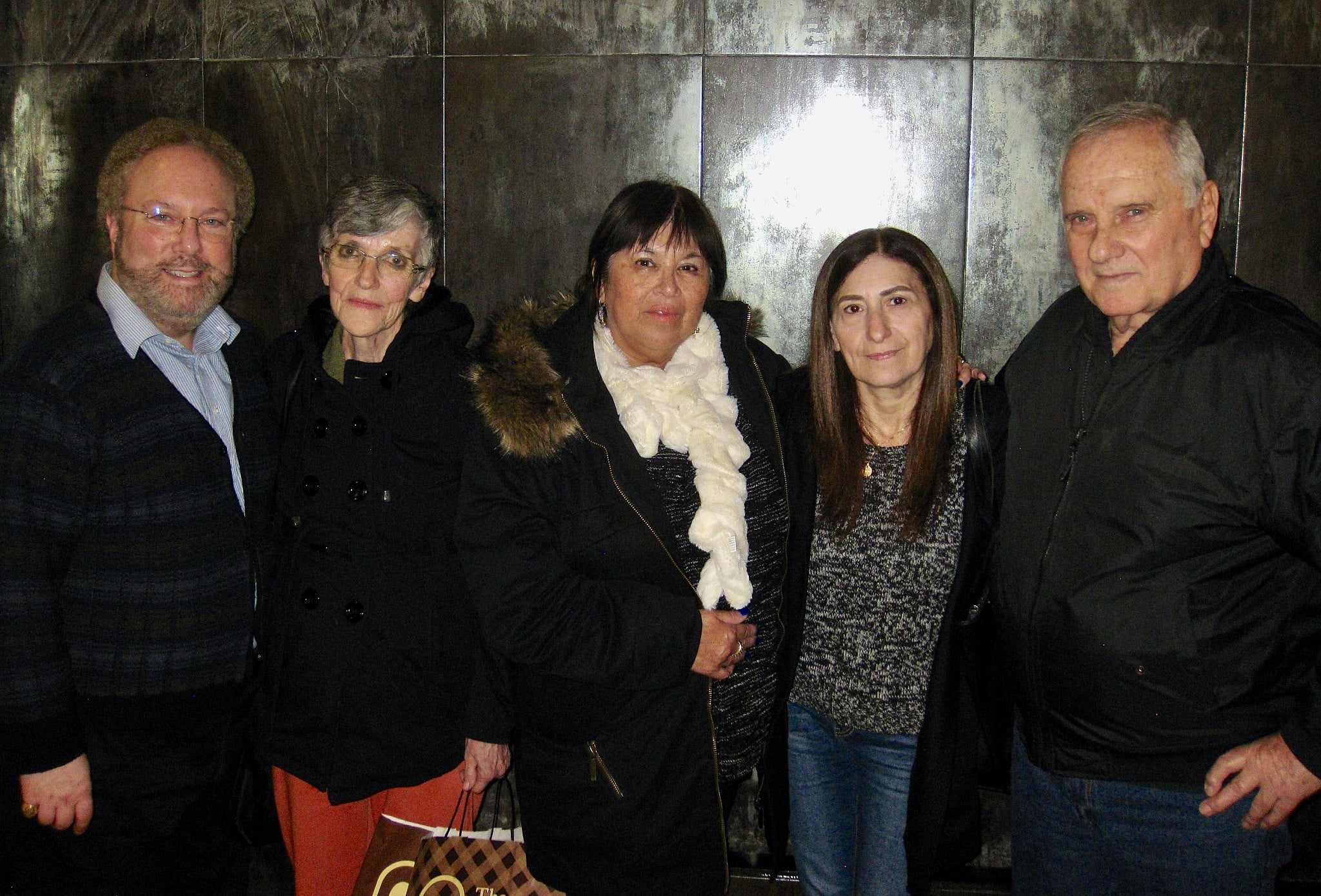
2016 reunion in Haifa of grandchildren of three siblings originally from Skierniewice, Poland (Steve North, Graciela Ogen, Shoshi Sinvani, Chana Dahan, Baruch Avidar)
(courtesy Steve North)
But alongside the names of my two great-aunts who stayed behind in Poland, Dvora and Rifka and their eleven children, only Dvora’s son Adam had any descendants listed: Baruch and his two kids. For a brief moment, the hard veneer cracked, and he let out a deep sigh.
“Look at that”, he said, shaking his head and revealing the pain behind the mask. “Can you imagine what a huge family I would have had, if only… if only they had let us live?”
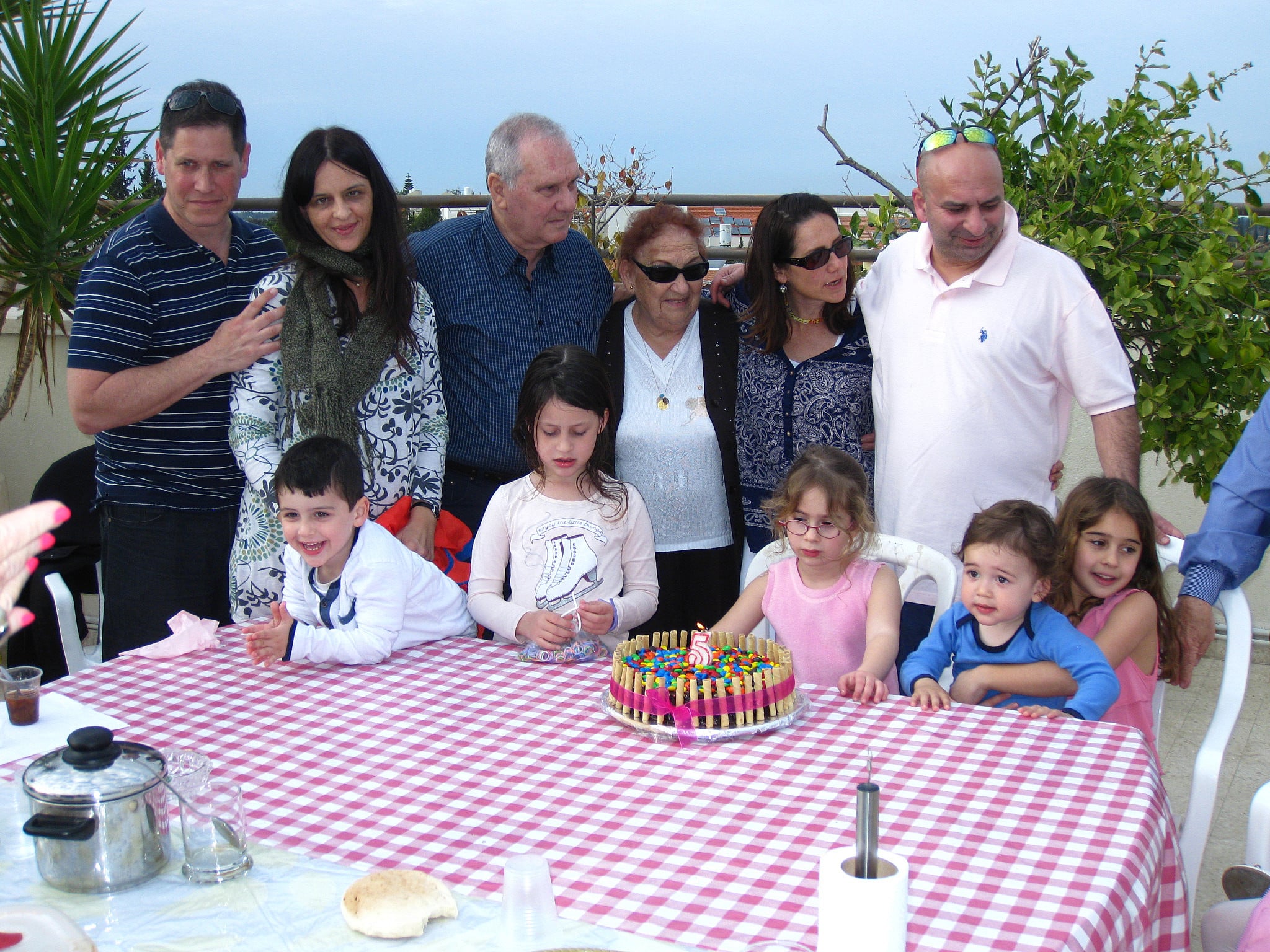
Baruch with his son Doron and daughter-in-law Idit, daughter Nurit and son-in-law Avi (and Avi’s mother), and his five grandchildren in Herzliya, 2013
(photo by Steve North)