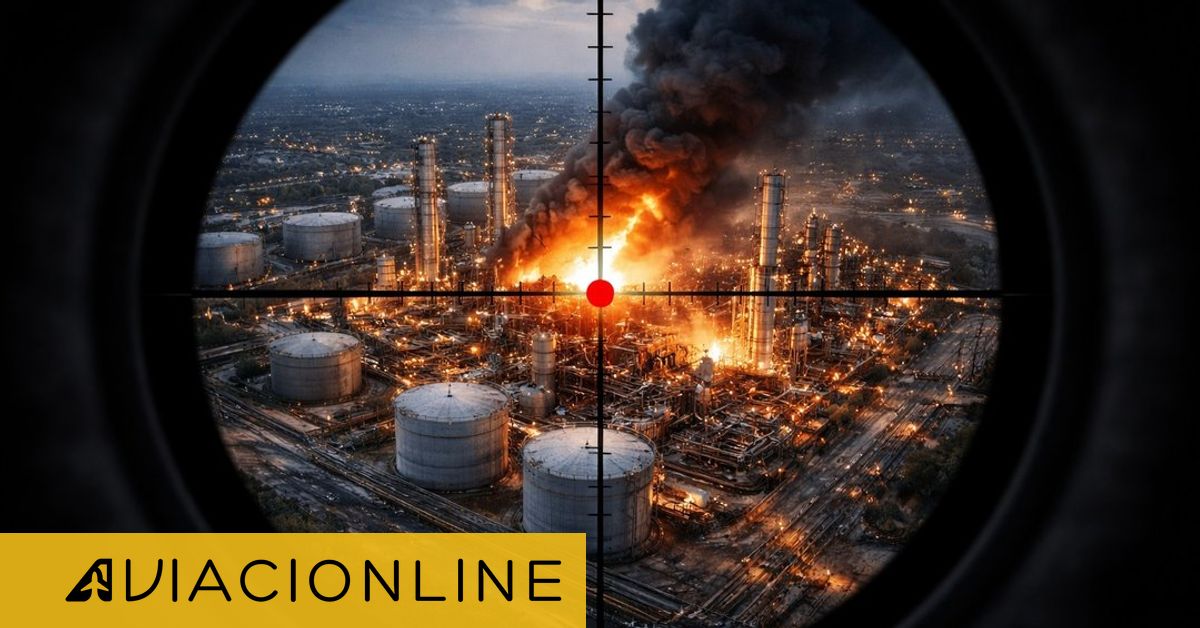
The war involving Israel, the United States, and Iran has entered a new phase of escalation following airstrikes on facilities linked to the South Pars gas field—the world’s largest gas complex—located in Iran’s Bushehr province. The operation, attributed by Israeli sources to the Israeli Air Force (IAF) with U.S. support, struck critical infrastructure at the most important energy node in Iran’s economy.
According to official reporting and OSINT-based reconstructions, the strikes impacted both onshore processing facilities and offshore operational segments, temporarily taking several development phases offline. Iranian state media confirmed damage in the Asaluyeh area, the industrial hub of the project.
X de Clash Report
X de OSINTdefender
The nature of the target is significant. Unlike previous campaigns focused on military infrastructure, air bases, or logistics nodes, the strike on South Pars explicitly introduces the energy domain as a primary target set, raising the systemic risk of the conflict.
What target did Israel strike in Iran?
The attack targeted facilities linked to the South Pars gas field—the world’s largest gas complex—located in Bushehr province, with reported damage in the Asaluyeh area.
Who carried out the operation?
Israeli sources attribute the strike to the Israeli Air Force (IAF), with U.S. support.
Why is targeting energy infrastructure significant?
Striking the energy sector aims to degrade critical revenue streams for the Iranian regime, eroding its financial and political capacity while increasing strategic pressure beyond the purely military domain.
What threats did Iran issue in response?
Iranian state media and security-linked channels threatened attacks against refineries, petrochemical complexes, and gas fields in Qatar, Saudi Arabia, and the United Arab Emirates, and called for the evacuation of energy facilities.
What impact could this have on energy markets?
An escalation affecting Gulf infrastructure or traffic through the Strait of Hormuz could significantly disrupt oil and gas supply, driving price volatility and impacting global supply chains.
From military attrition to direct economic coercion
Target selection reflects a clear evolution in the Israeli-U.S. campaign: degrading not only military capabilities but also the Iranian regime’s critical sources of revenue. Strategically, this shifts pressure from the battlefield to the economic sustainability of Tehran’s war effort—and, more broadly, to the long-term viability of its state apparatus.
Within this framework, strikes on energy infrastructure complement prior operations targeting internal security nodes and assets linked to Iran’s regional power projection, forming a multidimensional pressure campaign aimed not only at limiting military capability but at eroding the regime’s mechanisms of control, financing, and stability.
Iran’s response was immediate and aligned with previous warnings. State media issued explicit threats to strike energy infrastructure in Qatar, Saudi Arabia, and the United Arab Emirates, including refineries, petrochemical complexes, and gas fields.
X de OSINTdefender
Among the potential targets mentioned are high-value assets such as the Jubail industrial complex and the SAMREF refinery in Saudi Arabia, gas infrastructure in the UAE, and petrochemical plants in Qatar. In parallel, channels linked to Iran’s security apparatus called for the evacuation of regional energy facilities, mirroring psychological signaling patterns previously employed by Israel ahead of its own strikes.
A tested pattern: energy as a pressure vector
The threat does not emerge in a vacuum. It is part of an operational logic Iran has been employing since late February, combining precision strikes against military nodes with actions targeting critical energy infrastructure across the Gulf.
As observed in previous waves, Tehran has demonstrated the capability to reach key installations such as Ras Laffan in Qatar, as well as to sustain saturation campaigns using ballistic missiles, cruise missiles, and drones against the UAE and Saudi Arabia. The objective is twofold: degrade defensive capabilities while raising the economic cost of the conflict for regional actors and global markets.
Tehran Targets Missile-Defense Architecture and Energy Infrastructure: Who Bears the Brunt of the Strikes?
In this context, the Israeli strike on South Pars provides Iran with both operational and political justification to escalate along the same axis—potentially with greater intensity and domestic legitimacy.
Regionalization, global markets, and Iran’s strategic calculus
The potential execution of Iranian strikes against Gulf energy infrastructure reintroduces the risk of severe disruption to global energy markets. Qatar accounts for approximately 20% of global LNG supply, while Saudi Arabia and the UAE are central players in the oil market.
At the same time, the Strait of Hormuz once again emerges as a critical chokepoint: with roughly 20% of global crude transiting the corridor, any escalation—whether through direct attacks, naval mining, or harassment of shipping—would have immediate effects on prices and supply chains.
In this context, initial spikes in Brent crude following early tensions have partially moderated, due in part to mitigation measures led by the United States and aligned actors, including coordinated strategic reserve releases and market-stabilization mechanisms. This introduces a degree of short-term containment, but does not alter the underlying structural fragility.
Against this backdrop, Iran’s behavior so far suggests a calibrated approach. Despite its rhetoric, previous campaigns indicate a preference for high-impact strategic strikes with relatively controlled collateral effects, prioritizing critical infrastructure over civilian targets. The logic remains consistent: maximize economic and political pressure without triggering a disproportionate regional or international response that could threaten regime survival.
However, the strike on South Pars introduces an additional destabilizing variable. By targeting the core of Iran’s energy system, Israel raises Tehran’s tolerance threshold, potentially forcing a more visible response—particularly in the energy domain—to sustain deterrence credibility, while still attempting to maintain a pattern of controlled escalation, at least in the current phase.
The war involving Iran is increasingly defined by the interdependence between air operations, energy markets, and regional stability, where each strike is measured not only in terms of physical damage, but also by its impact on the broader strategic balance.