
DAMASCUS — The head of the UN’s nuclear watchdog said Tuesday that its inspectors had found several tons of nuclear material in Syria, at a site which the authorities said they reported to the agency last month.
Rafael Grossi, the head of the International Atomic Energy Agency (IAEA), praised Damascus’s “courageous decision” to report the undisclosed site, which dates to the Assad era, and said the material would be put under “international safeguards.”
“We are talking about a few tons of nuclear material that could be put to bad use,” he said.
Speaking at a joint press conference with Grossi, however, Syria’s Foreign Minister Asaad al-Shaibani indicated that the material would be used toward a peaceful nuclear energy program.
“On July 17, we sent an official letter to the agency, in which we declared of our own free will the presence of nuclear materials at an undeclared site within the legacy left by the former regime,” said Shaibani.
Get The Times of Israel’s Daily Edition
by email and never miss our top stories
By signing up, you agree to the terms
He said that “technical assessments” indicate that “these materials do not pose a risk,” adding that they “will remain in Syrian national custody and subject to the agency’s safeguards system.”
Shaibani asserted Syria’s “sovereign and legal right” to pursue a peaceful nuclear program, and said Syria had the right to use nuclear energy “for civilian and peaceful purposes.”
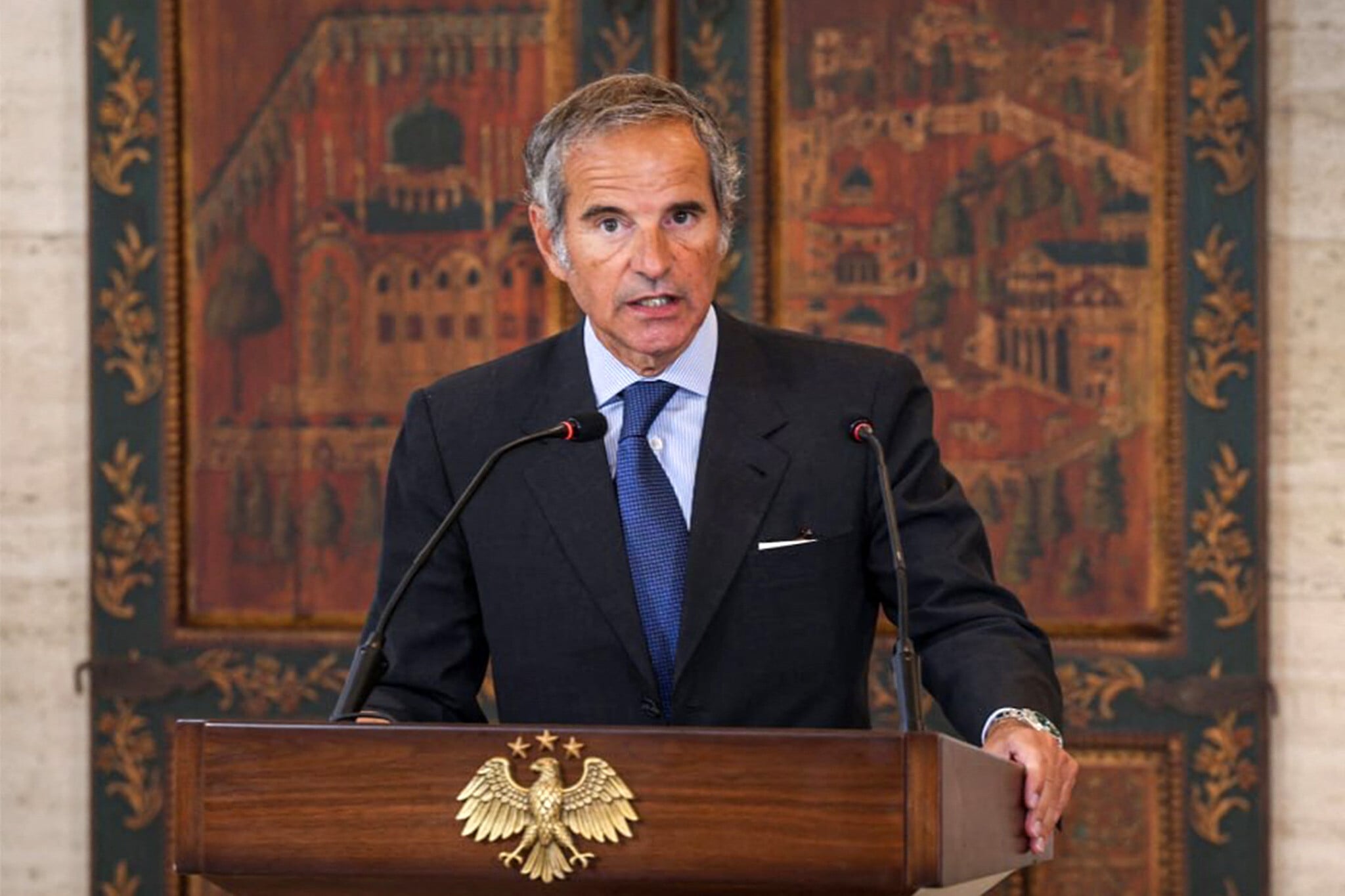
This handout picture released by the official Syrian Arab News Agency (SANA) International Atomic Energy Agency (IAEA) Director General Rafael Grossi giving a news conference after his meeting with Syria’s interim foreign minister in Damascus on August 18, 2026. (SANA/AFP)
Grossi, meanwhile, said, “this material will be accounted for, will be put within the international safeguards system.”
Syrian and IAEA experts will work together to safely store the materials, he said.
“We are starting to turn a page, and turning a page does not mean forgetting the past.”
Grossi also visited a site in Deir Ezzor in the east, which has been shut for 18 years and which the IAEA had suspected contained a nuclear reactor. Israel bombed the site on September 6, 2007, in a mission known to much of the world as Operation Orchard.
The attack, which Israel refused to comment on until 2018, is believed to have ended the regime’s efforts to build a nuclear weapon.
“We were at the… site of Deir Ezzor, where a very comprehensive work of excavation and exploration is taking place now,” Grossi said. “This is very important because, of course, this validates the longstanding evaluation of the IAEA that a nuclear facility was being built in secrecy.”
The watchdog said last year that it discovered uranium particles at the site during an inspection in 2024.
Shaibani said Syria had granted the IAEA access to the Deir Ezzor site on its own initiative.
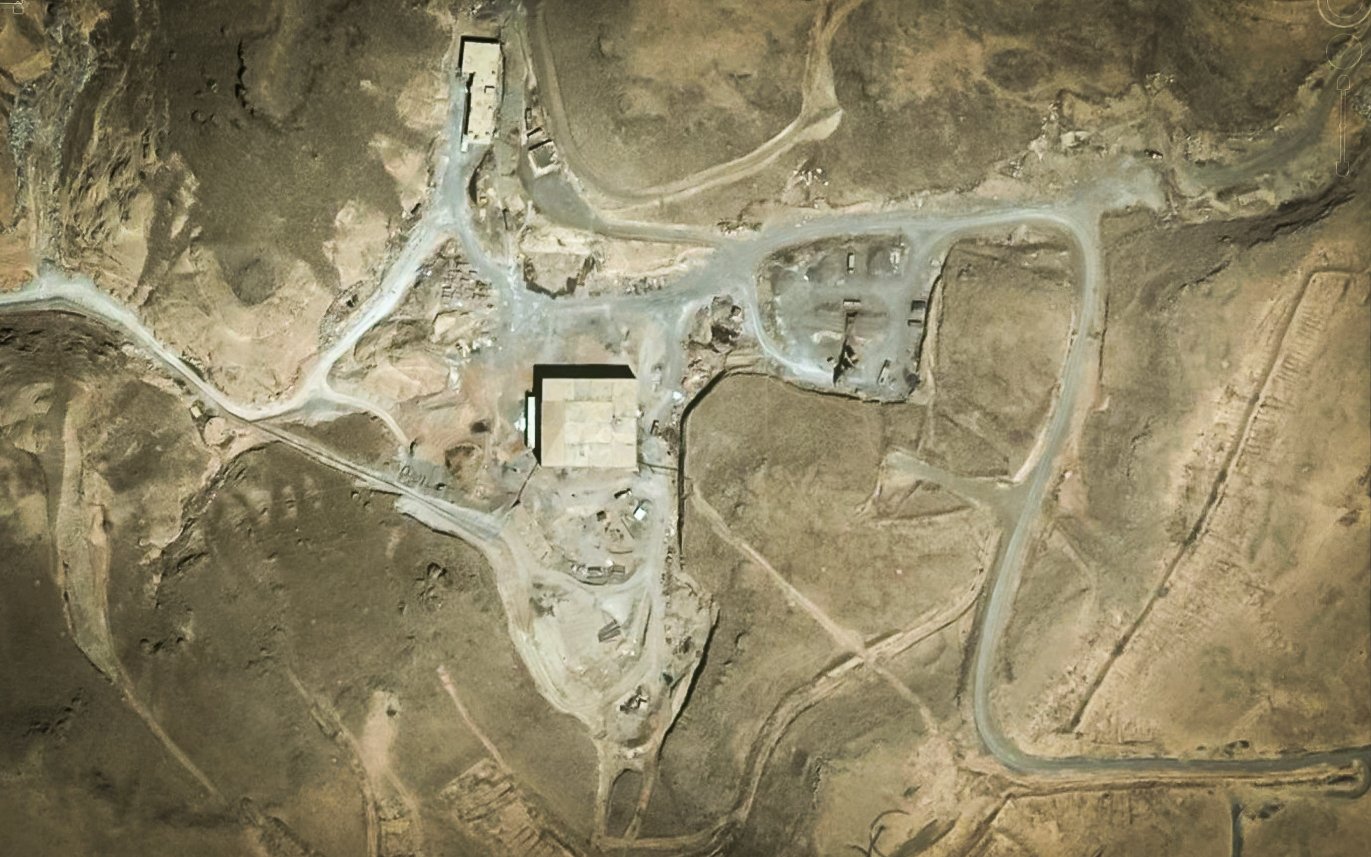
The Syrian nuclear reactor site before it was destroyed by the IDF in 2007, as seen by satellite. (Photo: Google Earth)
Grossi’s visit came after news outlet Axios last week reported US and Israeli officials as saying Washington and the IAEA reached an agreement to have the watchdog remove nuclear material stored at a clandestine site in Syria after having “reached understandings with Syria and Israel.”
Axios said Israel was closely monitoring a location called “Site 99,” where Israeli officials say the Assad government stored nuclear material that was part of the Deir Ezzor project, also known as Al-Kibar, and that Israel threatened to bomb it.
The White House, IAEA, and Israel’s Prime Minister’s Office declined to comment on the report.
Help us report truthfully on social media

As a multimedia journalist, my job is to take the quality, fact-based journalism produced by The Times of Israel newsroom and make it accessible across every platform — from Instagram posts to podcasts to short-form videos.
This is how many, especially young people, consume news these days. But misinformation is rampant on social media. Our team at ToI produces accurate, responsible short-form reporting on Israel and the Jewish world.
If you believe in the importance of factual social media journalism, please consider joining our reader support group, The Times of Israel Community. Your financial support is essential to sustain responsible multimedia reporting.
— Gabriella Jacobs, multimedia journalist
Already a member? Sign in to stop seeing this
You’re a dedicated reader

That’s why we started the Times of Israel – to provide discerning readers like you with must-read coverage of Israel and the Jewish world.
So now we have a request. Unlike other news outlets, we haven’t put up a paywall. But as the journalism we do is costly, we invite readers for whom The Times of Israel has become important to help support our work by joining The Times of Israel Community.
For as little as $6 a month you can help support our quality journalism while enjoying The Times of Israel AD-FREE, as well as accessing exclusive content available only to Times of Israel Community members.
Thank you,
David Horovitz, Founding Editor of The Times of Israel