Quick Read
Bessent predicts land pipelines render Hormuz irrelevant in two years; former Chevron (CVX) exec Moshiri backs Western Hemisphere supply as the geographic fix instead.
U.S. crude exports bypass Hormuz entirely, so Iranian disruptions hammer Asian and European allies far harder than American energy supply.
WTI jumped to $90 overnight after the latest U.S. strikes on Iran, which retaliated by hitting two tankers with Hormuz naval mines.
Just released. Our analysts combed the entire stock market and named the ten best stocks to buy right now. The report is free. Enter your email and see if any of your stocks made the cut.
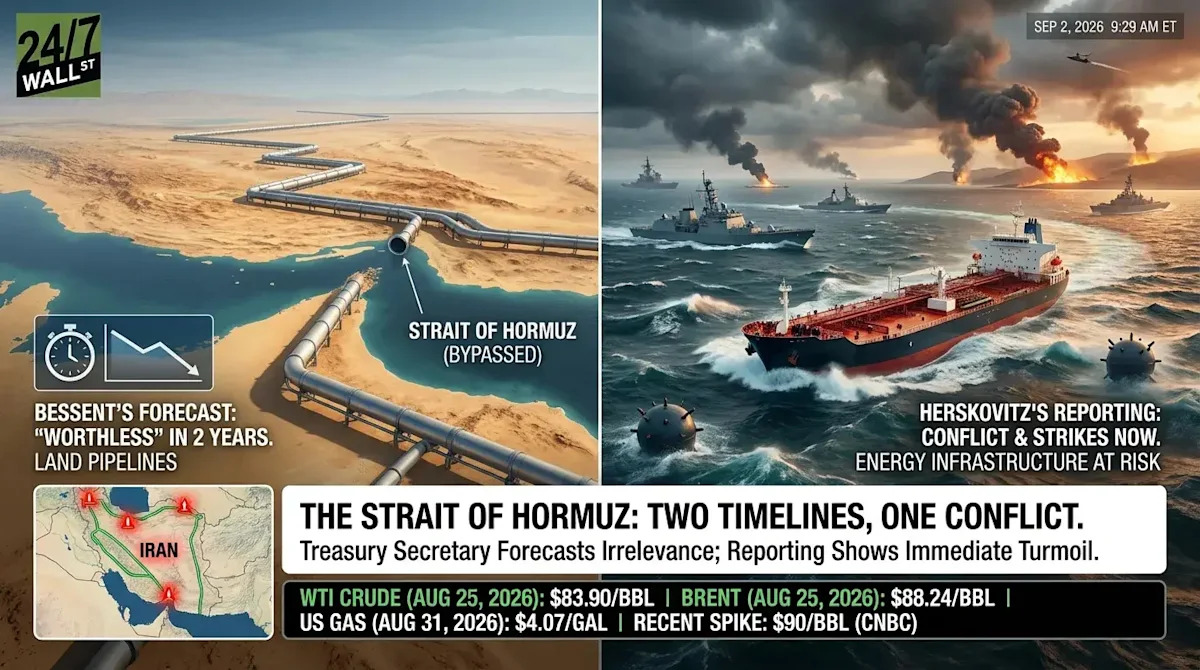
Treasury Secretary Scott Bessent, speaking at the G20 finance chiefs meeting, offered a two-year forecast in which he predicted the Strait of Hormuz would stop mattering to global oil. Meanwhile, Bloomberg’s Jon Herskovitz described how a fresh round of U.S.-Iran strikes is happening now.
 24/7 Wall St. Bessent Says Pipelines Will Make Hormuz “Worthless” in 2 Years
Bessent had an optimistic forecast for oil over the medium-term: “In two years, the Strait of Hormuz will be, like, a worthless piece of water, as the oil will be going on pipelines across land,” he said. He explained that the current disruption hurts other countries far more than it hurts the U.S.: “It’s not a choke point for the US, but it is a choke point for many, many other countries.”
Land pipeline capacity at the scale required to remove Hormuz from the global oil map demands construction, financing, host-country agreements, and physical security. Pipeline projects of that scale rarely are completely built on a two-year timeline, and the segment offered no detail on routes, capital sources, or throughput.
Recently, CNBC’s Brian Sullivan detailed why the announced Venezuela arrangement will likely not relieve near-term supply, citing production that has fallen from roughly 3.2 million barrels per day in 1997 to about 1.2 million with dilapidated infrastructure. Energy security proposals keep hitting the same timeline problem.
Free Report, Just Released
Did Any of Your Stocks Make the Top 10 List?
It is an uncomfortable question, and there is now an answer to it.
24/7 Wall St has helped investors make money for over two decades, and our top analysts just finished ranking the definitive Top 10 Stocks To Buy Now. Not the ten biggest companies. Not the ten everyone is arguing about. The ten best stocks to buy right now.
Open your account and look at what you own. Some of it you bought for a reason you could still defend today. Some of it you bought years ago for a reason you can no longer remember.
Story Continues
The report is free. Put the ten next to what you own and find out which is which.
Enter Your Email and See the Ten →
Free from 24/7 Wall St. It lands in your inbox.
Hormuz Matters Far More to Asia Than the United States
The United States is a net exporter of crude and refined products, and its marginal barrels do not transit through Hormuz. For allied economies in Asia and parts of Europe, the Strait remains central for their oil imports. The Strait of Hormuz has more drastic consequences for oil importers, which is why global oil markets and allied economies absorb the risk even when U.S. domestic supply does not.
That framing echoes remarks from former Chevron (NYSE:CVX) Latin America president Ali Moshiri on August 28, who argued U.S. energy security depends on sources avoiding Hormuz, Red Sea, and Black Sea chokepoints, with Western Hemisphere supply from Brazil, Venezuela, and Argentina as the answer.
Iran Is Threatening Energy Infrastructure Beyond Hormuz
Against that two-year horizon, Herskovitz described events on a compressed timeline. “The US has escalated its round of strikes. The first strikes, which got it started, were at two launchers, artillery rocket launchers, which were suspected of being able to place mines in Hormuz. The latest attacks were broader,” he said.
“Iran has changed its strategy. It said that it’s looking to a longer-range battle where it can go after its neighbors in the region. If Iran sees its infrastructure attacked, it’s looking to go after infrastructure in the region of its neighbors, energy infrastructure, which could damage the economies of these regions and also really affect global oil supplies,” Herskovitz said. Attacks on neighboring energy infrastructure would move supply regardless of the Strait’s status.
Oil Is Back Near $90 as the Conflict Escalates
WTI opened at over $90 per barrel on September 2, down nearly 10% from a month earlier but well above the $55.44 low from December 16, 2025. U.S. regular gasoline sat at $4.07 per gallon on August 31, 2026. Overnight, CNBC reported Iran said two tankers hit Hormuz naval mines while it attacked regional targets in retaliation.
Key Takeaways
Bessent may ultimately be right that pipelines and alternative supply routes will reduce the world’s dependence on Hormuz. But with U.S.-Iran strikes escalating, regional energy assets under threat, and crude back around $90 per barrel, the oil market’s immediate problem remains the conflict happening today.
Got $1,000? Before You Buy Another Stock, Read This
If you have cash sitting in your account right now, give this two minutes. After more than two decades of helping investors beat the market, our top analysts at 24/7 Wall St. put together a definitive report on the Top 10 Stocks To Buy Today.
They combed the entire market. It’s not 10 ideas, not 10 stocks everyone is talking about, it’s what their research point to as the 10 best stocks to buy right now, and it’s free. Read more here and see which stocks made the cut –>>
Contact editorial@247wallst.com for any questions or corrections.