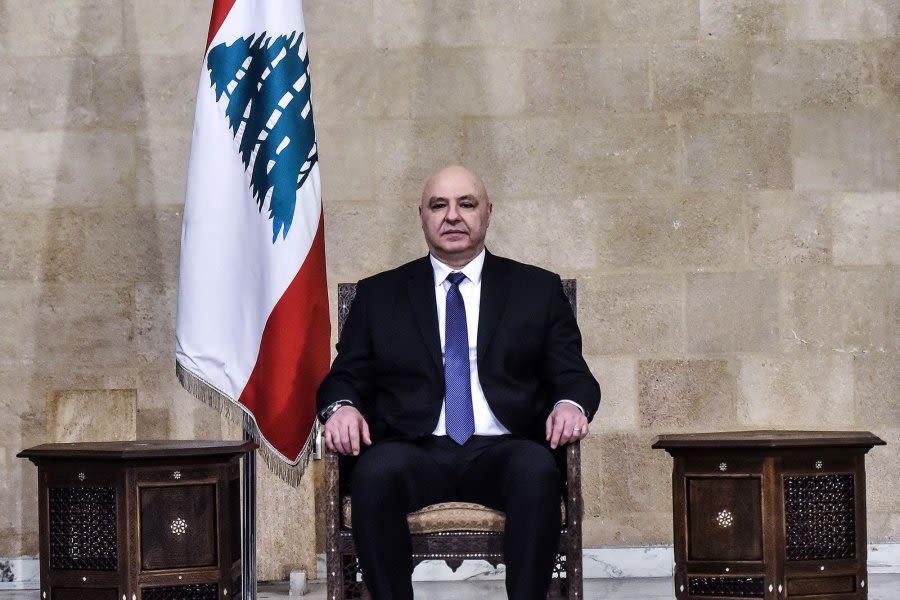
BEIRUT, Aug. 31 (UPI) — Lebanese President Joseph Aoun said Monday that Lebanon’s stability is essential to Europe’s, calling for the full implementation “without selectivity” of the U.S.-brokered framework agreement reached last June to end the war between Israel and Hezbollah and for maintaining a United Nations role in southern Lebanon.
Aoun said during separate meetings with Greek President Konstantinos Tasoulas and Prime Minister Kyriakos Mitsotakis in Athens that “the stability of the region and Lebanon is essential to the stability of Greece and Europe,” warning that instability in Lebanon will have “negative repercussions across the region.”
He said that the June 26 framework accord between Lebanon and Israel cannot be implemented by one side alone and must be honored by both parties “in full and without selectivity,” calling on Greece “to provide as much assistance as possible” to help ensure the agreement is upheld.
Aoun said the Israel-Hezbollah war, which broke out on October 8, 2023, when Hezbollah opened a support front for Gaza, and escalated on March 2, had achieved no results.
“Solving the problem through military force has not worked and will not work… The best way to address the problems we face is through diplomacy,” he said. “We are advocates of peace and are determined to end the state of hostility with Israel and build the best possible relations with our neighbors.”
Israel’s intensive military campaign has killed 8,915 people and wounded 30,543 since October 8, 2023, including 4,352 killed and 12,318 wounded since last March, according to Lebanon’s Health Ministry. It has caused massive destruction to property and infrastructure, with some 70 border villages in southern Lebanon reduced to rubble and rendered uninhabitable.
Tasoulas expressed support for the Lebanese president’s efforts to build peace and strengthen Lebanon’s independence, saying that Greece will do everything it can during its presidency of the European Union, beginning in January 2027, to consolidate and deepen relations between Lebanon and the EU.
Talks between Aoun and Mitsotakis addressed the need for a U.N. role in southern Lebanon following the scheduled departure of the U.N. peacekeeping force in southern Lebanon, known as UNIFIL, at the end of December.
Mitsotakis said the discussions covered the post-UNIFIL phase and “how to help prevent a security vacuum,” noting that the Lebanese Army must play “a central and fundamental role,” with European and international support and a presence to help ensure security.
“We consider security essential, but individual support alone is not enough,” he said, expressing Greece’s readiness to support “every effort towards de-escalation,” help with Lebanon’s reconstruction and provide humanitarian assistance as well as “greater” assistance to the Lebanese Army.
“Our position is clear: a strong state is a prerequisite for a strong Lebanon, with a central government that safeguards the security of all its citizens,” he said, referring to the “particular importance” of preserving Lebanon’s multicultural character and protecting its Christian communities.
Mitsotakis said there were numerous opportunities for the two countries to deepen cooperation through investment and partnerships in various fields, including tourism, culture, energy and infrastructure.
He emphasized that the Eastern Mediterranean must move from a region of tensions and conflicts to one of peace, cooperation and mutual understanding.
“Greece believes in energy bridges and joint infrastructure projects that bring not only the countries of the region closer together, but also the Eastern Mediterranean as a whole closer to Europe,” he added.
Aoun stressed that the two countries share common interests in areas including energy, transport and freedom of global trade and said the Mediterranean is “a sea that unites people and …has no room for extremism.”