
The disarmament proposal presented to Hamas by Gaza ceasefire mediators this week in Cairo envisions all armed groups in the Strip gradually handing over their weapons over the coming months, two Arab diplomats familiar with the matter told The Times of Israel on Friday.
The proposal requires Hamas to — within 90 days — hand over its heavy weaponry, such as missiles and rocket launchers, in addition to maps of its tunnel network.
A buy-back program would also offer jobs and funds to armed group members who agree to hand over their personal weapons, though, that process is expected to take longer than the initial three-month timeline given for heavy weaponry, the first Arab diplomat said.
While Hamas negotiators have expressed willingness in talks with Arab mediators to hand over the terror group’s heavy weapons, they have insisted on maintaining lighter weapons, arguing that they are necessary for self-defense, the Arab diplomat added.
Details of the disarmament proposal were first published by the National Public Radio, The New York Times, and Haaretz.
Get The Times of Israel’s Daily Edition
by email and never miss our top stories
By signing up, you agree to the terms
The proposal envisions the weapons being handed over to the yet-to-be-formed Palestinian police. The National Committee for the Administration of Gaza (NCAG), which is supposed to replace Hamas in governing Gaza, began recruitment for the new police force last month.
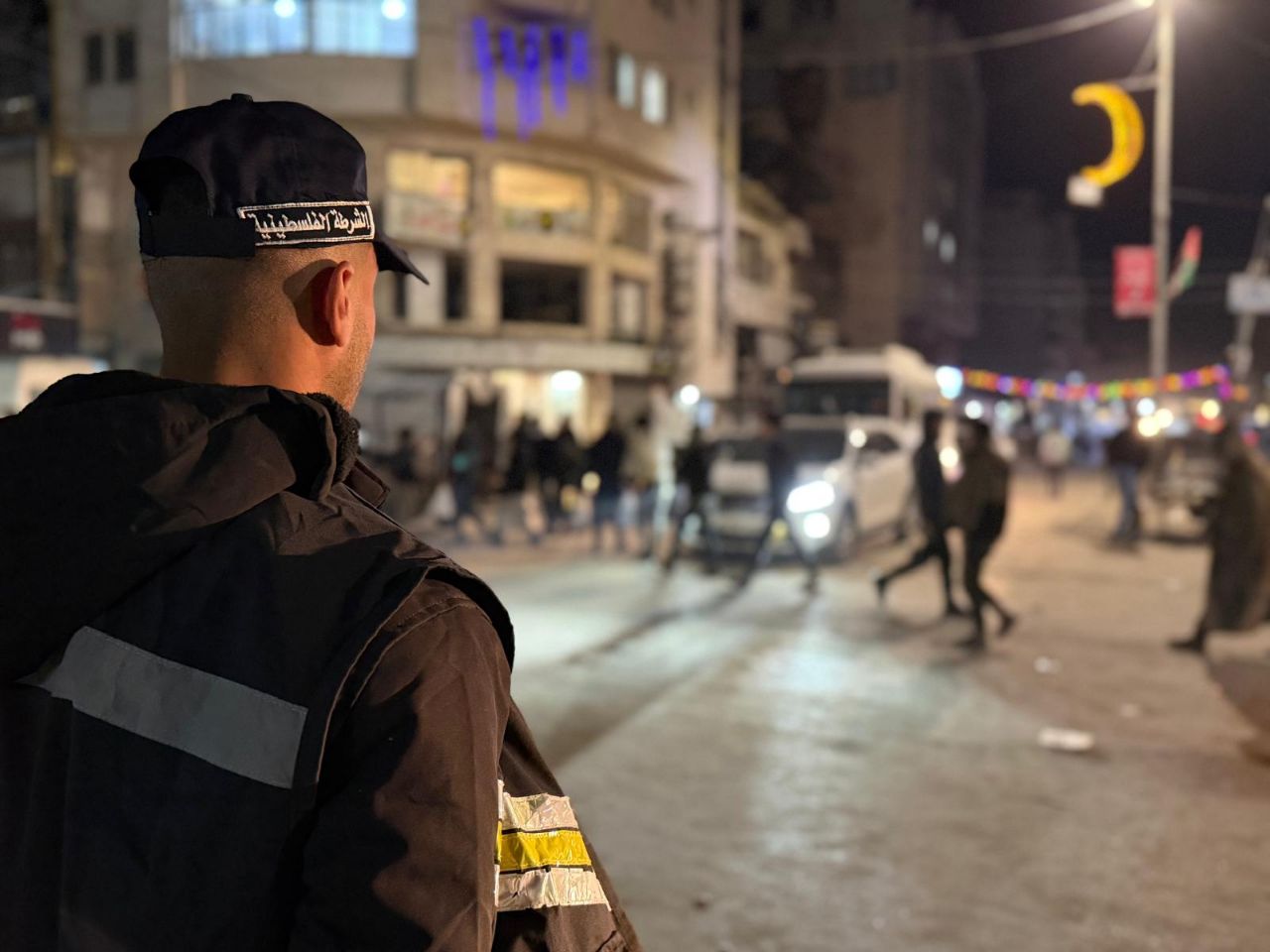
Hamas police officers in the streets of the Gaza Strip, as seen in footage published by the Hamas-run Interior Ministry. March 2026. (Used in accordance with Clause 27a of the Copyright Law)
Palestinians who previously served as Hamas civil servants have been allowed to apply to the new police force, but they will have to undergo Israeli vetting in order to be approved, the first Arab diplomat said, adding that those who Israel says were involved in Hamas’s October 7 onslaught may not be granted immunity.
The weapon handover will take place geographically, beginning with southern Gaza, and will see the Palestinian police and the International Stabilization Force phase out the IDF in areas from which weapons have been cleared, the Arab diplomat said.
The second Arab diplomat expressed skepticism that Israel would ultimately agree to further withdrawals of its troops from Gaza.
The proposal also envisions Israel lifting curbs on humanitarian aid and reconstruction equipment for Gaza as the handover of weapons progresses.
The gradual disarmament framework goes against what Israeli officials had long said was their stance, demanding that the weapons handover be conducted all at once.
However, mediating countries — the United States, Qatar, Turkey, and Egypt — were convinced that the Israeli demand was unrealistic, the Arab diplomat said.
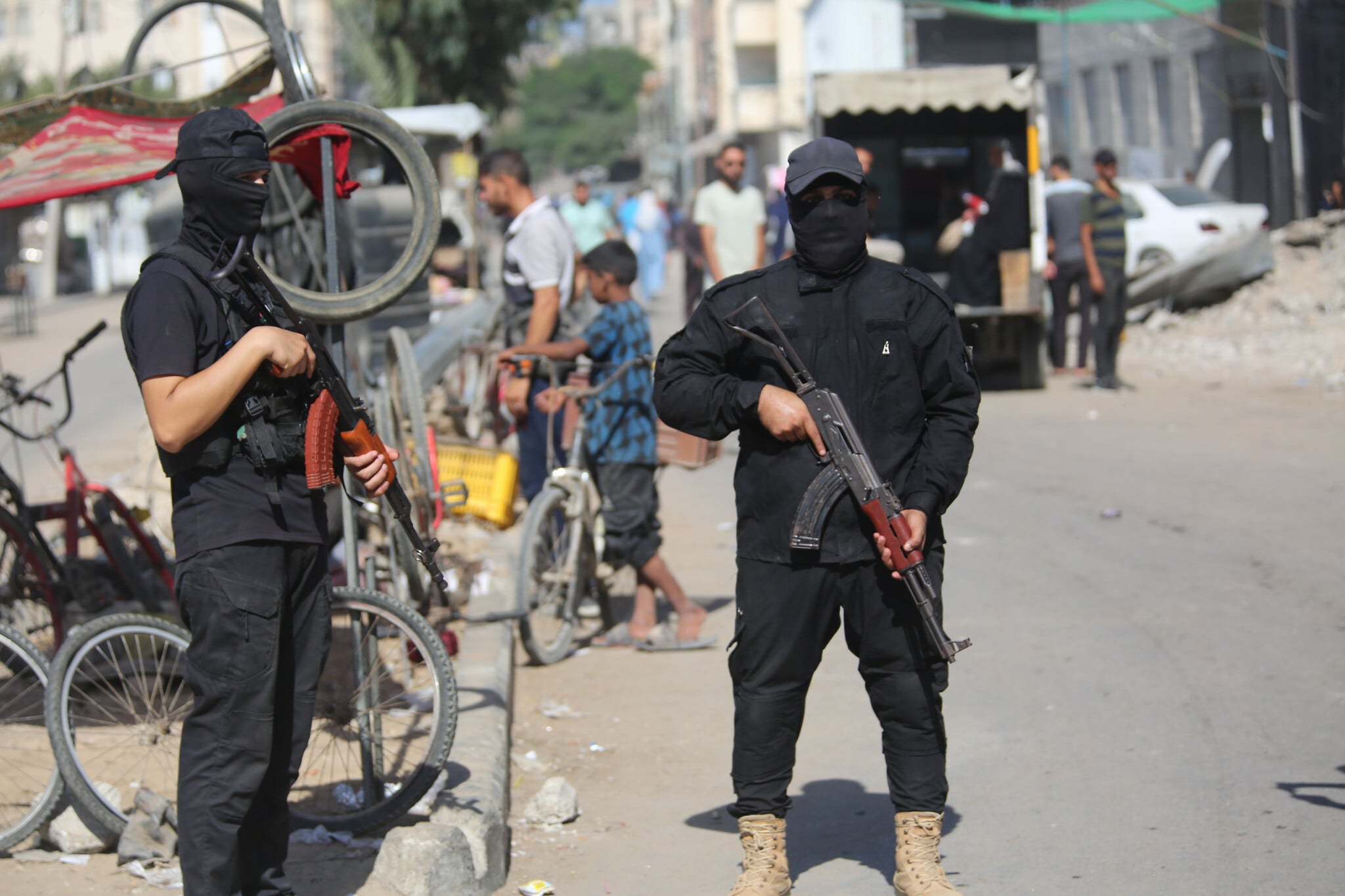
Armed Hamas police officers patrol in Gaza City, October 11, 2025. (Ali Hassan/Flash90)
Israel was aware of the proposal presented to Hamas in Cairo this week and did not object to it, believing that it would ultimately be rejected by Hamas anyway, the second Arab diplomat said.
The Gaza mediators are hoping Hamas responds to the proposal this week, and the Arab diplomat speculated that the terror group would come back with a counteroffer, which will further drag out the process.
The disarmament proposal was presented to Hamas in Cairo meetings headed by the Board of Peace’s High Representative for Gaza Nickolay Mladenov, along with US special envoy Steve Witkoff’s senior adviser Aryeh Lightstone, the Arab diplomats said.
Mladenov, the former UN diplomat charged with implementing US President Donald Trump’s plan for a postwar Gaza, said on Thursday that the ceasefire’s mediating countries all agreed on a “framework” that “can unlock reconstruction, breathe life into communities, and bring closer to unity and a negotiated resolution of the Palestinian question. It is now on the table.”
He said, however, that executing on the framework “requires one clear choice: full decommissioning by Hamas and every armed group, with no exceptions and no carve-outs.”
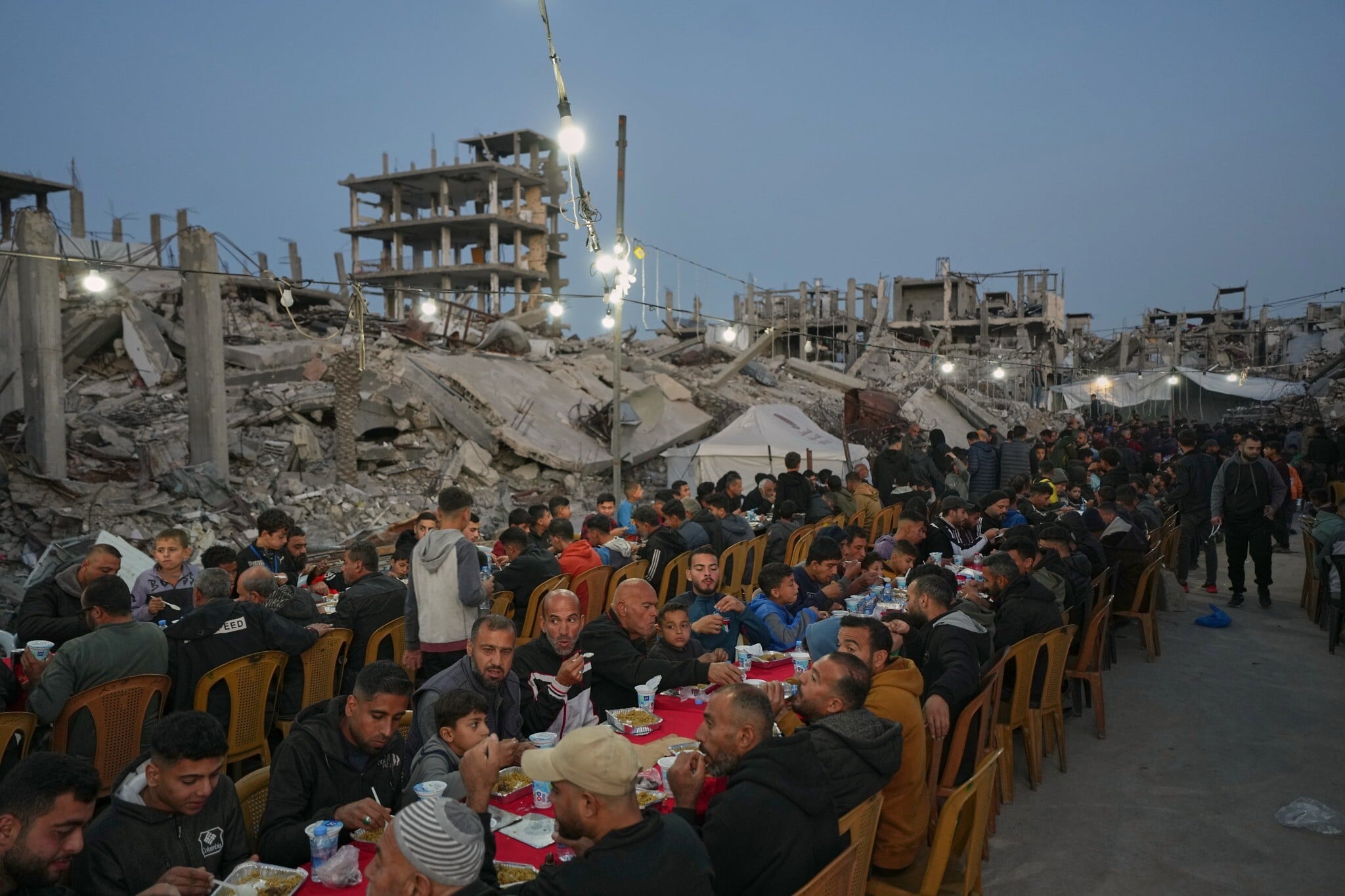
Palestinians gather for iftar, the fast-breaking meal during the Muslim holy month of Ramadan, amid the rubble of destroyed buildings in Jabaliya, northern Gaza Strip, Tuesday, March 17, 2026. (AP Photo/Jehad Alshrafi)
Mladenov’s announcement came as Hamas’s security forces stepped up their control of the territory in recent weeks.
The October 2025 ceasefire deal mostly ended two years of fighting triggered by Hamas’s 2023 attack on Israel, and the first phase secured the release of all remaining hostages taken by the terror group, in exchange for Israel’s release of thousands of Palestinian security prisoners and detainees.
Gazans who spoke with The Times of Israel in recent days testified to the terror regime’s increased presence in the Strip in recent weeks, enforcing price controls, managing the distribution of goods arriving from outside the Strip, and seeming to intimidate some residents who’d previously spoken to international media by name, but now insist upon anonymity.
You appreciate our wartime journalism

You clearly find our careful reporting of the Iran war valuable, at a time when facts are often distorted and news coverage often lacks context.
Your support is essential to continue our work. We want to continue delivering the professional journalism you value, even as the demands on our newsroom have grown dramatically during this ongoing conflict.
So today, please consider joining our reader support group, The Times of Israel Community. For as little as $6 a month you’ll become our partners while enjoying The Times of Israel AD-FREE, as well as accessing exclusive content available only to Times of Israel Community members.
Thank you,
David Horovitz, Founding Editor of The Times of Israel
Already a member? Sign in to stop seeing this