
It was the tail-end of a gruelling day of many, many speeches by the time Taoiseach Micheál Martin gave his national address in the UN general assembly hall on Thursday evening, but a burst of applause rippled throughout the hall when he told the delegates that when the “full truth of what has happened” in Gaza is finally known; “when the testimonies are heard, when the true horrors are finally and fully revealed, it will shame the world.”
Attention spans can wander in this enormous cavern, with its comfortable seating and poor acoustics, but at this point, Martin had a fixed attention.
“Nobody will be able to say that we did not know. Let it not be said that we did not act.”
The Irish address came just six hours after Israel’s Binyamin Netanyahu delivered a combative and even scornful denunciation of the accusations levelled at him and his government. The Irish delegation sat through the Israel address; it emerged that Spain was the only EU member state whose delegation absented itself.
In keeping with the theme of UN speeches which have been heavily critical of the actions of Israel in Gaza, the Taoiseach said “what we are witnessing on the ground is a deliberate attempt by some to make the prospect of a two-state solution impossible. This is not some mad conspiracy theory – it is the stated intent of the prime minister of Israel who said clearly that “we are going to fulfil our promise that there will be no Palestinian state. This place belongs to us” as he permitted the E1 [West Bank] illegal development in East Jerusalem. And the situation in Gaza remains an affront to all that is decent. How can we tolerate a situation where civilians are so desperate for shelter that they have to make their homes in war-damaged and unsafe buildings? Where eight children died because one of them collapsed? Where the most basic humanitarian aid – food and shelter – is deliberately impeded?”
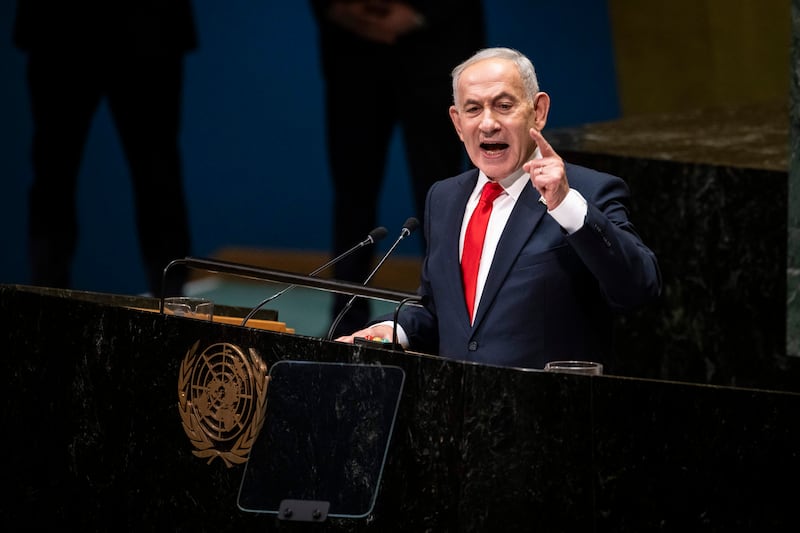 Israeli prime minister Binyamin Netanyahu addresses the UN General Assembly in New York. Photograph: Dave Sanders/The New York Times
Earlier on Thursday afternoon, Netanyahu had scoffed at the suggestion of a ‘colonisation’ of the territory. While Gaza, and Russia’s war with Ukraine dominated remarks all week, Martin strongly reinforced Ireland’s commitment to the International Criminal Court and highlighted the oppression of women in Afghanistan in emphasising Ireland’s support for gender equality and human rights.
“The women of Afghanistan have not disappeared. And neither should our solidarity. The same is true elsewhere. Across the world, women and girls face conflict-related sexual violence, forced displacement, trafficking and discrimination. Across the world, LGBTQI+ people face growing threats to their rights, safety and dignity. Ireland remains firmly committed to the universality, indivisibility and equal application of human rights. These principles are beyond question. That commitment is why Ireland is seeking election to the Human Rights Council for the 2027–2029 term.”
Ireland’s address came in the closing days of a subdued UN general assembly high-level week, after which the institution remains under pressure, to which Martin alluded in his speech.
“Because the answer to a world under strain is not less international co-operation. It is more. The answer to the weakening of principles is not to abandon them. It is to defend them. And if our multilateral system is not working effectively, the answer is not to walk away from it. It is to make it stronger, fairer and fit for the world we live in. That is Ireland’s position.”