
November WTI crude oil futures spent the week trading a possible reopening of the Strait of Hormuz against the risk that shipping conditions have not normalized. The contract fell to $88.67 Tuesday after reports that Iran could reopen the Strait within seven days, then recovered to $96.78 Thursday as the diplomatic story ran into the same problem it had all week: no agreement, no normal tanker traffic, and no proof the physical market is back to normal.
At 22:00 GMT Thursday, November, WTI crude oil futures were trading at $94.76, down $0.71 or 0.74% for the week. The market is off the week’s high, but it is also well above Tuesday’s low. That tells the story. Traders took premium out when Saudi barrels started moving, and Iran floated a deal. They put some of it back when it became clear that workaround routes are not the same as open shipping lanes.
Saudi and Iraqi Barrels Changed the Crude Trade
The week started with more crude getting through a market that had been priced for a bigger supply problem. Saudi Aramco increased shipments through Hormuz after attacks damaged its East-West Pipeline and interrupted some Red Sea loadings. Tanker tracking showed about 14 million barrels loaded on seven VLCCs inside the Gulf. Saudi flows through the Strait rose sharply from August levels.
The East-West Pipeline restart added another option. It was not a full return to normal capacity, but it gave Saudi Arabia a route to the Red Sea that did not require every…
November WTI crude oil futures spent the week trading a possible reopening of the Strait of Hormuz against the risk that shipping conditions have not normalized. The contract fell to $88.67 Tuesday after reports that Iran could reopen the Strait within seven days, then recovered to $96.78 Thursday as the diplomatic story ran into the same problem it had all week: no agreement, no normal tanker traffic, and no proof the physical market is back to normal.
At 22:00 GMT Thursday, November, WTI crude oil futures were trading at $94.76, down $0.71 or 0.74% for the week. The market is off the week’s high, but it is also well above Tuesday’s low. That tells the story. Traders took premium out when Saudi barrels started moving, and Iran floated a deal. They put some of it back when it became clear that workaround routes are not the same as open shipping lanes.
Saudi and Iraqi Barrels Changed the Crude Trade
The week started with more crude getting through a market that had been priced for a bigger supply problem. Saudi Aramco increased shipments through Hormuz after attacks damaged its East-West Pipeline and interrupted some Red Sea loadings. Tanker tracking showed about 14 million barrels loaded on seven VLCCs inside the Gulf. Saudi flows through the Strait rose sharply from August levels.
The East-West Pipeline restart added another option. It was not a full return to normal capacity, but it gave Saudi Arabia a route to the Red Sea that did not require every barrel to pass through Hormuz. Iraq also said it could raise exports through Turkey.
Those are actual barrels and actual routes. That is why crude sold off before the market had a diplomatic agreement. Traders do not need a peace deal to cut some premium if more oil can reach buyers.
The trade is still expensive and fragile. Producers are using ship-to-ship transfers off Oman, military escorts and changed loading plans to keep exports moving. The barrels are moving, but they are moving through a system that costs more, takes longer, and can break again on one attack. Reuters reported that visible vessel traffic through Hormuz remains far below pre-war levels, even as producers keep exports moving through workarounds.
Iran Offered a Path, Not an Opening
Tuesday’s sell-off accelerated after Kyodo News reported that Iran could reopen Hormuz within seven days if the United States eased military pressure. The market sold the headline as if the Strait were already reopening.
It was never that simple. Iran’s position was conditional. The United States did not announce a deal. Insurance, safe passage, tanker traffic and refined-product flows did not suddenly return to normal.
Thursday brought another version of the same trade. Reuters reported that U.S. and Iranian negotiators were discussing a phased path under which Tehran would permit navigation through Hormuz while Washington lifted its blockade. That was enough to knock WTI from the session high, but not enough to keep it down.
The reason is straightforward. The two sides had a similar framework earlier in the year, and it broke down. A report about talks changes expectations. It does not change the route until tankers are moving without military escort and the insurance market starts pricing less risk.
Diesel Is Not Following Crude Lower
The crude market found supply relief this week. The diesel market did not.
European gasoil’s premium to Brent reached a record near $95 per barrel. U.S. diesel prices remain above $6 per gallon. The product shortage comes from disrupted refinery and product flows, not a lack of crude alone.
That distinction matters. Saudi Arabia can redirect a crude cargo. Iraq can move more oil through Turkey. Neither action creates a barrel of diesel for Europe when Middle East product flows are impaired, and refiners are already running hard.
The White House added another layer when Politico reported that the administration was considering a 90-day diesel export ban. The White House later denied the report. The policy is not in place, but the idea showed where the pressure is building. Restricting exports may add barrels inside the United States. It also removes supply from Europe, which is already paying record premiums for distillate.
The product market is still telling crude traders not to become too comfortable with the supply relief. Crude can fall on a report about Saudi exports. Diesel needs refinery output and normal trade flows before its premium comes out.
Inventory Data Showed the Same Split
The EIA reported that U.S. commercial crude inventories rose 3 million barrels to 426.4 million barrels in the week ended September 18. Analysts had expected a draw. That gave sellers another reason to press crude after Saudi and Iraqi supply options improved.
Distillate inventories told a different story. Stocks fell 428,000 barrels to 107.4 million barrels. The draw was not large, but it came with diesel and gasoil premiums already at extreme levels.
Commercial crude is adding. Refined-product supply remains tight. The Strategic Petroleum Reserve has fallen toward 285 million barrels, leaving less cushion behind the commercial system. That is why the crude and diesel markets can send different signals during the same week.
Weekly November WTI Crude Oil Futures Technical Analysis
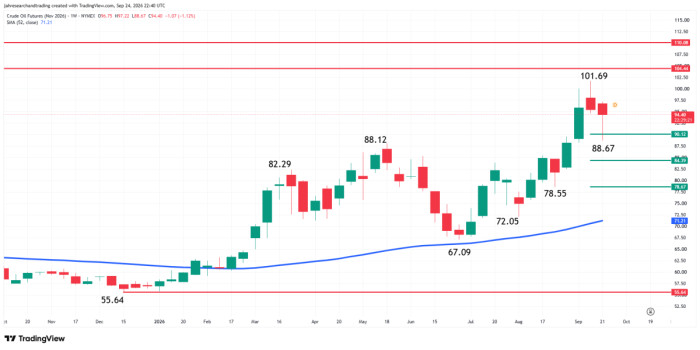
Trend Indicator Analysis
November WTI crude oil futures are edging higher for the week, but the market is close to posting a weekly closing price reversal top. The contract reached a new main top at $101.69 before turning lower. Last week’s close was $95.86. A weekly close below that level would confirm the reversal pattern. It would not change the main trend, which remains up, but it could shift momentum to the downside.
The nearest minor bottom is $78.55, and the main bottom is $67.09. The short-term retracement target is the 50% level at $90.12. The main 50% level at $84.39 is the next downside target. Both sit well above the rising 52-week moving average at $70.62. On the upside, a trade through $101.69 resumes the uptrend and opens the door to former tops at $104.44 and $110.08.
Weekly Technical Forecast
The direction of the Weekly November Crude Oil futures contract for the week ending October 2 is likely to be determined by trader reaction to $95.18.
Bullish Scenario
A sustained move above $95.18 will signal the presence of buyers. This will put the market in a position to possibly retest the contract high at $101.69 if the headlines turn bullish again. Potential upside targets include $104.44 and $110.08.
Bearish Scenario
A sustained move under $95.18 will indicate that buying is slowing and that selling pressure is increasing. If it creates enough downside momentum, then we could see a retest of $88.67. A trade through this level will send a strong signal that the rally is weakening, with $84.39 and $78.67 as other potential targets.
Weekly Outlook
The market has reduced the odds of an immediate Gulf supply shock, but it has not priced in a normal oil trade. Saudi barrels are moving. Iraq is adding supply options. Ship-to-ship transfers are keeping some Gulf crude flowing. Those developments limit the upside as long as they continue.
The risk is that traders have already discounted the diplomatic story twice without receiving a deal. If talks produce tanker flows, lower insurance costs, and normal shipping through Hormuz, more premium can come out of crude. If the talks fail, another attack hits Saudi infrastructure, or diesel inventories keep falling, the physical market will take control again.
The week’s range from $97.22 to $88.67, then back to $96.78 shows how quickly the market can reprice in both directions. The crude market has supply relief. The diesel market still has a shortage.
Technically, a closing price reversal top was produced at $101.69 the week ending September 18. This means we’re not looking at an ordinary top. Besides being a bearish indicator, it’s also a trigger point for an acceleration to the upside. So keep that in mind if it is taken out by renewed buying.
The downside targets are 50% levels. They include $90.12, $84.39, and $78.67. Buyers will treat them as value levels. Since the main trend is up, the market is still likely in “buy the dip” mode.
It isn’t until sellers start taking out swing bottoms at $78.55, $72.05, and $67.09 that traders are going to have to worry about a change in trend.
Most of all, the 52-week moving average at $71.21 is still holding the major long-term trend intact.