
JTA — While many of his classmates at his Orthodox high school in Los Angeles spent the last year juggling school and social life, Jackson Shrier was studying the Tanach, or Hebrew Bible, for five hours a day.
He was training for the Chidon HaTanach, or International Bible Quiz, a centerpiece of Israel’s Independence Day festivities that was founded by the country’s first prime minister, David Ben-Gurion, and has been held annually for over 60 years.
That dedication paid off last week, when Shrier placed second in the competition, fending off Jewish teens from Israel and around the world who similarly had prevailed in regional competitions.
Shrier, 15, went by his Hebrew name, Akiva, during the competition and wowed the judges with his Hebrew proficiency. He was not the only American to place highly in the contest: Joshua Appelbaum of Washington, DC, finished in third, while Hadassah Esther Ritch of Highland Park, New Jersey, came in fourth.
In fact, while the winner of the showdown was Hodaya Cohen, an Israeli 11th-grader from the southern agricultural community of Nir Akiva, this year marked a banner showing for the Americans, and was one of their strongest performances since 1973, when the first, second, and third place winners were all American.
Get The Times of Israel’s Daily Edition
by email and never miss our top stories
By signing up, you agree to the terms
An American has won the competition once since then, when Yishai Eisenberg tied for first place with Elior Bevian in 2013. A smattering of Americans and other foreign nationals have also come second and third over the years.
“When you’re an American, you know, usually the top American is like third or fourth, maybe fifth, but second place is… special either way,” Shrier said. “So when I got second place, I was just quite a bit shocked.”
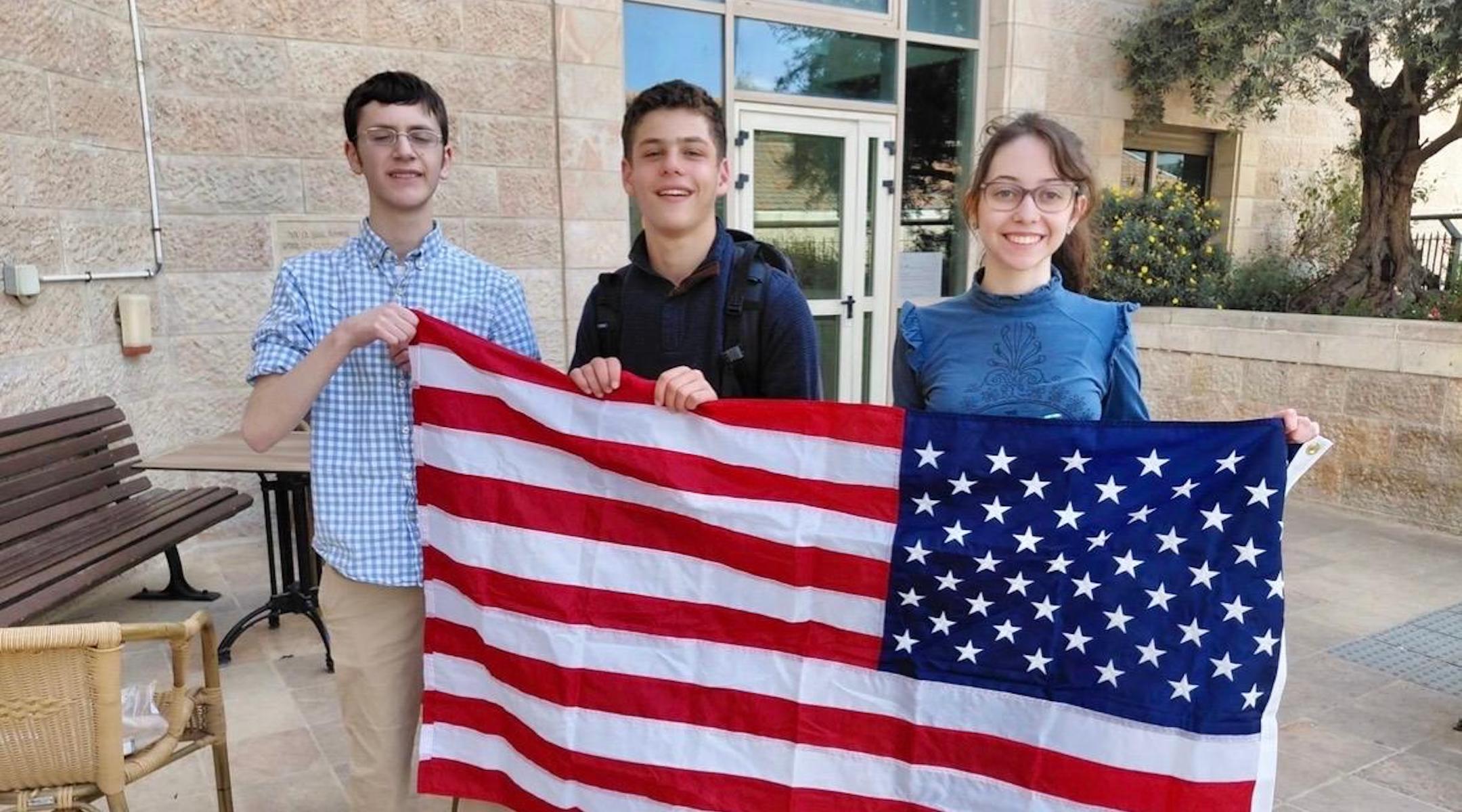
Joshua Appelbaum (L), Akiva Shrier (M) and Hadassah Ritch (R), competitors in the Chidon HaTanach, pose together. (Courtesy Avigail Ritch via JTA)
Shrier, who attends YULA High School in Los Angeles, said that, unlike in the United States, many of the Israeli competitors attend religious schools where preparation for the contest is built into the school day, sometimes for hours on end.
After first learning about the competition from a camp counselor before entering sixth grade, Shrier steadily ramped up his studies. He escalated his investment even more following his win at the Bible contest’s American Nationals last May.
The intense preparation paid off for Shrier, who said he felt well prepared to answer a spate of questions that included knowing which of four ancient Israeli cities “appeared exactly twice in the book of Judges” and, in the days of King Ahab, “what was a sinful [construction] that happened.” (The answers: Beersheba and the rebuilding of Jericho.)
“I was very happy,” Shrier said of the moment he learned he had placed second, following a lightning-round face-off with Cohen. “It was a little shocking for me.”
During the competition, all of the American participants spoke in Hebrew, a feat that drew praise from the competition’s judges and host, the Israeli news anchor Sarah Beck.
“It’s very exciting to hear a young man from America quote pesukim [Bible verses] in Hebrew,” said Liron Ben-Moshe, a past winner who writes the questions for the quiz and sits on its judging panel. Ben-Moshe was one of several judges this year who, in addition to being steeped in Bible knowledge, lost close family during Israel’s recent wars.
“When they see the kids quote pesukim in Hebrew, they were very surprised,” said Ritch’s mother, Avigail. She added that the judges had offered to give the students a “bonus” for their fluency in the language.
For Ritch, who is an 11th-grader at Bruriah High School for Girls in New Jersey, studying for the competition had been a worthwhile time investment.
“I love learning Tanach and often spend time reading it because I gain so much from it,” Ritch said in a text message. “Tanach is a core part of Jewish identity, and studying it brings guidance and meaning into everyday life. Participating in Chidon has changed me forever and deepened my connection to it.”
This year, the competition included 16 participants from seven countries outside of the United States and Israel, including the United Kingdom, South Africa, Mexico, Panama, and Canada.
“The quiz is far more than a knowledge competition — the Bible is the cultural and moral identity of the Jewish people, a compass that has guided us throughout the generations,” Education Minister Yoav Kisch said during the broadcast.
While some of the international participants attended the competition remotely due to the tenuous ceasefire between Iran and Israel and the US, Shrier and his American counterparts all made it to Jerusalem for the contest, which was taped in advance of Independence Day on Wednesday.
“I wasn’t really thinking about that so much, just because I really wanted to come,” he said about the war. “I’d been studying for the Chidon a long time, so, you know, for me, just the main focus was getting here.”
For Shrier’s mother, Abigail, a writer with roles at the conservative Manhattan Institute and the US publication The Free Press, the experience carried both pride and concern. She joined her son in Israel for the competition.
“We’re always concerned that there might be war when our kids are in Israel,” she said. “But Jack was absolutely single-minded and determined to participate in this to the full extent, and we watched him really show dedication that my husband and I have never seen before.”
While in Jerusalem for the competition, the students are hosted by the Bible Quiz Camp, where they are able to study together and connect with peers who share their intense focus on Tanach.
“Every time before this, I have been the one person to find myself around Tanach, and that’s nice and all, but there’s not really a lot of people to talk to,” Appelbaum said. “So it’s nice having other people who have the same shared interest, and also just generally being in Israel is nice. It’s nice to be in the place that I’ve been studying about.”
For Abigail Shrier, watching her son compete reflected a moment of connection and shared purpose for Jewish teens around the world.
“There’s a lot of negative forces right now acting on the Jewish people, but there are also a lot of positive things happening,” she said. “And this worldwide Jewish competition, to learn as much Tanach as you can, to cheer for each other and study together and learn as much as you can of the Tanach is, is really one of the most positive things.”
Times of Israel staff contributed to this report.