
As a series of complex post-Iran war dilemmas is being examined, the IDF has shifted to focus almost all its Tehran-related attention to the nuclear issue, with the ballistic missiles and regime change questions mostly falling by the wayside.
In briefings, the IDF is spending significant time emphasizing the continued danger of the 60% enriched uranium, which the Islamic regime might access under the rubble of its Isfahan and other facilities.
Discussing that issue, the IDF is making it clear that it would be ready to return to a full-fledged war to prevent Iran from using the uranium to move toward a nuclear weapon.
Yet in the same briefings, the ballistic missile threat, which has been used with lethal effect against the Jewish state four times since 2024 and for which ostensibly Israel went to war with Iran on February 28, is getting much less attention.
It is unclear whether the downplaying of the threat relates to the messaging of the United States, the greater relative danger posed by a nuclear weapon, the success of the current war in setting the threat back multiple years, or the post-war fog surrounding how many missiles remain and how quickly Iran might rebuild the threat.
 A large plume of smoke rises over Tehran after explosions were reported in the city during the night on March 28, 2026 in Tehran, Iran. (credit: GETTY IMAGES)IDF never promised regime change
Of course, the IDF is still carefully monitoring the ballistic missile threat. However, the impression given in briefings is that the nuclear issue, which many said had been set back by years after Operation Rising Lion in June 2025, is far and above the focus for analyzing post-war moves.
Likewise, the issue of regime change has mostly disappeared from IDF briefings. All IDF officers are careful to state that the military never promised regime change; rather, at most, the opportunity to improve conditions for such a change.
On Friday, the IDF went as far as to admit that some of the attacks on low-level Basij militias and checkpoints in Iran may have been a waste of resources, since they had not changed the situation on the ground.
In defending such attacks, the IDF did not so much emphasize their positive aspects as note that even as it had carried them out, it had also continued to strike other aspects of the military threats which Iran posed to Israel.
Putting together the mosaic of targets in Iran, the IDF said, was like playing a complex symphony.
In terms of achievements against the Islamic Republic, the IDF said that part of its success had resulted from the January 16, 2024, and the March 7, 2024, decisions within the IDF to establish the now-enormous Iran-focused IAF unit.
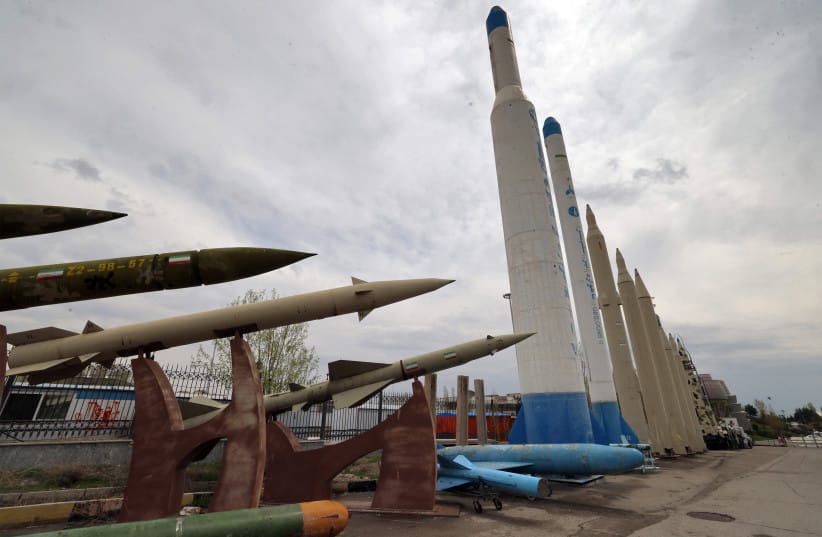 Mockups of domestically-made Iranian missiles are displayed at an exhibition outside the Defence Museum in Tehran on March 31, 2026. (credit: AFP VIA GETTY IMAGES)
According to the IDF, this sub-unit has effectively become the military’s “Iran Command.”
Discussing other moves that the IAF may make in the future, the air force said that it may establish a full-time division devoted to the Central Command for fighting Palestinian terror in the West Bank.
In the summer of 2023, the IDF began to use the air force continuously more aggressively against West Bank Palestinian terror – something it had not done for years, since the end of the Second Intifada in 2005.
On Thursday, the Central Command announced that it was establishing a larger and more systematic targeting center for aerial and other heavy firepower, similar to what exists for the IDF Northern and Southern commands.