
The former Roma striker, now a property developer: ‘Moratti told me I’d become an Inter legend, but two months later I was at Roma. If I could go back in time, I’d replay the Euro 2000 final against France. With property, it’s like being in the box: you have to sniff out the opportunity before anyone else.’
Nancy Gonzalez Ruiz
7 june 2026 (modifica alle 10:05) – MILANO
Italian version
He arrives for the sunset meeting in sportswear, as punctual as if he were still heading to training. Marco Delvecchio retired years ago, but football has stayed with him: in his stride and his discipline. Even at his favourite bar, he doesn’t need to order: a black coffee, regardless of the time, because “sugar is bad for you”. Today, he buys, sells, and rents properties in central Rome. The real estate sector has given him a second career, not another life. “The mentality is the same as Delvecchio the striker.” The pitch changes, but not his approach to life. And to think, he once even tried to hide his profession. When he met his future wife, he didn’t tell her he was a footballer. She found out at the stadium: the seat next to hers was empty. Because Marco wasn’t in the stands. He was on the pitch.
Tell us the truth: were you ashamed of being a footballer?
‘No, it wasn’t shame. It’s true, I had hidden it from my ex-wife, but that was because I didn’t want her to approach me just because I was a Serie A player…. I needed to find out if there was something more.’
When you met her, you were still the young striker on whom Inter were building their future.
‘Yes, I felt the trust. They had launched me into Serie A, and I always got on very well with Moratti. Two months before selling me, he told me I would become an Inter legend. Then came the swap deal involving Branca, and I ended up at Roma. Today, I can only be grateful for that decision.’
Roma wanted a prolific striker like Balbo or Völler; I wasn’t that type of forward, and they made me feel it.
Marco Delvecchio
Carlo Mazzone welcomed you to the capital.
‘Mazzone was a spectacular man. As soon as I arrived, he told me: “Up front, we have two phenomenal players, Balbo and Fonseca, and then behind them there’s a very strong youngster who wants to play regularly. You’ll carve out your own space.” That youngster was Francesco. I thought: “So what have I come here for?” But then things turned out differently.’
Mazzone in a nutshell?
‘A strong, decisive man, but also full of irony. I remember the last match with him, against Inter. He came into the dressing room and said: “Lads, we might not have won anything, but how much fun did we have?” That was Carlo.’
When Zeman arrived in 1997, so did the criticism towards you.
‘Roma were actually looking for a different type of centre-forward, a prolific striker like Balbo or Völler. I wasn’t that kind of attacker, and a section of the fans made me feel it. There was even talk of a swap deal with Trezeguet, but in the end, nothing came of it with Monaco.’
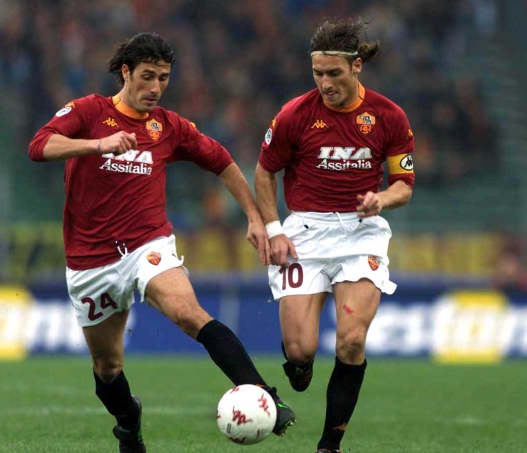
From those jeers, an iconic celebration was born: hands behind the ears.
‘It started as a challenge: I wanted to make it clear that I was doing my job. Then, after a confrontation with the fans at Trigoria, that gesture changed its meaning. It was no longer about hearing the jeers, but the cheers of the people. It became my way of celebrating Roma.’
You, however, celebrated Roma especially in the derbies.
‘They were the most important matches of the year, but I approached them with a light heart. Perhaps that was the secret: when you feel a game too much, you risk making mistakes.’
Nesta used to tell me: ‘You became famous because of me.’
Marco Delvecchio
And in those derbies, there was always one opponent who seemed to struggle against you more than others: Nesta.
‘Alessandro was a very fair defender, and that benefited me. We were also physically similar, in the way we ran. Perhaps that’s why I managed to cause him problems, even making him slip. When we met up with the national team, I often teased him, but he would reply: “You became famous because of me.”‘
Of all the derbies, is there one that holds a special place in your heart?
‘The one on 11th April 1999. Everything went well that day: we won 3-1, I scored twice, and Francesco got one. There were also the t-shirts: his, “I’ve purged you again,” remains memorable because it was a taunt. Mine was a derby self-celebration.’
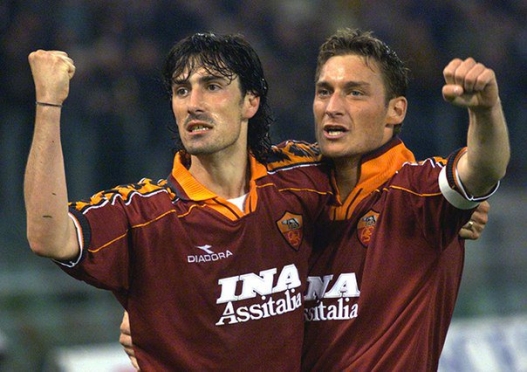
Ultimately, that match also tells another story: yours and Francesco Totti’s.
‘Francesco was the constant throughout an entire era. The legend and the eighth king of Rome. The greatest player I ever played with. Together, we shared a lifetime of memories.’
Tell us a story that truly represents him.
‘I was returning from the World Cup in Japan and Korea and hadn’t even had a training session yet. I thought I was just there to be part of the squad. At the team meeting, Capello read out the starting XI, and I heard my name. Francesco burst out laughing, turned to the coach, and said: “Is this man mad?” In the end, I played and even scored.’
That understanding was crucial for Capello, especially in the Scudetto-winning season.
‘In July 2000, Fabio called me and said: “This year, I’ll play with Totti and Batistuta up front, but you have to cover the entire flank for me. Only then can we win the Scudetto.” I accepted, and he was right.’
If a time machine existed, where would you go back to?
‘Euro 2000. I would replay that final against France exactly the same, changing only the last twenty seconds. Scoring in a European final for the national team was extraordinary. Conceding that goal to Wiltord in the 93rd minute, however, was one of the greatest pains of my career (the match then went to extra time with Trezeguet’s golden goal, editor’s note). Second only to leaving Roma.’
Today, your field is different: property.
‘The key has remained exactly the same: sniffing out the opportunity before anyone else.’
This article was originally written in Italian by La Gazzetta dello Sport editor. The English version has been generated using AI translation tools. If you notice any translation errors or have suggestions, please contact us at iniziativegazzetta@rcs.it
© RIPRODUZIONE RISERVATA