
Nuvinda, a startup specializing in high-torque motors for robotics and mobility, is teaming up with Osaka University and Chungnam National University to jointly develop next-generation drive motors for robots. The company plans to combine Korean and Japanese expertise in electromagnetic design and industrial infrastructure to secure key technologies for ultra-high-torque, high-efficiency motors and step up its push into global markets.
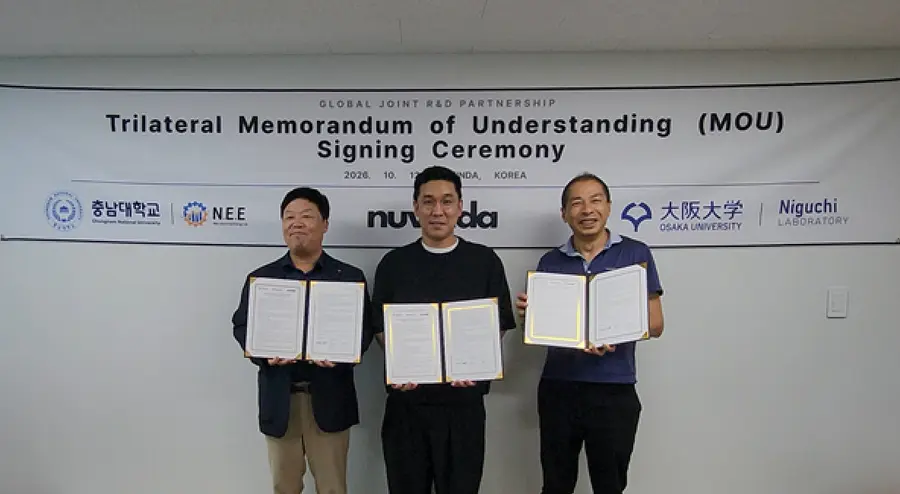 At a ceremony marking the signing of a three-party MOU at Nuvinda’s headquarters in Hwaseong, Gyeonggi Province, on the 12th, (from left) Professor Jang-young Choi of Chungnam National University, Nuvinda CEO Hyo-seok Si, and Professor Noboru Niguchi of Osaka University pose for a photo.
Nuvinda said on the 16th that it signed a three-party memorandum of understanding (MOU) on the 12th at its headquarters in Dongtan, Hwaseong, Gyeonggi Province, with Osaka University’s Niguchi Laboratory and the N.E.E. Laboratory in the Department of Electrical Engineering at Chungnam National University. The agreement establishes joint research on motor electromagnetic design and drive technologies. It was arranged as part of a Japan exchange program under the Daegu Startup City Project, led by the Daegu Center for Creative Economy & Innovation.
Korean and Japanese motor experts join forces in seven areas
Key researchers leading the field of motor electromagnetic design in South Korea and Japan attended the signing ceremony. They included Chungnam National University’s Professor Jang-young Choi, an authority on electrical machinery in South Korea, and Osaka University’s Professor Noboru Niguchi, chair of the Japan Society of Electrical Engineers (IEEJ) committee on small drive motors for robotics.
Under the agreement, the three institutions will work closely in seven areas, including holding at least one regular Korea-Japan research exchange meeting each year, jointly researching ultra-high-torque, high-efficiency drive motors for robots, and jointly applying for government R&D projects involving international cooperation between the two countries. They plan to focus in particular on developing compact, high-torque, low-heat drive motors that affect the performance of next-generation robots, including humanoid and collaborative robots.
Design optimization with Chungnam National University to overcome a motor development bottleneck
In South Korea, Nuvinda will build a close industry-academia partnership with Chungnam National University’s N.E.E. Laboratory. Nuvinda will set development priorities based on industry needs, while the laboratory will optimize the motors’ electromagnetic design using its in-house analysis methods.
Repeatedly analyzing numerous variables during motor design is considered a major bottleneck. Drawing on fast, accurate analysis algorithms developed over more than a decade, the N.E.E. Laboratory is expected to dramatically cut the time required for design and optimization. The two sides also plan to train motor specialists by connecting student internships with hands-on research opportunities.
Tapping Osaka University’s network to target Japan’s robotics market
The partnership with Japan aims to achieve two goals: advancing the technology and entering the local market. Nuvinda is looking to Professor Niguchi’s strong network in industry. Professor Niguchi works closely with companies including Hayashi Industry, which has world-class motor prototyping technology, and IMD, a joint venture between Hayashi Industry and Nitto Denko. He also serves as chief technology officer (CTO) of Tsukasa.
Nuvinda plans to leverage this infrastructure to draw on Japan’s advanced capabilities in motor testing and prototyping. It also plans to step up its entry into Japan, one of the world’s largest robotics markets, using the IEEJ committee network, which includes major Japanese companies such as Omron Robotics, the Sumitomo Group, and Kawasaki.
Nuvinda: an innovator in drive solutions for robotics and mobility
“By combining the high-speed, high-precision electromagnetic analysis technology of Chungnam National University’s N.E.E. Laboratory with Nuvinda’s industry experience in design, we believe we can significantly shorten the development timeline for drive motors for robots,” Nuvinda CEO Hyo-seok Si said. “In South Korea, we will develop key technologies with Chungnam National University. In Japan, we will connect with world-class manufacturing infrastructure and industry networks, including Hayashi Industry, to advance our technology for ultra-high-torque drive motors for robots.” He added, “We will use the collaborative framework we have built with leading researchers from South Korea and Japan to accelerate our entry into the Japanese market.”
Founded in 2025, Nuvinda is a promising startup selected as an innovative company for IBK Changgong, the startup incubation platform of Industrial Bank of Korea. It is developing a range of drive solutions for robotics and mobility, including high-torque direct-drive motors and QDD (Quasi-Direct Drive) actuators. The company operates its own motor winding and assembly plant in Daejeon, carrying out the entire process—from design through final assembly—in South Korea, and has earned recognition for its technological capabilities.