
Japan has tightened the requirements for its business manager residence status, which allows foreign nationals to start businesses in the country. The move was driven by multiple concerns, including misuse of the visa. While the crackdown aims to restore trust in the system, experts say it also risks pushing legitimate foreign entrepreneurs away from Japan. NHK World’s Ekuan Koji listens to voices of those involved to explore this unfolding dilemma.
Concerns of misuse
The business manager visa is intended for entrepreneurs from overseas who come to Japan, with the expectation they would foster innovation and create jobs.
Since last October, applicants must meet a capital requirement of 30 million yen (about $190,000) ― a sixfold increase from the 5 million yen previously required. The changes came in response to concerns that the requirements were too loose, allowing some people to use the status to facilitate immigration ― and some to even abuse it through such means as creating shell companies.

Doorknocks uncover shell companies
Last December, NHK World accompanied officials from the Tokyo Regional Immigration Services Bureau to an area north of the capital in Ibaraki Prefecture. The officers were searching for a design firm, using an address a man from South Asia had provided in his residence application.

Officials of the Tokyo Regional Immigration Services Bureau conduct a fact-finding survey on business manager residence status.
On that day, the officials found no evidence of the office ― and no one in the neighborhood had heard of either the company or the applicant.
One of the officials noted that was a common scenario: “Even when we go to the office location, no one is there and it’s hard to meet anyone. Sometimes they don’t even answer the phone.”

Tokyo Regional Immigration Services Bureau
The Tokyo Regional Immigration Services Bureau says that it investigated 300 suspected cases between September 2023 and December 2024. Officers found various problems with about 90 percent of them, including lack of substantive business activity.
Investigations have revealed numerous shell companies in areas including Osaka. These findings have made Japan’s parliament aware of the problem.
Influx from China
The popularity of the business manager visa had been soaring. As of June last year, about 45,000 people held the residence status ― approximately 2.7 times the number a decade ago. About half of them were Chinese nationals.
Before the crackdown, many advertisements in Chinese social media made claims such as, “It’s easy to get a visa” and “The costs aren’t high.”

Post on Chinese social media in October 2025
An agent specializing in helping people migrate told NHK World about circumstances unique to China that made Japan an attractive option. He asked that his name not be used due to the sensitivity of the issue.
“When COVID-19 spread, China’s lockdown policy brought strict controls over daily life, and many people wanted to go overseas,” the agent said. “Another factor is China’s intense exam competition from childhood. Even after entering university, the recession means jobs can be hard to find. That’s why more parents don’t want their children to suffer.”

This agent specializes in helping people migrate to Japan.
The agent said the capital requirement of 5 million yen to obtain the status was less than other countries’ requirements.
NHK World was able to meet many Chinese nationals who moved to Japan due to dissatisfaction with their country’s COVID-19 policies and concerns about their children’s educational environment.
Under the system, as long as applicants were legitimately operating businesses, they were not in violation, even if their primary motivation was to relocate to Japan. However, facing mounting criticism that Japan’s requirements were too loose and that the system was being used to facilitate immigration, the government convened an expert panel to look into the issue. It heard a variety of views: some said urgent countermeasures were needed to address systemic abuse, while others said a crackdown would drive away foreign investment.
The government eventually decided to tighten the rules, creating challenges for the Immigration Services Agency.

Ito Junji, Residency Management Division Director of Immigration Services Agency
“The business manager residence status was originally positioned as one of the categories intended to accept specialized foreign professionals, and as a status that Japan itself should actively promote,” explained Ito Junji, director of the agency’s residency management division.
“But now there are aspects suggesting the system may be abused,” he said. “So how to strike the balance (between acceptance and regulation), and what the final plan should be ― this was extremely difficult.”
Pressure mounts
In addition to increased capital, other new conditions include an obligation to employ at least one full-time staff member. There are limits on who can fill this role ― with the options including Japanese nationals or permanent residents. Another change is a requirement for Japanese language proficiency.
Foreigners who already hold the business manager status have been given a three-year preparation period to meet the new conditions.
Concerns about the rules were raised at a consultation session held by administrative scriveners in December. About 10 Chinese nationals attended the meeting at Osaka International Legal Office, a firm that helps people with residency applications and renewals.

A consultation session on the new rules in Osaka in December
“It’s very painful that the requirements for the residence status suddenly changed and I might not be able to stay here,” said one Chinese attendee who owns a restaurant.
Another participant who owns a trading company noted, “China’s education isn’t good for children’s mental health. My child has already started junior high school in Japan, so we can’t go back to China now.”
According to the legal office, the crackdown on residency rules has already forced some foreign business owners to abandon Japan.

Lee Hwisa, Osaka International Legal Office
“Some people lack confidence to continue operating under these circumstances and are closing their companies to return home, while others are changing to another residence status,” said Osaka International Legal Office’s Lee Hwisa. “Going forward, the number of new applicants for this status may decrease significantly.”
Concerns about employment
A key concern for Chinese shop owner Ma Xiaoqing is how to find a full-time employee. She obtained her business manager status about three years ago and sells Japanese crafts at a curated shop in Tokyo.

Ma Xiaoqing in her shop
Her shop showcases ceramics, lacquerware, scarves, towels, and other items she has personally sourced from across Japan. She generates around 15 million yen (about $95,000) in annual sales, including international exports.
Ma hires a part-time worker about once a week. But due to a deepening labor shortage, she is not confident she can hire someone full time.

Ma Xiaoqing, shop owner
“Would a Japanese person go out of their way to work for a Chinese-owned company?” she asked. “Even Japanese owners find it hard to hire; for foreign owners, it’s even harder. And if I do hire, payroll costs would be about double what they are now, so I’d have to increase sales. I have ties with people here, so I want to stay in Japan.”
The way forward
An expert on international labor mobility believes that while the revised residency requirements were necessary, the new rules should be considered from a long-term perspective.
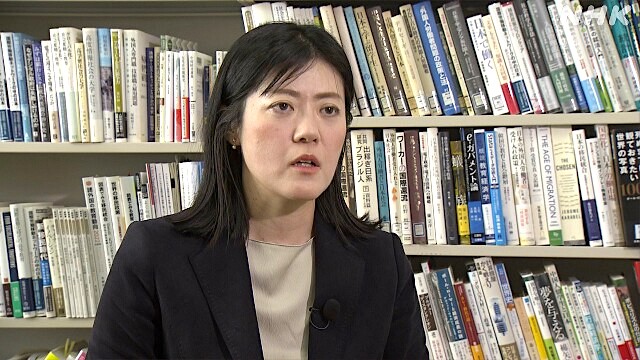
Matsushita Namiko, Professor at Suzuka University
“There’s a possibility that young foreigners who want to do business in Japan will turn to starting businesses in other countries,” says Suzuka University professor Matsushita Namiko. “We need to think through and debate various issues by working backward from what we want Japanese society to be.”
The number of foreign workers in Japan exceeded 2.5 million last year. The country has a shrinking population and a chronic labor shortage ― and grapples with how to come up with policies to address those issues.
Matsushita calls for calm debate and urges people in Japan to avoid being swayed by emotion or anxiety as the nation examines the effects and challenges of the residency system and finds ways to improve it.