
When it comes to Japan’s bid to reduce greenhouse emissions, the latest data shows a positive trend — with emissions dropping by 1.9% in 2024, the third straight annual fall and the lowest level since 1991, according to government data. Overall, emissions have dropped by 28.7% since 2013.
Yet, to reach net zero by 2050, that’s not nearly enough.
“The pace of the decline has been sluggish,” Environment Minister Hirotaka Ishihara said in a recent news conference, adding that the government needs to accelerate efforts to achieve its reduction target.
Japan’s latest effort to decarbonize saw it join much of Europe, South Korea, and parts of the United States and Canada with the implementation of its first mandatory emissions trading program, known as GX-ETS. Part of the broader Green Transformation (GX) plan released by the administration of Prime Minister Fumio Kishida in 2023, its goal is to use market-based mechanisms, through the trade of emissions allowances, to create a pathway for Japan to meet both its Paris Agreement and net-zero commitments.
“The GX-ETS will comprise one of the two pillars of the new carbon pricing in Japan,” says Tatsuya Terazawa, chairman at the Institute for Energy Economics Japan (IEEJ), a Tokyo-based think tank. “The other pillar will be the introduction of a fuel surcharge, which will target all fossil fuels starting in fiscal year 2028. The two pillars are expected to complement each other to promote the energy transition.”
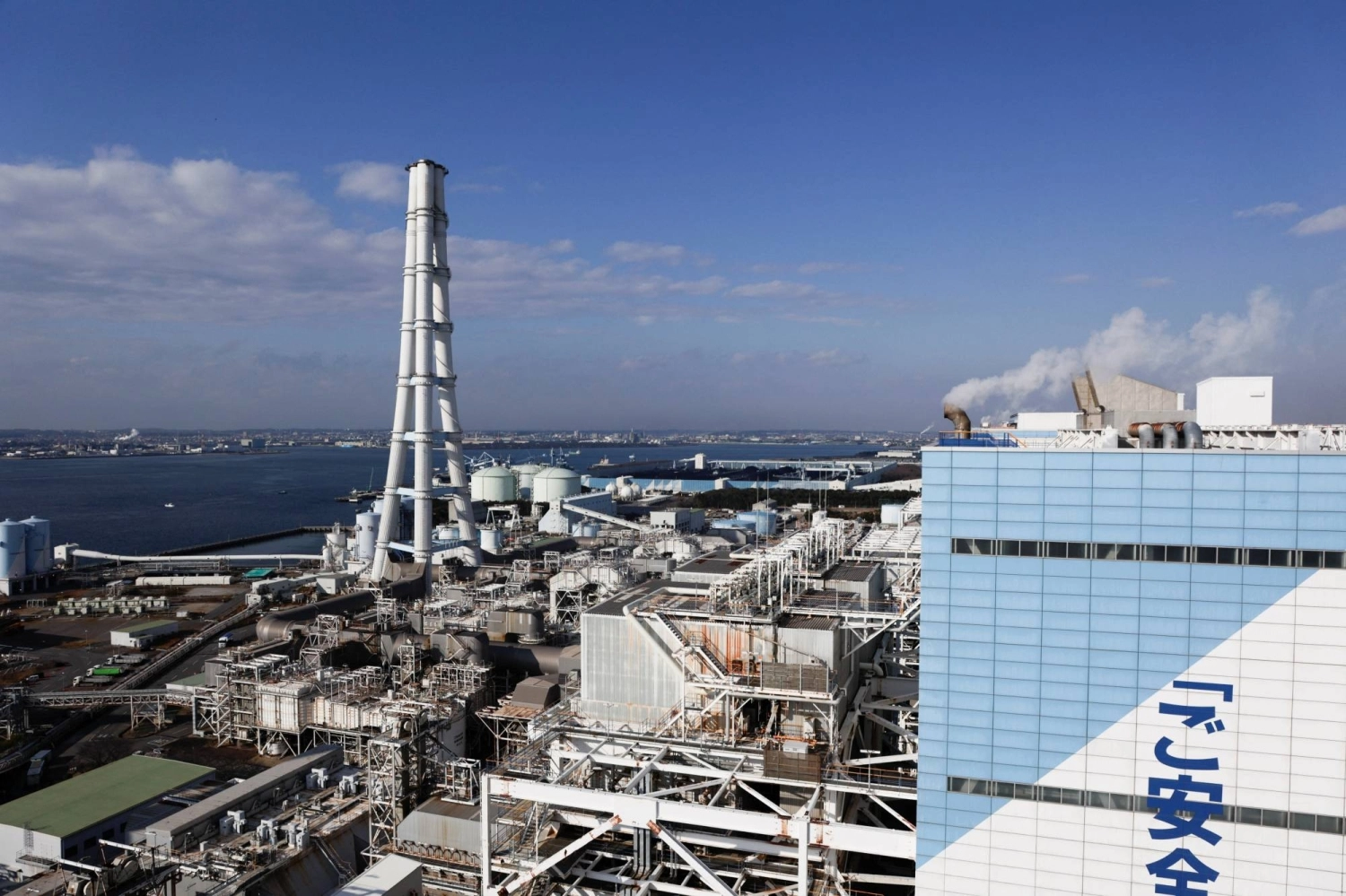
Jera’s Hekinan thermal power station in Aichi Prefecture in January
| REUTERS
While climate advocates welcome emissions trading in Japan due to the nation’s role as a major historical emitter, there are concerns that GX-ETS lacks ambition and won’t do enough to incentivize high-emitting sectors — such as the steel, pulp and paper and thermal power industries — to decarbonize. Those critics are also concerned that industry influence in developing the policy may have led to weak sectoral targets and a low cap.
“GX-ETS, as currently designed, can hardly be considered an effective tool for transitioning away from fossil fuels or improving energy efficiency,” says Teruyuki Ohno, executive director of the Tokyo-based Renewable Energy Institute. “The pace of improvement in benchmarks is too slow, and the structure does not create incentives to shift from fossil fuel-based generation to renewable energy.”
What is GX-ETS?
Cap-and-trade systems are not a new tool for environmental protection, with an early wide-scale program coming into force in the United States as far back as 1990 in order to guard against acid rain.
Such programs put a price on carbon, forcing companies to pay for their emissions and, ideally, encouraging them to innovate in order to reduce their carbon footprints.
But critics see holes in the framework of GX-ETS that could dull its effect and fail to incentivize the country’s largest emitters to decarbonize.
For the past three years, Japan’s homegrown GX-ETS was a voluntary system meant to allow companies to transition and prepare for the mandatory program, which came into force last month. According to Transition Asia, during the voluntary phase, Japan didn’t penalize participating companies for missing corporate targets and the system was mostly ineffective at adding a cost to emissions.

Prime Minister Fumio Kishida speaks during the COP26 climate conference in Glasgow, Scotland, in November 2021
| REUTERS
Currently, as many as 400 companies with average emissions of at least 100,000 tons per year are included in the GX-ETS program, covering around 60% of Japan’s greenhouse gas emissions. Despite it being mandatory, it will provide many companies with a free pass, at least initially, based on efficiency standards. Unlike other systems around the world, GX-ETS also allows companies to purchase credits and offsets to cover up to 10% of their emissions.
Moreover, in the power sector, one of Japan’s largest sources of emissions due to the prevalence of gas and coal-fired thermal power plants around the country, the paid allocation of emissions allowances will only start in 2033.
Essentially, this means that many of Japan’s largest emitters, such as JERA and J-Power, which operate coal and gas-fired power plants, won’t have to do or pay much to comply with GX-ETS.
“The system is not designed in a way that promotes investment in decarbonization,” Ohno says.
Making GX-ETS mandatory saw significant opposition from Japanese businesses, with interest groups representing carbon-intensive manufacturing industries expressing concerns. Keidanren, the influential Japan Business Federation, also led calls — with support from major trade associations in steel, electronics, power and petroleum — to forgo the introduction of a cap-and-trade emissions trading system.
“To overcome the resistance, GX-ETS was labeled as growth-oriented,” Terazawa says. “Instead of a top-down approach based solely on carbon neutrality, Japan has opted for a more realistic bottom-up design.”
Terazawa argues that the allocations are not weak, but instead realistic, and that a more ambitious plan would have had less chance of being implemented.
“The emission allowances are set based on the potential for improvement, reflecting the realistic expectation for emissions reduction based on detailed analysis,” says Terazawa.
METI, the ministry in charge of the GX-ETS program, did not respond to a request for comment.
A question of ambition
While Japan’s top emitters failed to prevent its implementation, Ohno has concerns that they did lobby enough to weaken the program and that it does not do enough to promote emissions reductions through investment in new and costly technologies to promote electrification.

A solar farm in Nipton, California, in February 2022
| REUTERS
“Even for firms that are willing to move forward with decarbonization, the system does not effectively support or incentivize their efforts,” Ohno says. “In fact, we have heard from major companies in heavy and chemical industries that the standards are too lax, which in turn discourages investment.”
There are plenty of lessons to be learned from other systems.
Europe’s Emissions Trading Scheme (ETS) is now 20 years old, and Ohno sees much the Japanese government could have learned from that system and how it has evolved over time. Unlike Europe, “GX-ETS does not set an overall cap on emissions allowances allocated to covered sectors, so even if individual companies reduce their emissions to meet their assigned targets, it remains unclear whether these reductions will translate into overall emissions cuts for Japan as a whole,” Ohno says.
While Europe’s model is more market-driven, South Korea’s ETS, launched in 2015, is more regulatory in nature and has suffered from frequent rules changes. Still, it covers 77.75% of the country’s emissions and aims to drive a 40% reduction of greenhouse gas levels, based on 2018 figures, by 2030 – far more ambitious than GX-ETS’s goals.
There are meaningful sub-national efforts too, including California’s 2012 Cap-and-Trade program, which has funneled billions to clean energy initiatives and one in Quebec that covers 80% of the Canadian province’s greenhouse gas emissions. Quebec and California linked their systems in 2014 and held their 45th joint auction last year.
“Without learning from the experiences of (the EU or South Korea), and despite the urgent need for significant reductions due to the late start of the program, the Japanese government did not set ambitious targets,” says Yasuko Suzuki, a program coordinator with the Tokyo-based Kiko Network nonprofit. “As a result, this reduced its effectiveness.”
Wake-up call
The Middle East crisis and the ongoing challenges in transporting oil and gas through the Strait of Hormuz have led to rising energy prices and shortages of key products around the world. To Ohno, the oil shock should be a wake-up call for Japan to shift from dependence on imported fossil fuels, and GX-ETS can help drive that transition.
“The recent Middle East crisis has once again highlighted Japan’s vulnerability,” Ohno says. “Strengthening GX-ETS should be accelerated ahead of schedule.”
The Renewable Energy Institute has several recommendations, including making GX-ETS’s benchmarks in power generation and industrial sectors stronger. But the results of the last election, which saw the ruling Liberal Democratic Party gain a supermajority in the Lower House of Parliament, have made engagement more challenging, Suzuki says.
“Many climate-focused lawmakers lost their seats in the election,” she says. In general, they’ve found it challenging to get METI and ruling party lawmakers to accept their concerns.
“We surely need to raise awareness of the fact that meaningful reductions cannot be achieved unless more ambitious targets are set, rather than focusing solely on the views of industry stakeholders,” Suzuki says.