
Prime Minister Sanae Takaichi and British leader Keir Starmer have agreed to bolster supply chain resilience, citing “serious concerns” over export restrictions on critical minerals, in a veiled swipe at China.
Takaichi met Starmer in London on Sunday, with the two also pledging further support for the embattled Global Combat Air Program (GCAP), a next-generation fighter jet project involving their countries and Italy.
In a joint declaration focused on economic security cooperation, the two leaders agreed to deepen ties and work with other Group of Seven members and like-minded countries on mining, refining, processing, recycling and stockpiling of critical minerals.
During the summit, Takaichi said Japan-U.K. ties had reached a level that could be described as “quasi-allies,” adding that the security of the Indo-Pacific and the Euro-Atlantic are inseparable.
Though the declaration did not name a specific country, some of its language reflected concerns shared among G7 economies over China’s growing use of its economic leverage.
China produces around 60% of global rare earths and accounts for roughly 90% of processing capacity — leverage Beijing has increasingly employed via export restrictions and licensing requirements.
Condemning these moves, Tokyo and London also agreed to share information and consult on possible responses.
Starmer, who visited Japan in January, said the two countries are working more closely not only on technology and business, but also on security and their defense industries.
The British leader, who is facing turmoil within his government that saw his defense chief resign last week amid concerns over defense spending shortfalls, joined Takaichi in reiterating their commitment to GCAP.
The two sides agreed to accelerate the initiative with an international contract expected by the end of this month between the GCAP International Government Organisation and Edgewing, the trinational industrial joint venture leading the aircraft’s design and development.
It was not immediately clear if this would be a stopgap measure to keep the program funded pending the award of a subsequent contract or a longer-term contract, but Chief Cabinet Secretary Minoru Kihara said Monday that GIGO and Edgewing are in the “final stages of negotiations toward concluding a long-term contract.”
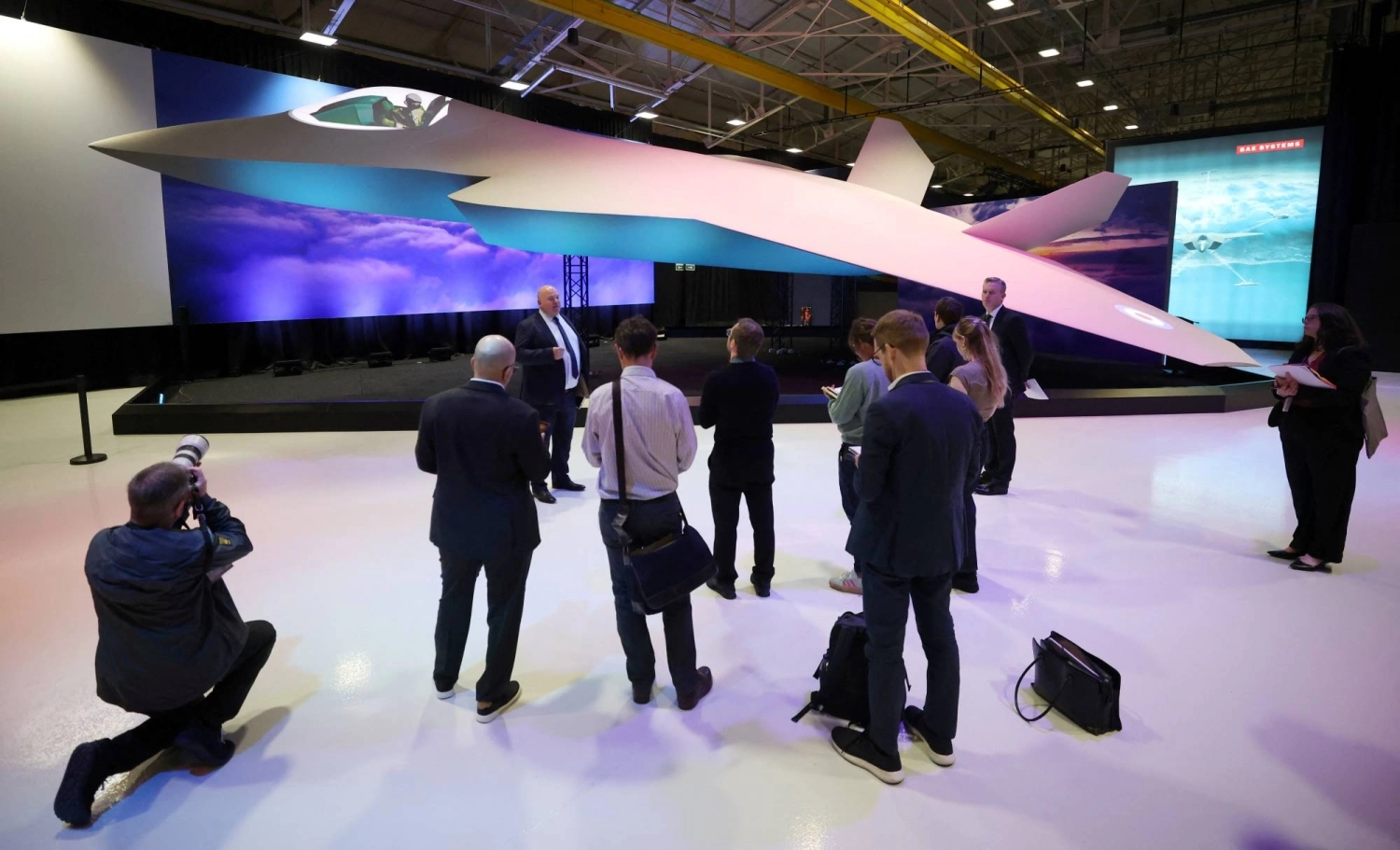
Journalists stand next to a concept model of the new Global Combat Air Program next-generation fighter jet at the BAE Systems Warton factory in Warton, England, last July.
| REUTERS